Back to 2026 Abstracts
Urethroplasty complications after primary repair for distal and midshaft hypospadias: mid-term results from the multicenter prospective Dutch Hypospadias Study
Jochem van Veen, BSc1, Fred van der Toorn, MD2, Barbara Kortmann, PhD3, Jeroen Scheepe, PhD2, Piet Callewaert, MD4, Katja Wolffenbuttel, PhD2, Eric van der Horst, MD5, Martijn Steffens, PhD6, Aart Klijn, PhD1, Keetje de Mooij, MD1, Josine Quaedackers, PhD7, Allon van Uitert, PhD3, Martje Schotman, MD8, Jeffrey Huynh, BSc1, Rogier Schroeder, PhD1.
1University Medical Centre Utrecht, Utrecht, Netherlands, 2Erasmus University Medical Centre, Rotterdam, Netherlands, 3Radboud University Medical Centre, Nijmegen, Netherlands, 4Maastricht University Medical Centre, Maastricht, Netherlands, 5Amsterdam University Medical Centre, Amsterdam, Netherlands, 6Isala Hospital, Zwolle, Netherlands, 7University Medical Centre Groningen, Groningen, Netherlands, 8Haga Hospital, The Hague, Netherlands.
BACKGROUND: Although hypospadias repair is associated with notable urethroplasty complication (UC) rates, most literature relies on short-term follow-up data. This limits insight into the timing and incidence of mid-term and late presenting complications, particularly in distal and midshaft hypospadias. Our prospective multicenter cohort study now has reasonably long follow up. Analyzing this can provide us insight into the timing and incidence mid-term and late-presenting complications. It can help optimizing a follow up scheme for hypospadias. We aim to evaluate the incidence of newly occurring UC between six months postoperatively and 5 years of age following urethroplasty for distal and midshaft hypospadias.
METHODS: This study is part of the Dutch Hypospadias Study. In this study the follow up protocol is six months postoperatively and at the ages of 5, 10 and 15. Boys undergoing primary urethroplasty between 2008 and 2016 were evaluated at six months postoperatively and at 5 years of age. Urethroplasty complications consist of fistula, dehiscence, meatal stenosis, urethral stenosis and urethral diverticulum. The primary outcome was the incidence of newly occurring UC after the six months follow-up.
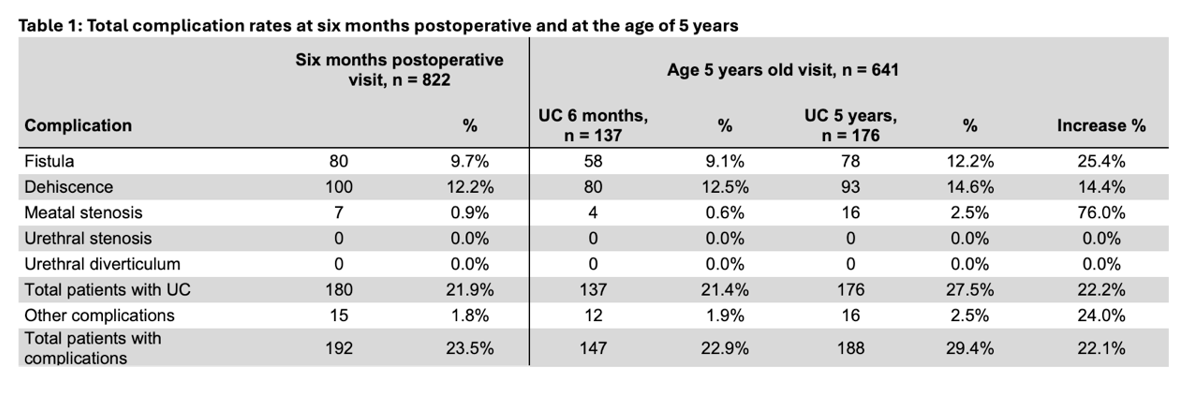
RESULTS: Of 875 patients, 822 were analyzed at six months and 641 at age 5 years (median follow-up of 44.0 months). At six months, 21.9% developed urethroplasty complications, most commonly dehiscence (12.2%) and fistula (9.7%). By 5 years, 39 additional patients had developed UC, raising the cumulative incidence to 27.5%. Of the 176 UCs registered at the age of 5, 137 (77.8%) had already been diagnosed at the six-month postoperative visit. Therefore, the remaining 22.2% were newly identified at age 5 years. Overall dehiscence (14.6%) and fistula (12.2%) remained most frequent. Meatal stenosis increased from 0.9% to 2.5%. No significant differences in overall urethroplasty complication rates were observed between the urethroplasty techniques.
CONCLUSIONS: Of all UC’s at age 5, a minority of 22.2% newly occurred after six months postoperatively. Based on our findings, we could discuss and potentially optimize the follow-up schedule and monitoring strategy.
Back to 2026 Abstracts


