Back to 2026 Abstracts
Factors Related to the Vaginal Replacement for Primary Repair in a Contemporary Cohort - A PCPLC Registry Study
Chad Wallis, MD1, Ray Yong, MD1, Briony Varda, MD2, Katherine Hayes, MD1, Ron Reeder, PhD1, Rachel Crady, MS1, Michael Rollins, MD1.
1University of Utah, Salt Lake City, UT, USA, 2Children's National Hospital, Washington, DC, USA.
BACKGROUND: Anatomical factors associated with the use of vaginal replacement during cloacal repair are unknown, though it has been suggested that vaginal length <4cm may be associated. Series looking at vaginal replacement in this population are limited and come from single institution or single surgeon series. We aimed to identify the rate of vaginal replacement and associated factors in a contemporary cohort using the Pediatric Colorectal and Pelvic Learning Consortium (PCPLC) multi-site registry.
METHODS: Patients with a diagnosis of congenital cloaca who underwent primary repair between 2015 through 2025 were abstracted from the PCPLC registry data. The primary outcome was whether vaginal replacement was used at the time of primary repair. Patient demographic data, medical comorbidities, cloacal anatomy (based on endoscopy and cloacagram), and surgical details were collected. Descriptive statistics were performed. A p-value < 0.05 was considered significant.
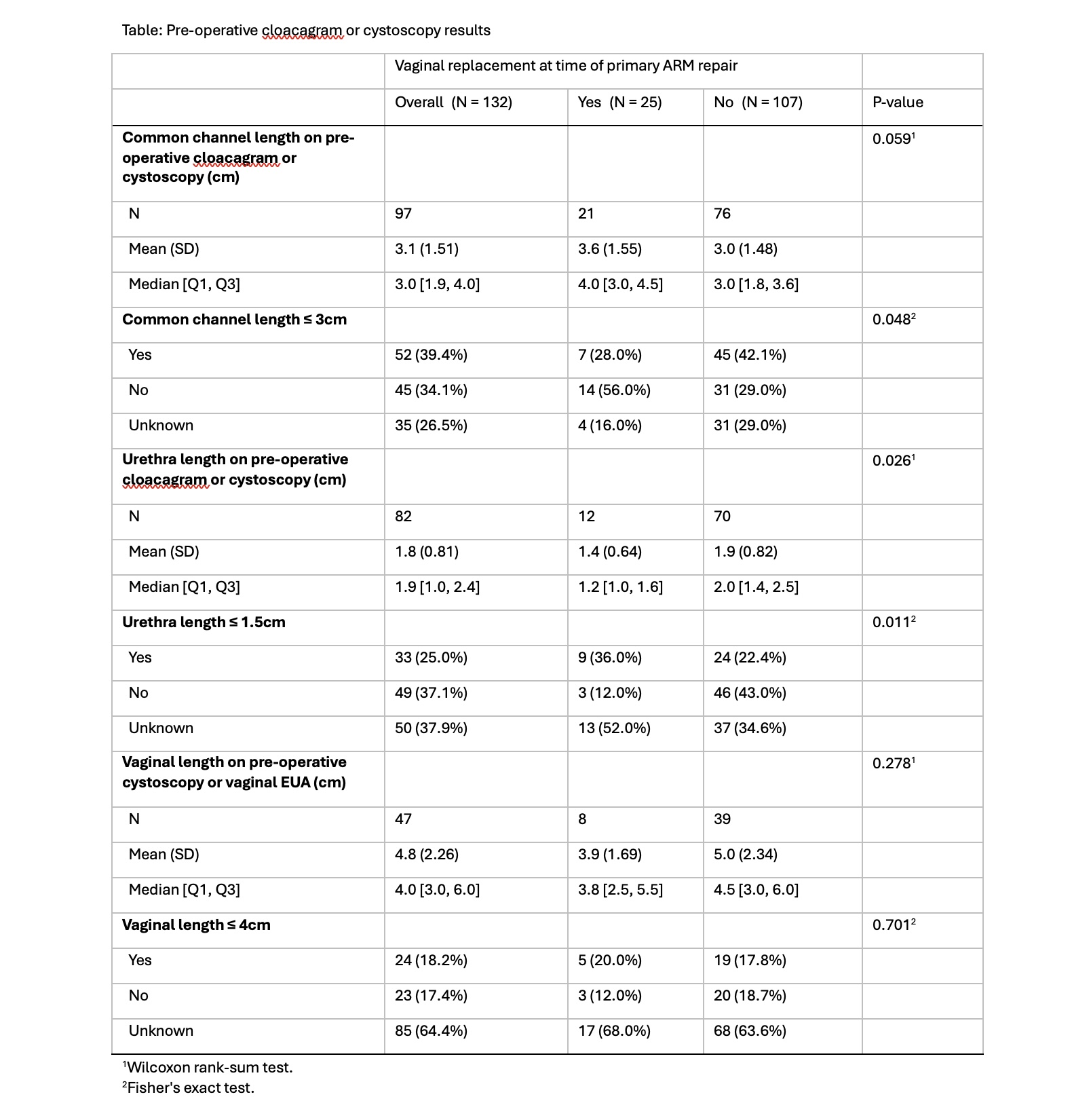
RESULTS: A total of 132 patients with congenital cloaca were identified. The median age at primary repair was 10.5 months [IQR 7.0, 15.5]. A majority of patients were White (64%), non-Hispanic (73%), and publicly insured (52%). Among all patients the median sacral ratio was 0.6 [IQR 0.4, .08]. Among patients with available data the median common channel [CC] length was 3 cm [IQR 1.9, 4.0] (n = 97), the median urethral length was 1.9 cm [IQR 1.0, 2.4] (n=82), and the median vaginal length was 4 cm [3.0, 6.0] (n=47). Among 103 patients with available surgical data, 58.3% underwent total urogenital mobilization (TUM) and 41.7% underwent urogenital separation (UGS). Vaginal replacement was performed in 25/132 patients (19%). Three factors were associated with vaginal replacement: separation technique, common channel length, and urethral length. 62.5% (15/24) of patients who had a vaginal replacement procedure underwent UGS versus 37.5% (9/24) who underwent TUM (p = 0.032). Patients who underwent vaginal replacement had a mean urethral length of 1.4cm versus 1.9cm in those who did not (p < 0.026). Vaginal replacement was performed in 56% of patients with a CC length >3cm (p=0.048). Mean vaginal length was shorter in patients who underwent vaginal replacement (3.9cm versus 5.0cm; p=0.278), but this finding was not statistically significant.
CONCLUSIONS: A multi-institutional registry of patients with anorectal malformation demonstrated that shorter urethral length, longer common channel and UGS technique increased the likelihood of utilizing vaginal replacement for cloacal reconstruction. Mean vaginal length was shorter in the vaginal replacement group, but this did not reach statistical significance.
Back to 2026 Abstracts


