Back to 2026 Abstracts
The Shifting Landscape of Continuous Antibiotic Prophylaxis Prescription in Pediatric Patients with Vesicoureteral Reflux Before and After the 2017 American Urologic Association Guideline Updates - Analysis of a Real-World Claims Database
Ash Zawerton1, Thomas Syphan, MD
1, Jessica Hannick
2, John Weaver, MD
2
1Geisinger Medical Center, Danville, PA, USA, 2Cleveland Clinic Children's Hospital - Department of Urology, Cleveland, OH
BackgroundAmerican Urological Association (AUA) recommendations for pediatric vesicoureteral reflux (VUR) have changed substantially since 1997. Continuous antibiotic prophylaxis (CAP), once considered standard of care, was reconsidered after several landmark trials including RIVUR trial in 2014 and the PREDICT trial, which which led to guideline amendments that reflected the questionable benefit for prevention of long term kidney injury through the use of CAP. Little is known how these advancements have changed in actual daily clinical practice. We evaluate antibiotic prescribing patterns before and after the guideline amendment and hypothesize that prescribing rates decreased afterward in pediatric patients with VUR across United States.
MethodsThis was a retrospective cohort study using the TriNetX research network US collaborative research network, which contains over 115 million patients from 67 health care organizations (HCO’s) nationwide. We created two cohorts made up of all patients in the database aged 1-18 years of age with a history of VUR of any severity without obstructive hydronephrosis or anatomic urinary tract malformation. Cohort 1 had a history of febrile UTI at the time of VUR diagnosis; Cohort 2 did not. After propensity matching for age, sex, ethnicity, socioeconomic status, mode of delivery, and other comorbidities, we compared rates of prescription for the most common antibiotics used in pediatrics as CAP within the 3 years following VUR diagnosis.
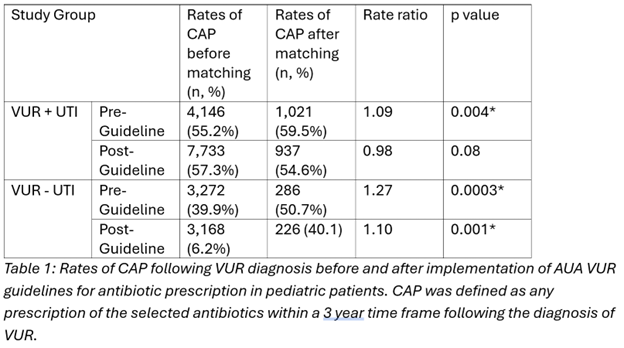
ResultsThere were 7,511 patients included in the pre-guideline group of cohort 1 and 13,499 in the post guideline group; similarly, there were 8,207 patients in the pre-guidelines component of cohort 2 and 8,749 in the post guideline group. After propensity matching, 1,716 patients from pre and post guideline amendment were compared in cohort 1 and 564 for cohort 2. The primary outcome was antibiotic use in the 3 years following VUR diagnosis (table 1).
.DiscussionRates of antibiotic use following diagnosis of VUR fell after the implementation of the most recent iteration of the AUA VUR guidelines, in patients with both febrile UTI at presentation and those with asymptomatic VUR without febrile UTI. The rapid implementation of the guidelines in such a short time after implementation is encouraging, and the strength of this study is bolstered by the real-world component of the data that allows a realistic look into how the guidelines are implemented by clinicians in each unique patient context. Other strengths include the large sample size. This study was limited by the inability to granularly differentiate between VUR severity, and we were unable to identify if a urologist was prescribing the antibiotics or another practitioner. Furthermore, there were likely antibiotic prescriptions that were given for other reasons other than VUR CAP. However, the general trends we observed are a powerful indicator of how practice patterns are shifting in the US following guideline implementation and invite further research into how these changing practice patterns will impact long term epidemiologic outcomes for patients with VUR.
Back to 2026 Abstracts


