Back to 2026 Abstracts
Clinical and Microbiological Profile of Urinary Tract Infections in Children with Posterior Urethral Valves: Association with Long-Term Renal Outcomes
Ana Gabriela Bernal, MD, Joana Dos Santos, Doctor, Nithiakishna Selvathesan, Doctor, Chia Wei Teoh, Doctor, Ashlene McKay, Doctor, Adree Khondker, Doctor, Samer Maher, Doctor, Joao Pippi Salle, Doctor, Rodrigo Romao, Doctor, Michael Chua, Doctor, Nikan Zerafatjou, Doctor, Armando J. Lorenzo, Doctor, Mandy Rickard, NP.
Hospital for Sick Children, Toronto, ON, Canada.
Background: Urinary tract infections (UTIs) are a major contributor to morbidity children with posterior urethral valves (PUV). Beyond symptom burden, recurrent UTIs may contribute to progressive renal deterioration through repeated episodes of pyelonephritis. We aimed to characterize the clinical and microbiological profile of UTIs in PUV, define their association with long-term renal outcomes, and assess the impact of a dedicated multidisciplinary clinic care.
Methods: A single-center retrospective cohort of 283 boys with PUV; 151 (53%) were enrolled in a detailed episode-level UTI database, classifying them as surveillance (spontaneous during follow-up, including those occurring during intermittent catheterization [CIC]), instrumentation-associated (within 30 days of a procedure or with a foreign body
in situ), or presentation (triggering the initial PUV diagnosis). Outcomes included recurrent UTI (rUTI, ≥3 episodes), hospitalization, IV antibiotic use, and organism resistance (≥1 antibiotic). Current eGFR (Schwartz) and kidney replacement therapy (KRT) were compared across surveillance UTI burden categories (0, 1–3, >3 episodes) using Kruskal-Wallis and Fisher exact tests. Before/after PUV clinic era comparisons used Mann-Whitney U testing.
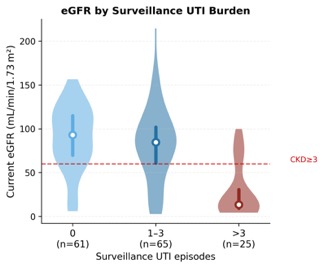
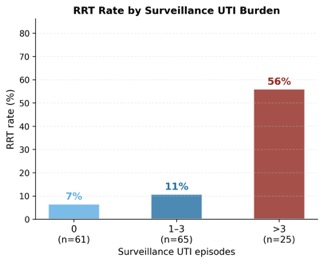
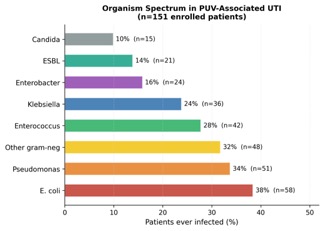
Results: Among 447 characterized episodes, 80% were febrile, 54% were surveillance, 33% were instrumentation-associated, and 12% were presentation UTIs. rUTI occurred in 46% of patients. UTIs were often severe: 88% of patients had one or more hospitalizations and at least one course of IV antibiotics; 78% had at least one resistant organism identified. The predominant causative pathogens were E. coli (38%), Pseudomonas aeruginosa (34%), Enterococcus (28%), Klebsiella (24%), and Enterobacter (16%); ESBL-producing organisms were present in 14% and Candida in 10% (Figure 3). A striking frequency-response was observed between surveillance UTI burden and kidney outcomes: median eGFR declined from 93 mL/min/1.73 m² with no surveillance UTIs to 85 with 1–3 episodes and to 13 with >3 episodes (p<0.001); KRT rates increased from 7% to 11% to 56%, respectively (Figure 1). This gradient was most pronounced for surveillance UTIs compared with instrumentation- or presentation-type UTIs.
Conclusion: UTIs in PUV are common, often severe, and strongly linked to adverse kidney outcomes. The frequency-response relationship between surveillance UTI burden and kidney function loss suggests that these infections directly contribute to renal deterioration, likely through repeated pyelonephritis. Dedicated PUV clinic care was associated with earlier CIC initiation, supporting proactive bladder management as a strategy to reduce infection burden and protect renal reserve.
Back to 2026 Abstracts


