Back to 2026 Abstracts
Decision-Making for Reconstructive Urinary Continence Surgery in Adolescents and Young Adults with Spina Bifida and Associated Spinal Anomalies: A Mixed-Methods Study of Motivators, Barriers and Facilitators
Tatjana Heisinger-Heidler, MD, Ilina Rosoklija, MPH, Josephine Hirsch, BA, Jaclyn L. Papadakis, PhD, Emilie K. Johnson, MD, MPH, Elizabeth B. Yerkes, MD.
Lurie Children's Hospital, Chicago, Chicago, IL, USA.
BACKGROUND:Reconstructive urinary continence surgery in adolescents and young adults (AYA) with spina bifida (SB) and associated spinal anomalies often involves shared decision-making between caregivers, patients and pediatric urologists, with varying levels of AYA involvement depending on age and developmental readiness. This study aimed to explore experiences of AYA and their caregivers regarding the decision-making for reconstructive urinary continence surgery.
METHODS:We conducted a mixed-methods study of AYA aged 12-25 years with SB and associated spinal anomalies who underwent urinary reconstructive surgery and their caregivers. Semi-structured Zoom interviews were conducted from 10/2025 to 04/2026 and explored decision-making experiences regarding continence surgery. Interviews were audio-recorded, transcribed verbatim, and coded using inductive and deductive approaches. An online survey including demographic data and the validated Decision Regret Scale (DRS; 0-100, lower scores indicate less decisional regret) was administered to AYA, while caregivers completed the DRS only. Survey results were summarized descriptively.
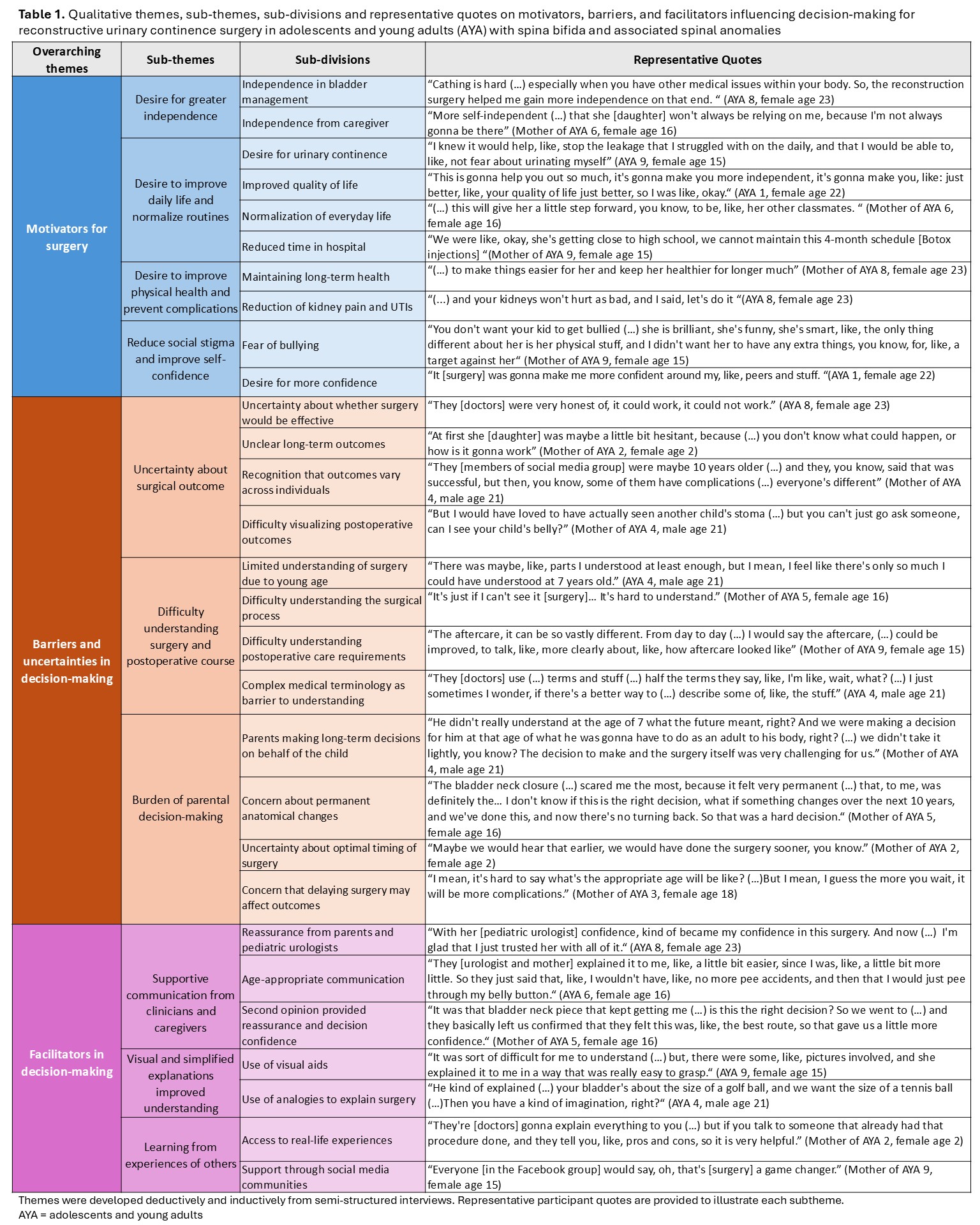
RESULTS:Of 21 families approached, 10 AYA and 9 mothers participated. Among AYA, 60% were female and 80% had myelomeningocele; median age was 9 years at surgery (range 5-15) and 19 years at interview (range 15-23). Six AYA reported involvement in decision-making and filled out the DRS. Median DRS score was 0 for both groups (AYA range 0-15; mothers range 0-10). Qualitative analysis identified three overarching themes related to decision-making: motivators for surgery, barriers and uncertainties, and facilitators in decision-making (Table 1). Motivators were typically multifactorial rather than driven by a single factor. Across groups, they included increased independence, improved daily life and normalization of routines, prevention of long-term health complications, and reduced social stigma with increased self-confidence. AYA emphasized functional and psychosocial benefits, whereas mothers highlighted prevention of bullying and social stigma. Barriers and uncertainties included concerns regarding surgical effectiveness, long-term outcomes, and difficulty visualizing postoperative outcomes due to limited understanding of internal and external anatomical changes. Both AYA and mothers reported difficulties understanding surgical procedures and postoperative expectations, particularly due to complex medical terminology and young patient age. Mothers further described the emotional burden of making long-term decisions on behalf of their child, including concerns about irreversible anatomical changes and potential regret regarding timing. Facilitators included supportive communication from pediatric urologists and caregivers, age-appropriate and visual explanations, and learning from experiences of others. In particular, mothers emphasized insight into postoperative daily life and bladder management from individuals who had already undergone surgery, either in person or via social media. These facilitators enhanced understanding and increased confidence in the decision-making process for both AYA and caregivers.
CONCLUSIONS:Decision-making for reconstructive urinary continence surgery in AYA with SB and associated spinal anomalies is a shared and complex process involving caregivers and pediatric urologists, with variable AYA involvement depending on age and developmental readiness. Despite identified barriers and uncertainties, facilitators were common and decisional regret was minimal. These findings may inform preoperative counseling by addressing barriers and supporting shared decision-making for families.
Back to 2026 Abstracts


