Back to 2026 Abstracts
Bladder Safety After Fetoscopic Versus Open Prenatal Myelomeningocele Repair: Longitudinal Outcomes from Infancy to School Age
Alexandra R. Siegal, MD, Kathleen Hosek, MS, Samuel McClugage, III, MD, Michael Belfort, MD, Magdalena Sanz-Cortes, MD, Rebecca Johnson, MS, Luc Joyeaux, BS, Paul F. Austin, MD, William Whitehead, MD, Nicolette Janzen, MD.
Texas Children's Hospital, Houston, TX, USA.
BACKGROUND: Following the Management of Myelomeningocele Study (MOMS), prenatal myelomeningocele (MMC) repair has been increasingly adopted for its fetal neurologic benefits. Both open and fetoscopic approaches are used, with fetoscopic offering important maternal health benefits. However, comparative urological outcomes between these approaches, particularly from infancy through school age, are lacking. This study compares bladder safety after fetoscopic versus open prenatal MMC repair at two longitudinal timepoints.
METHODS: This single-institution retrospective cohort study included children who underwent prenatal fetoscopic or open MMC repair between December 2011-December 2020. Urological evaluation was performed at two timepoints: initial assessment within the first 1.9 years of life and school-age follow-up at approximately 5 years. Evaluation included urologic history, urodynamic study (UDS), and voiding cystourethrogram (VCUG). Bladder safety was stratified using CDC UMPIRE criteria into high-risk versus safe/intermediate. Outcomes included high-risk classification, individual UDS parameters (maximum detrusor storage pressure [MDSP], neurogenic detrusor overactivity [NDO], loss of compliance, bladder capacity/ age-expected ratio, post-void residual), trabeculations on VCUG, and a composite adverse outcome defined as high-risk bladder or clean intermittent catheterization (CIC) initiation due to unfavorable urodynamics, new vesicoureteral reflux, new hydronephrosis, or new bladder trabeculations. Logistic regression was performed adjusting for gestational age, birth weight, ethnicity, ventriculomegaly, and functional lesion level.
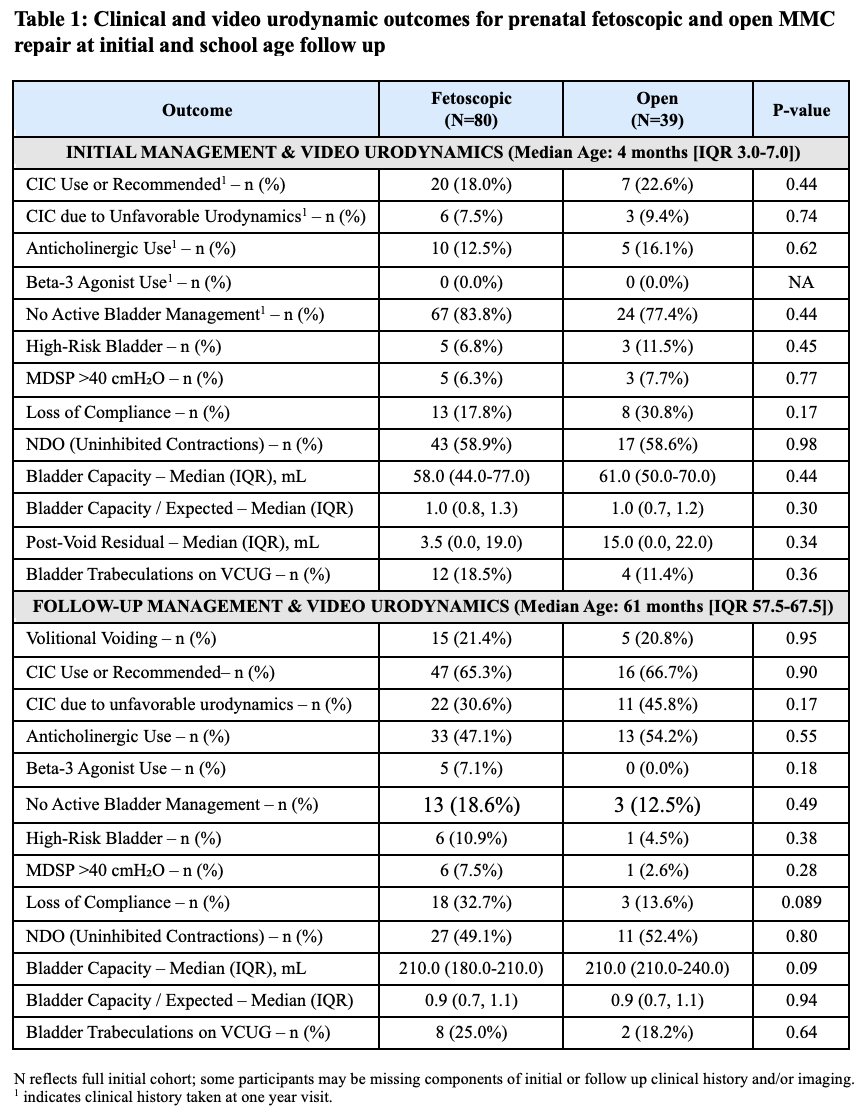
RESULTS: A total of 119 children underwent prenatal MMC repair (fetoscopic n=80, open n=39). In the study period, 8 fetoscopic and 12 open patients were lost to follow-up; reasons included transfer of care and 1 death in the fetoscopic group. Aside from the obstetric differences inherent to each technique, fetoscopic and open patients were well-matched with anatomic lesion level, prenatal motor function, ventricular size, hydrocephalus treatment, and ambulatory status (all p>0.05). At initial evaluation (median age 4 months), high-risk bladder classification did not differ between groups (6.8% vs. 11.5%, p=0.45), and the composite adverse outcome was similarly distributed with unfavorable outcomes in 18.7% of fetoscopic and 29.7% of open cases (OR=0.88, 95% CI 0.30-2.56, p=0.81). Video UDS parameters including MDSP, NDO, loss of compliance, capacity, PVR, and trabeculations were comparable between groups, as were rates of volitional voiding, CIC use, and anticholinergics or beta3 agonists (all p>0.05).
At school-age follow-up (median 61 months), high-risk bladder rates remained similar (10.9% vs. 4.5%, p=0.38) as well as the composite adverse outcome with 40.0% of fetoscopic cases and 34.5% of open cases having an unfavorable outcome (OR=1.00, 95% CI 0.39-2.6, p=1.00). Individual video UDS parameters and management again remained comparable (all p>0.05).
CONCLUSIONS: Fetoscopic MMC repair demonstrates comparable bladder safety to open repair from infancy through early school age. These findings should be interpreted alongside clearly established maternal benefits favoring the fetoscopic approach. Providers and parents should also be aware that irrespective of prenatal repair type, by five-years-old 35-40% of patients will go on to have an unfavorable outcome such as a high-risk bladder on UDS and may require management such as CIC.
Back to 2026 Abstracts


