Back to 2026 Abstracts
Management of Prostatic Utricle Cysts in Neonates - Diversion and Robotic Resection
Craig A. Peters, MD1, Lisa Frey, MD2, Christian Hoffmann, MD3, Gundula Staatz, MD3, Robert Dotzauer, MD2, Axel Haferkamp, MD2, Annette Schröder, MD2.
1University of Texas Southwestern/Children's Medical Center Dallas, Dallas, TX, USA, 2Department of Urology, University Medical Center Johannes Gutenberg University, Mainz, Germany, 3Department of Diagnostic and Interventional Radiology, Section of Pediatric Radiology, University Medical Center Johannes Gutenberg University, Mainz, Germany.
BACKGROUND:Prostatic utricle cysts are rare and surgically challenging due to variable anatomy, deep pelvic location, and proximity to critical structures. We report two pediatric cases to highlight diagnostic complexity and the role temporary diversion and delayed robot-assisted resection.
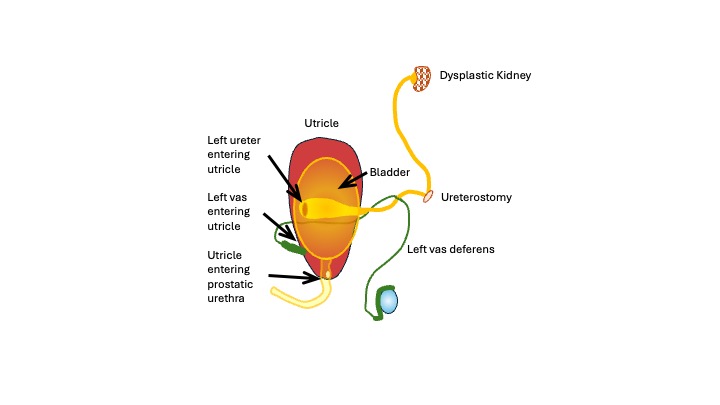
METHODS: Patient #1 presented neonatally with a giant utricle cyst causing bilateral urinary and bowel obstruction and was initially managed with a cutaneous utriculostomy. Patient #2 presented as a neonate with a large utricle cyst associated with a refluxing ectopic ureter and non-functioning left kidney. A left loop cutaneous ureterostomy effectively decompressed the utricle and dilated left kidney.Imaging with ultrasound, MRI, VCUG, and renal scintigraphy with cystoscopy were used to define anatomy and plan for definitive reconstruction.Both patients underwent delayed robot-assisted resection of the utricle cyst with a transperitoneal three-arm approach at 16 and 36 months. Patient #1 also underwent left nephroureterectomy and patient #2 had bilateral inguinal hernias repaired; both through the same port configuration.
RESULTS:In the first case, the ectopic ureter entered the utricle cyst on the contralateral side as did the left vas deferens. Resection of the ureter between the bladder and cyst required bladder incision and repair. A suprapubic catheter was placed due to unclear bladder function; with an alpha-blocker, spontaneous voiding resumed. The perioperative course in the second case was uneventful. Complete resection was achieved in both cases without complications.
CONCLUSION:Large utricle cysts in the newborn may be effectively managed with initial diversion and delayed robotic excision. Careful delineation of the variable anatomy is essential for surgical planning. The robotic approach enables excellent visualization and precise dissection in complex pelvic anatomy and allows for concomitant procedures without additional access.
Back to 2026 Abstracts


