Back to 2026 Abstracts
Urinary Microbiome Dysbiosis and Functional Pathway Alterations Associated with Urodynamic Phenotypes in Children with Neurogenic Bladder
Deepthi Ramya Ravindran, M.sc,
Sachit Anand, MBBS, MCh, Ajay Verma, MBBS, MCh, Jitendra Kumar Meena, MD, DNB, ACME, Himalaya Kumar, Msc, Pankaj Hari, MD, FIAP, FAMS, Vineet Ahuja, MBBS, MD, DM.
All India Institute of Medical Sciences, New Delhi, India
BACKGROUND: Neurogenic Bladder in pediatric populations is a complex condition involving abnormalities in bladder storage and voiding physiology. Increasing evidence suggests that urinary microbial dysbiosis contributes to disease pathogenesis. However, the relationship between urinary microbiome composition, microbial metabolic pathways, and urodynamic study (UDS) phenotypes remains poorly characterised. This study aimed to integrate urinary microbiome profiling, functional pathway analysis, and Machine Learning-based modelling to identify microbial signatures associated with bladder capacity, compliance, detrusor overactivity (DO), and storage pressure.
METHODS: Urinary microbiome datasets obtained from children with NB (N=37) were categorized with UDS parameters and further analysed using alpha-diversity metrics (Shannon, Simpson, Chao1, and Observed richness), beta-diversity analyses (Bray-Curtis and Jaccard dissimilarities), differential abundance testing, and pathway prediction analysis. Integrated multi-omics analyses combined microbial genera and predicted metabolic pathways using clustering, heatmaps, network analysis, and shared-signature mapping. Machine learning and deep learning approaches were used for predictive modelling and feature prioritisation.
RESULTS: Alpha-diversity analyses demonstrated biologically relevant associations with UDS phenotypes. Shannon diversity showed positive correlations with capacity (ρ=0.15), compliance (ρ=0.11), and DO (ρ=0.18), while pressure demonstrated a weak negative association (ρ=−0.04). Similar trends were observed for Chao1 and Observed richness. Beta-diversity analyses demonstrated phenotype-specific microbial clustering, although PERMANOVA effect sizes were modest (R²≈0.025-0.028). Differential abundance analyses identified significant enrichment of
Burkholderia-Caballeronia-Paraburkholderia,
Veillonella,
Escherichia-Shigella,
Nosocomiicoccus,
Methylophilus, and
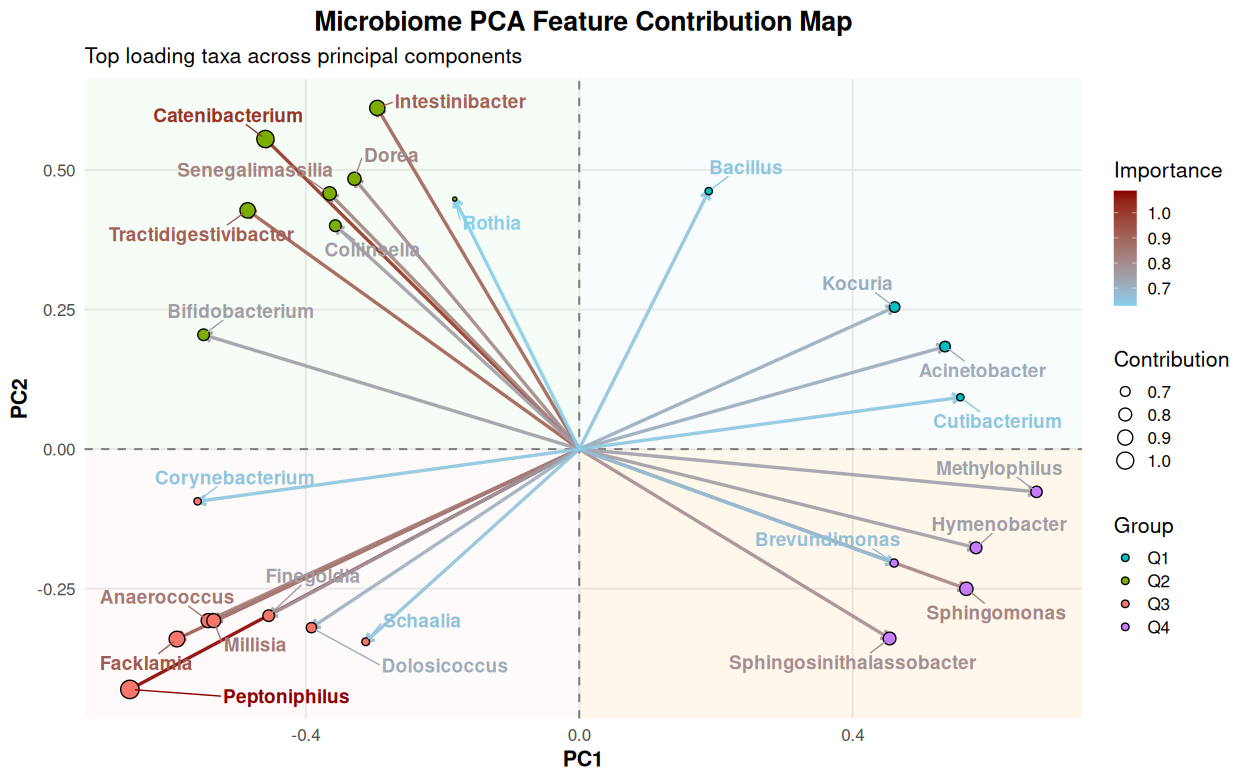
Cutibacterium in abnormal UDS phenotypes, with several taxa exhibiting log2 fold-changes exceeding ±20. Functional pathway analyses revealed alterations in amino acid biosynthesis, fermentation pathways, nucleotide metabolism, and redox-associated pathways. Neurodysbiosis scores were elevated in abnormal compliance and pressure groups (Δ≈0.15-0.21). Integrated predictive modeling demonstrated strong classification performance, with PLS-DA achieving AUC values of 0.84 for DO, 0.88 for compliance, 0.83 for capacity, and 0.80 for pressure. Deep learning feature-importance analysis consistently identified microbial taxa and metabolic pathways contributing to phenotype discrimination. Multi-omics network analysis revealed dense microbial-pathway interaction hubs specific to each UDS phenotype.
CONCLUSIONS:Integrated multi-omics analysis identified distinct urinary microbial and metabolic signatures associated with major urodynamic dysfunction phenotypes. Combining microbiome profiling with machine learning and deep learning approaches provides a systems-level approach for biomarker discovery and precision therapeutic targeting in children with NB.
Back to 2026 Abstracts


