Back to 2026 Abstracts
Distribution of Semen Parameters in a Large Cohort of Adolescent and Young Adult Males Using a Mail-In Semen Analysis Kit
Elizabeth Gurt Lynch, MD1, Daniel Nolte, BS2, Laurence Baskin, MD1, James F. Smith, MD, MS3, Yi Li, MD1.
1University of California San Francisco, San Francisco, CA, USA, 2Fellow Health, San Leandro, CA, USA, 3University of California San Francisco, Fellow Health, San Francisco, CA, USA.
Background: Adolescent and young adult (AYA) males increasingly seek semen analysis (SA) for fertility preservation, fertility evaluation, or personal curiosity, yet age-specific parameters remain undefined. Existing data come largely from small clinic-based fertility preservation cohorts, limiting generalizability. CLIA-accredited mail-in cryopreservation kits enable large-scale evaluation of AYA semen parameters outside the traditional clinic setting. We characterized the distribution of SA parameters across age in a large contemporary AYA cohort to inform interpretation and counseling.
Methods: We conducted a cross-sectional study of males aged 12-25 who completed a CLIA-accredited mail-in SA between April 2021 and May 2025. Semen volume, sperm concentration, and total motile count (TMC) were measured. Patient-reported indication for testing was recorded at registration. Patients were stratified into four age groups: 12-15, 16-18, 19-21, and 22-25 years. Continuous parameters were compared across groups using the Kruskal-Wallis test and categorical outcomes using chi-squared or Fisher exact tests, as appropriate.
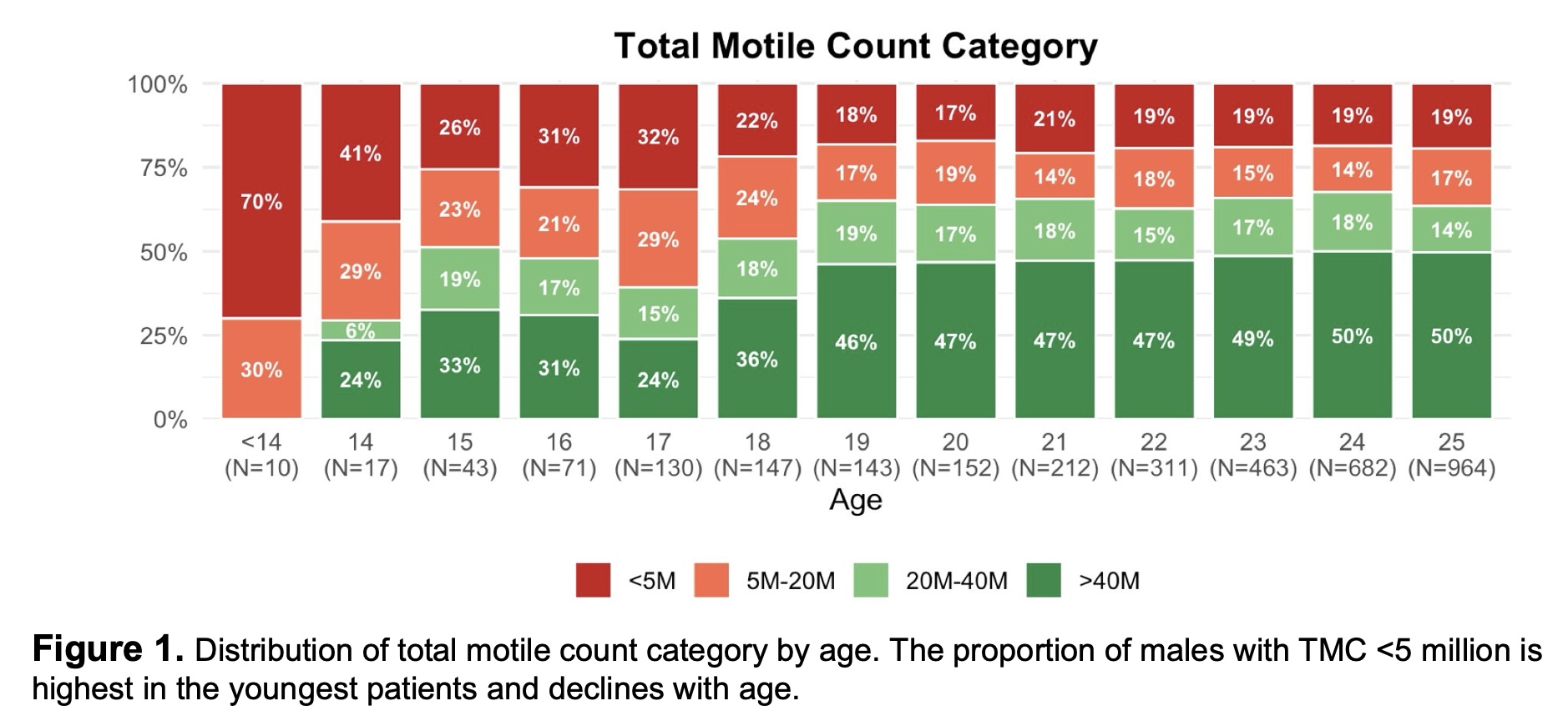
Results: A total of 3,345 AYA males underwent SA; 70 (2.1%) were aged 12-15, 348 (10.4%) 16-18, 507 (15.2%) 19-21, and 2,420 (72.3%) 22-25 years. Indication for testing varied significantly by age (p<0.001): “just curious” predominated among older adolescents (45.7% at 16-18 years), while cryopreservation prior to gender-affirming therapy (18.6%) and chemotherapy (8.6%) were disproportionately represented among 12-15-year-olds. All semen parameters improved with advancing age. Median semen volume rose from 1.7 mL (IQR 1.0-2.5) in 12-15-year-olds to 3.5 mL (IQR 2.5-4.7) in 22-25-year-olds (p<0.001), median concentration from 19.6 (IQR 3.4-54.7) to 34.9 million/mL (IQR 10.9-79.8; p<0.001), and median TMC from 12.3 (IQR 1.1-39.2) to 38.7 million (IQR 10.5-122.3; p<0.001). Markers of impairment were concentrated in the youngest patients: azoospermia occurred in 11.4% of 12-15-year-olds versus 5.3% of 22-25-year-olds (p=0.011), and TMC <5 million in 35.7% versus 19.1%, respectively (p<0.001) (Table 1). The proportion of males with a severely low TMC fell steeply across single years of age, exceeding 40% in those younger than 15 and stabilizing near 19% by age 19 (Figure 1).
Table 1. Semen parameters by age group | Parameter | | 12-15 (n=70) | | 16-18 (n=348) | | 19-21 (n=507) | | 22-25 (n=2,420) | | p |
| Volume (mL), median (IQR) | | 1.7 (1.0-2.5) | | 2.8 (1.9-3.7) | | 3.4 (2.4-4.7) | | 3.5 (2.5-4.7) | | <0.001 |
| Concentration (million/mL), median (IQR) | | 19.6 (3.4-54.7) | | 23.1 (7.1-54.7) | | 30.4 (11.3-79.8) | | 34.9 (10.9-79.8) | | <0.001 |
| TMC (million), median (IQR) | | 12.3 (1.1-39.2) | | 18.6 (4.1-64.4) | | 35.5 (10.4-111.0) | | 38.7 (10.5-122.3) | | <0.001 |
| Azoospermia, n (%) | | 8 (11.4%) | | 26 (7.5%) | | 27 (5.3%) | | 129 (5.3%) | | 0.011 |
| TMC <5 million, n (%) | | 25 (35.7%) | | 95 (27.3%) | | 96 (18.9%) | | 462 (19.1%) | | <0.001 |
Conclusions: In the largest AYA SA cohort to date, abnormal semen parameters were concentrated in the youngest adolescents and improved progressively with age, suggesting that adult WHO reference thresholds may overestimate impairment during pubertal maturation. These findings support age specific interpretation of adolescent SA and caution against using a single early SA to guide irreversible fertility related decisions. Limitations include a cohort that includes patients with possible fertility-impacted medical diagnoses, smaller numbers in the youngest age groups, and absence of Tanner staging.
Back to 2026 Abstracts


