Back to 2026 Abstracts
Time is Testicle: A System-wide Quality Improvement (QI) Initiative to Improve Door to OR Times for Testicular Torsion
Stacy Hyojin Jeong, MD1, Annaliese Ionson, MD1, Michael Gross, MD1, Kamilla Abdurakhmanov, MD1, Niki Rodgers, BS2, Patrick Potoczak, BS3, Anna Zampini, MD, MS, MBA1, John K. Weaver, MD1, Lynn Woo, MD1, Jessica Hannick, MD1.
1Cleveland Clinic, Cleveland, OH, USA, 2Case Western Reserve University School of Medicine, Cleveland, OH, USA, 3Cleveland Clinic Lerner School of Medicine, Cleveland, OH, USA.
Introduction Testicular torsion is an emergency where rapid diagnosis and intervention are critical. Door-to-incision (DTI) time less than 4 hours is a national benchmark for performance in pediatric urology. Prior retrospective analysis of our multi-hospital network revealed that only 54% of our torsion cases had a DTI time < 4 hours. We implemented a multidisciplinary, system-wide quality improvement (QI) initiative using Testicular Workup for Ischemia and Suspected Torsion (TWIST) scoring to improve timeliness and consistency of care for pediatric patients with suspected torsion. We aimed to improve the proportion of torsion cases with DTI time < 4 hours by 15% over an 18-month period.
Methods Previous unpublished analysis of the process flow map at our institution identified bottlenecks surrounding ultrasonography (US) completion and patient transfer. Responding to this, our primary intervention incorporated an automatically suggested TWIST score into ED triage documentation for patients presenting with torsion symptoms. ED providers were advised to immediately consult urology for patients with TWIST scores ≥ 5 before ultrasound completion. Our second intervention incorporated TWIST score into the US order to signal test priority. A retrospective cohort included males aged 6-21 years who underwent surgery for testicular torsion between August 2023 and July 2024. Following implementation of the TWIST pathway in July 2024, a prospective intervention cohort was accrued through December 2025. Process measures included DTI time, time to urologic consultation, US completion time, and transfer time. Outcome measures included proportion of DTI time < 4 hours, transfer rate, and orchiectomy rate.
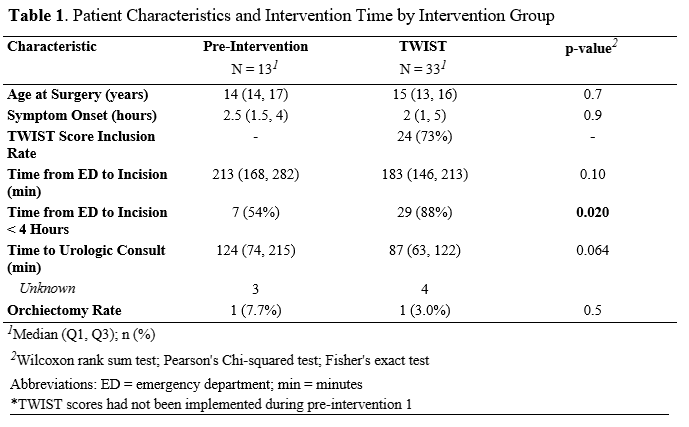
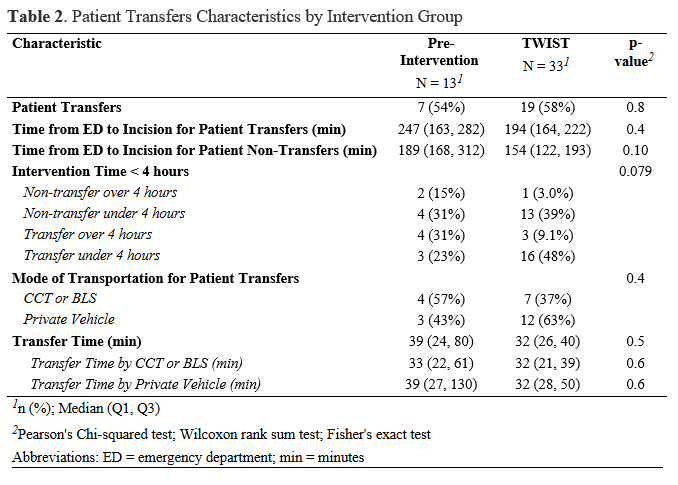
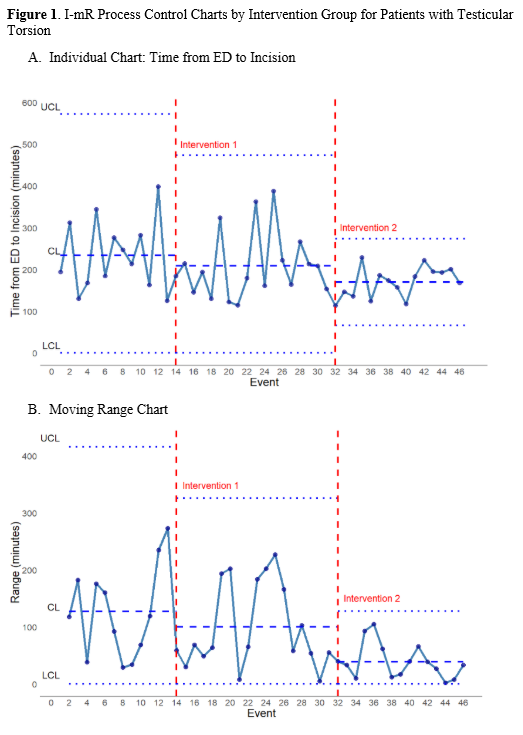
Results Forty-six patients underwent surgical management of testicular torsion, including 13 pre-intervention patients and 33 intervention patients (Table 1). There was a significant increase in the proportion of patients with DTI < 4 hours (54% vs 88%, p=0.02). Time to urologic consultation demonstrated a downward trend (124 vs 87 minutes, p=0.064). There was a non-significant improvement in the proportion of transferred patients with DTI < 4 hours (23% to 48%, Table 2). There were no significant differences in median DTI, ultrasound completion time, transfer rates, or orchiectomy rates. Process control charts demonstrated sustained and decreased variability in DTI following interventions (Figure 1).
Conclusion Implementation of an automated TWIST score and appropriate prioritization of US significantly increased the proportion of patients achieving DTI < 4 hours. We observed rapid intervention adoption, a trend toward shorter time to urologic consultation, and sustained reductions of DTI
variability. Ongoing efforts will focus on further improving transfer pathways and expediting imaging workflows.
Back to 2026 Abstracts


