Back to 2026 Abstracts
Lack of Response to Testosterone as a Risk Factor for Complication Development in Distal Hypospadias Repair
Amelia K. Wildermuth, BS, Karl F. Godlewski, MD, Dennis J. Fleysh, BA, Meghan F. Davis, MD, Dana A. Weiss, MD, Jason Van Batavia, MD, Katherine M. Fischer, MD, Sameer Mittal, MD, Arun K. Srinivasan, MD, Stephen A. Zderic, MD, Mark R. Zaontz, MD, Thomas F. Kolon, MD, Christopher J. Long, MD.
Children's Hospital of Philadelphia, Philadelphia, PA, USA.
BACKGROUND: Administration of preoperative testosterone (T) improves postoperative complications in select hypospadias patients, but individual responses to T are variable. We hypothesize that minimal or no response to T in distal hypospadias patients is associated with an increased incidence of complications.
METHODS: A retrospective review of a prospectively collected hypospadias database including patients who underwent primary distal hypospadias repair from 2016-2025. Patients were included if preoperative T was administered, meatus following orthoplasty was glans-distal shaft, formal urethroplasty was required, intraoperative glans width (GW) measurements were obtained, and they had at least 3 months follow-up. We collected age at surgery, length of follow-up, prematurity, complications, repair type, pre- & intraoperative GW, and T dosage. Pre-op and intraoperative GW were compared to determine the response to T. Responders (R) were classified as having ≥ 2 mm or ≥ 3mm increase in GW following 1 or 2+ doses of T, respectively. Non-responders (NR) were defined as falling below these parameters. Multivariable analysis was performed to determine the effect of no response to testosterone after adjusting for surgical repair type.
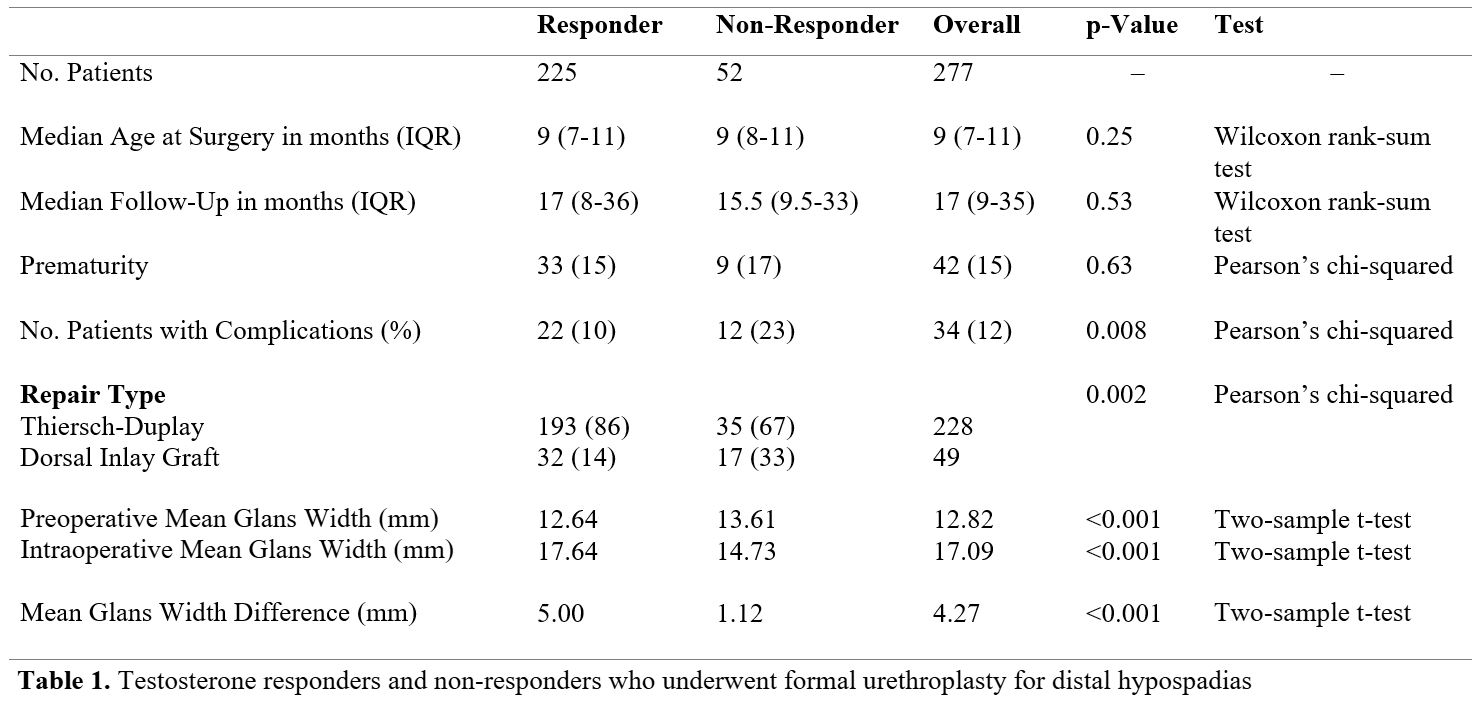
RESULTS: 277 patients were included, with 225 R and 52 NR. 52/277 (19%) distal hypospadias patients did not respond to T. 25/52 (48%) NR had ≤ 1 mm response to T. The median age at surgery was the same for both groups (9 months; p = 0.25) and median follow-up was similar between R and NR (17 vs 15.5 months; p = 0.53). Univariate analysis showed that the incidence of complications for R was significantly lower than NR (10% vs 23%; p = 0.008). Mean GW was significantly larger in R in comparison to NR (17.64 mm vs 14.73 mm; p = <0.001). Additionally, the difference between pre- and intraoperative mean GW for R was significantly higher than NR (5.00 mm vs 1.12 mm; p = <0.001). Patients had a similar GW regardless of complication within R and NR groups. Multivariable analysis accounting for differences in repair type showed significantly less complications in the R group (p = 0.03).
CONCLUSIONS: In distal hypospadias patients undergoing primary repair with formal urethroplasty, postoperative complication rates are significantly lower in R vs NR on univariate and multivariable analysis accounting for differences in techniques. 19% of patients with distal hypospadias had minimal to no response in glans width after preoperative T. Evaluation of glans width after T administration prior to surgery is recommended to determine if patients are R or NR and consideration should be given for androgen receptor gene testing in NR.
Back to 2026 Abstracts


