Back to 2026 Abstracts
Comorbidity Drives Acute Healthcare Utilization in Spina Bifida: A Statewide Analysis
Rennen Haramaty, MD, Jennika Finup, NP, Leeyan Nasrallah, Student, Kali Mesdjian, NP, Vinaya Bhatia, MD, Walid Farhat, MD, Kristin Ebert, MD.
University of Wisconsin–Madison, Madison, WI, USA.
IntroductionPatients with spina bifida (SB) experience substantial acute healthcare utilization across the lifespan, particularly during the transition from pediatric to adult care. While prior studies suggest increased utilization during adolescence and young adulthood, the underlying drivers remain poorly defined. In particular, the relative contributions of age, comorbidity burden, and social determinants of health (SDOH) are unclear. Leveraging a statewide all-payer claims database, we aimed to identify the primary predictors of urologic acute healthcare utilization among patients with SB.
MethodsThis cross-sectional study utilized Wisconsin Health Information Organization (WHIO) data from 2017–2024. Patients with spina bifida under 35 years old with urologic-related ICD-10 diagnoses during emergency department or inpatient encounters were included. Demographic variables included age, sex, rural versus non-rural residence, insurance status, and Charlson Comorbidity Index (CCI). Patients were categorized as pediatric (<18 years) or adult (18–34 years), with subgroup analysis of adolescents (12–17 years) and young adults (18–24 years). The primary outcome was cumulative annual length of stay (LOS), defined as total days spent in emergency or inpatient care per year. Secondary outcomes included annual acute healthcare encounter frequency. Statistical analysis included t-tests, chi-square tests, and multivariable modeling using negative binomial and linear regression, adjusting for demographic and SDOH variables.
ResultsA total of 487 patients were included (pediatric: n=270; adult: n=217). Adults demonstrated higher comorbidity burden (CCI 2.50 vs 1.51, p<0.001) but similar healthcare utilization compared to pediatric patients, including LOS (4.32 vs 4.70 days/year, p=0.57) and encounter rates (0.70 vs 0.74/year, p=0.65) (Table 1).In multivariable analysis, comorbidity burden was the only consistent predictor of healthcare utilization, with each 1-point increase in CCI associated with a 5% increase in encounter rate (p<0.05). Age group, sex, rurality, and insurance status were not significantly associated with utilization after adjustment.
In the transitional age subgroup (12–24 years), adolescents demonstrated higher encounter rates compared to young adults (2.04 vs 1.54, p=0.015) (Figure 1), though this difference was not significant after adjustment. Rural patients demonstrated lower observed utilization, but this was not independently associated with outcomes after accounting for comorbidity.
ConclusionsAcute healthcare utilization among patients with spina bifida is primarily driven by comorbidity burden rather than age or sociodemographic factors. Disease complexity, not transition age, is the dominant predictor of healthcare use, and utilization does not significantly increase in young adulthood after adjustment. These findings support risk stratification to identify medically complex patients who may benefit from intensified ambulatory surveillance and structured transition support. Targeted interventions may improve care coordination and reduce acute care needs.
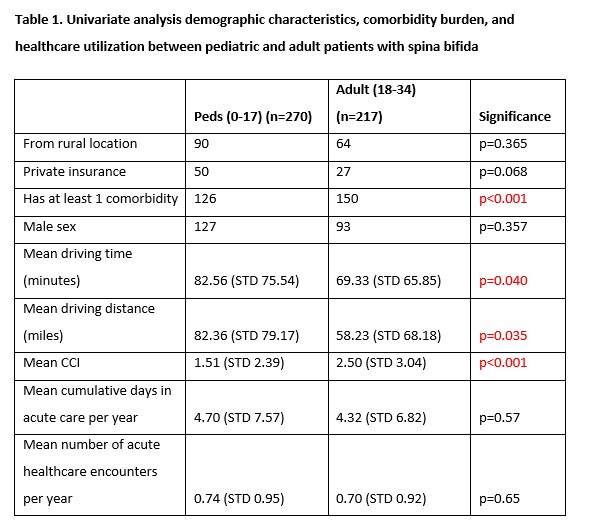
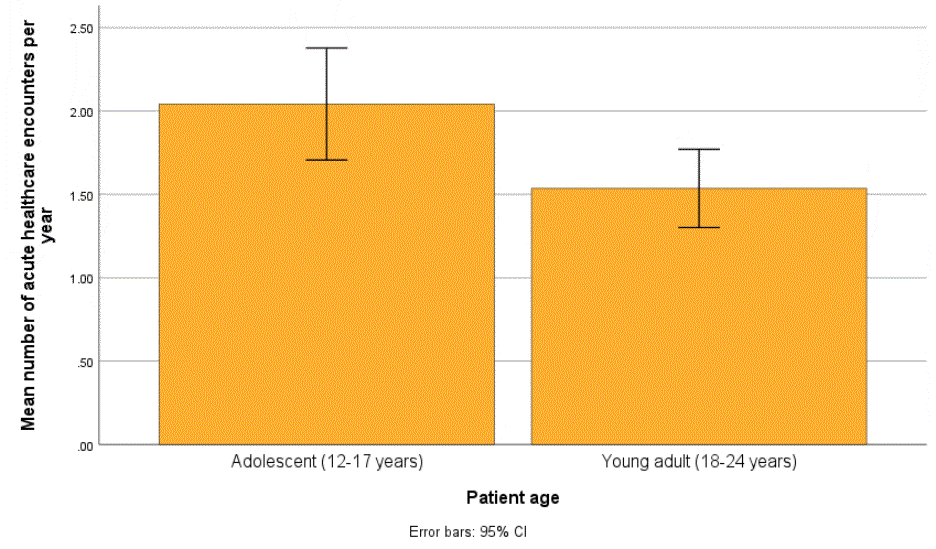 Figure 1. Healthcare utilization across the transition age window (12–24 years)
Back to 2026 Abstracts


