Back to 2026 Abstracts
Patient-Reported Anxiety and Depressive symptoms in a Multidisciplinary Spina Bifida Clinic: Associations with Transition Readiness
Jamie Michael, MD1, Lynn Huang, MS1, Ilina Rosoklija, MPH2, Danielle Herrera, BS2, Josephine Hirsch, BA2, Robin M. Bowman, MD2, Diana K. Bowen, MD2, Elizabeth B. Yerkes, MD2, David I. Chu, MD, MSCE2, Jaclyn Papadakis, PHD2.
1Northwestern Medicine, Chicago, IL, USA, 2Ann & Robert H. Lurie Children's Hospital of Chicago, Chicago, IL, USA.
Background: Successful transition to adult health care requires self-management skills, which may be impaired by co-occurring depression or anxiety. We aimed to describe the prevalence of anxiety and depressive symptoms in a multidisciplinary spina bifida (SB) clinic and examine their association with transition readiness.
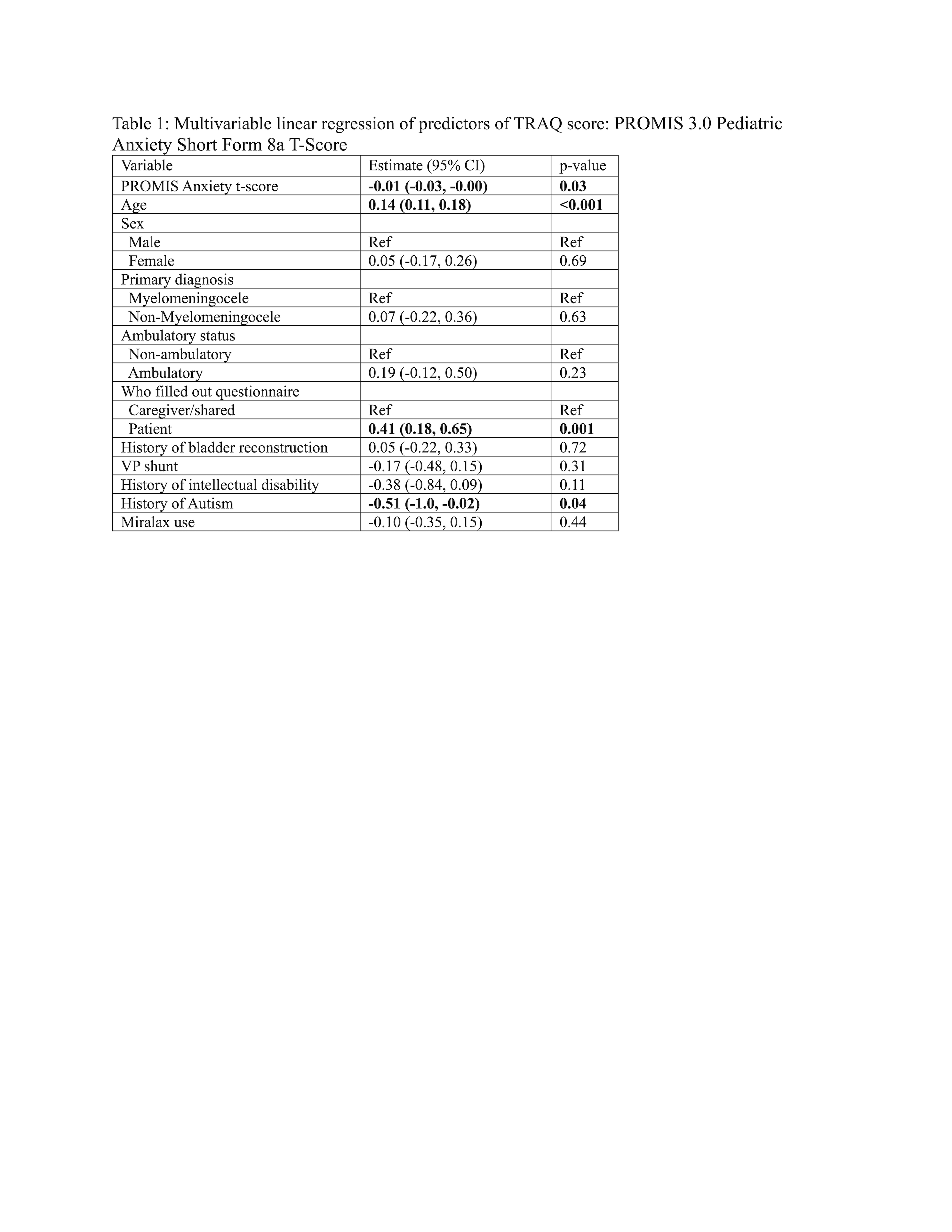
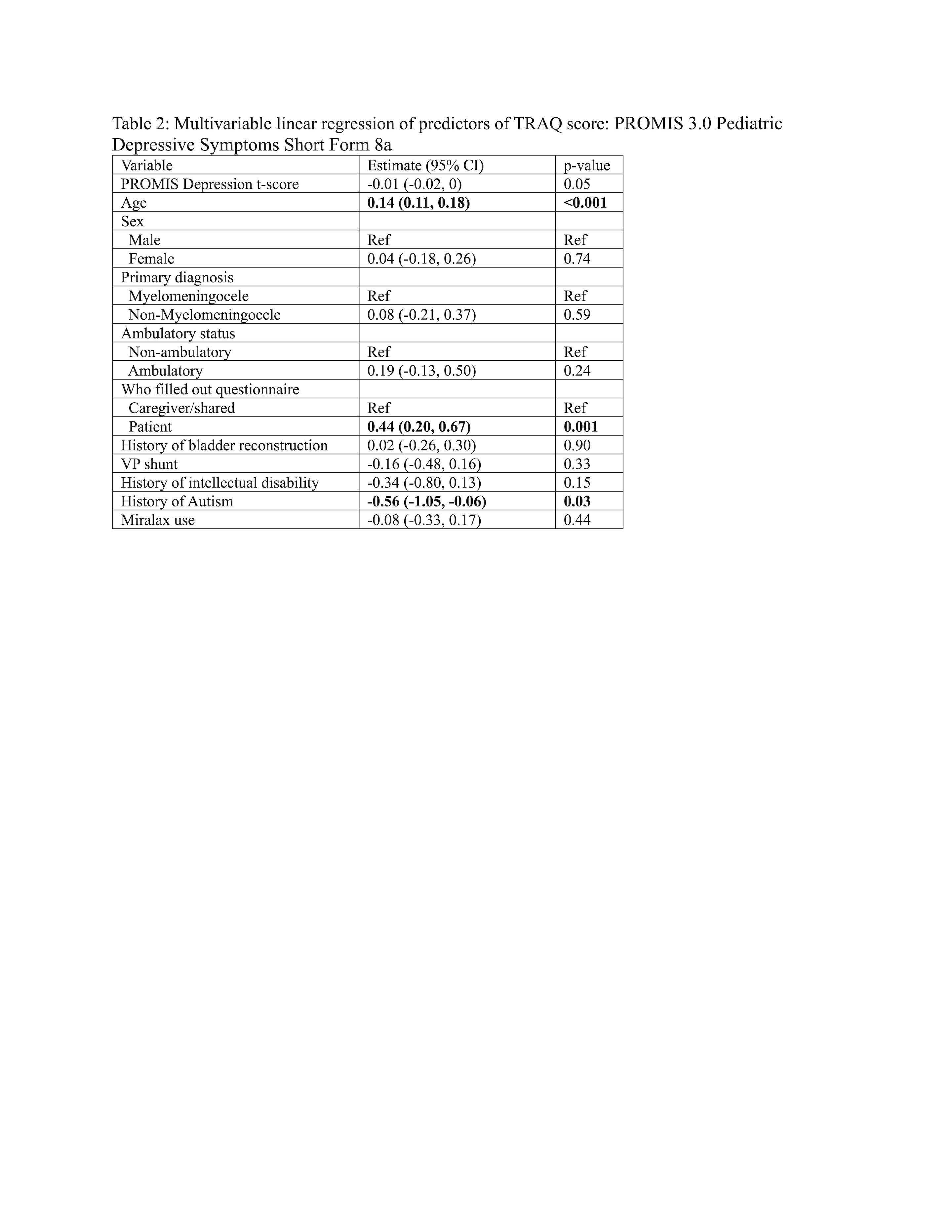
Methods: Since August 2023, our multidisciplinary SB clinic has incorporated standardized anxiety and depressive symptom screening into an existing patient-reported outcomes (PRO) registry for patients 12 years and older. We retrospectively analyzed patients who completed the PROMIS 3.0 Pediatric Depressive Symptoms Short Form 8a, the PROMIS 3.0 Pediatric Anxiety Short Form 8a, and the Transition Readiness Assessment Questionnaire (TRAQ). For patients with repeated measures, date of first anxiety and depression symptom screening was used as study timepoint. PROMIS T-scores were categorized into normal (<55), mild (55-59), moderate (60-64), moderately severe (65-69) or severe (>70). Multivariable linear regression assessed the association between PROMIS T-scores and TRAQ score, adjusting for age, sex, primary diagnosis, ambulatory status, independent questionnaire completion, history of bladder reconstruction, shunt status, Miralax use, and history of intellectual disability or Autism Spectrum Disorder (ASD).
Results: We identified 221 patients who completed the PROMIS Anxiety, PROMIS Depressive Symptoms, and TRAQ. Median age was 15 years (IQR 13, 18) and 54% were female. Thirty-one (14%) patients had a pre-existing diagnosis of depression and 71 (32%) had a pre-existing diagnosis of anxiety. PROMIS Anxiety T-scores were normal in 149 (67%), mild in 48 (22%), moderate in 16 (7%), moderately severe in 6 (3%), and severe in 2 (1%). PROMIS Depressive Symptoms T-scores were normal in 164 (74%), mild in 36 (16%), moderate in 13 (6%), moderately severe in 4 (2%), and severe in 4 (2%). The median TRAQ Total score was 2.85 (out of 5, with higher scores indicating greater transition readiness). On adjusted analysis, higher PROMIS Anxiety T-scores were independently associated with lower TRAQ scores (β= -0.01 [95%CI -0.03, 0]). Higher PROMIS Depressive T-scores showed a similar trend that did not reach statistical significance (β= -0.01 [95%CI -0.02, 0]. In both models, younger age, caregiver assistance versus patient self-completion of questionnaires, and a documented ASD diagnosis were independently associated with lower TRAQ scores.
Conclusion: Higher anxiety symptom burden was independently associated with lower transition readiness, even after accounting for age, SB diagnosis type, and neurodevelopmental comorbidities. Depression scores showed a similar trend but did not reach significance. Younger age, caregiver assistance with questionnaire completion, and history of ASD were also consistently associated with lower TRAQ scores. These findings identify subgroups within the SB population who may benefit from targeted transition support; however, longitudinal studies are needed to further assess transition outcomes.
Back to 2026 Abstracts


