Back to 2026 Abstracts
Making the Leap: Outcomes of a Dedicated Spina Bifida Transition Clinic with High Rates of Transfer to Adult Urology Care
Jamie Michael, MD1, Elizabeth B. Yerkes, MD2, David I. Chu, MD, MSCE2, Mara Markzon, LCSW1, Robin Bowman, MD2, Stephanie Hendrick, MD3, Natasha Bhatia, MD3, Ilina Rosoklija, MPH2, Diana K. Bowen, MD2.
1Northwestern Medicine, Chicago, IL, USA, 2Ann & Robert H. Lurie Children's Hospital of Chicago, Chicago, IL, USA, 3Shirley Ryan AbilityLab, Chicago, IL, USA.
Background Successful transition from pediatric to adult care remains challenging for patients with spina bifida (SB), with success rates as low as 47% even when pediatric and adult services are at the same institution. Multiple strategies have been proposed to improve transition, including dedicated transition clinics with structured protocols and proactive barrier reduction. We evaluate transition outcomes between a dedicated pediatric SB transition clinic and an adult SB clinic at financially separate but academically affiliated institutions.
MethodsWe reviewed patients with SB seen in the pediatric transition clinic 2021-2025. The clinic includes urology, neurosurgery and social work from both pediatric and adult institutions; the adult SB clinic includes urology (same provider as pediatric), physiatry, and social work, with the social worker (SW) coordinating insurance and scheduling the first adult urology visit at time of transition clinic. The primary outcome was successful transition, defined as completion of a first adult urology visit. Demographic, insurance, and clinical and urologic variables were compared between groups. Univariable logistic regression and survival analysis assessed factors associated with transition and time to transition. Available Transition Readiness Assessment Questionnaire (TRAQ) scores were compared between groups (higher scores equal greater readiness).
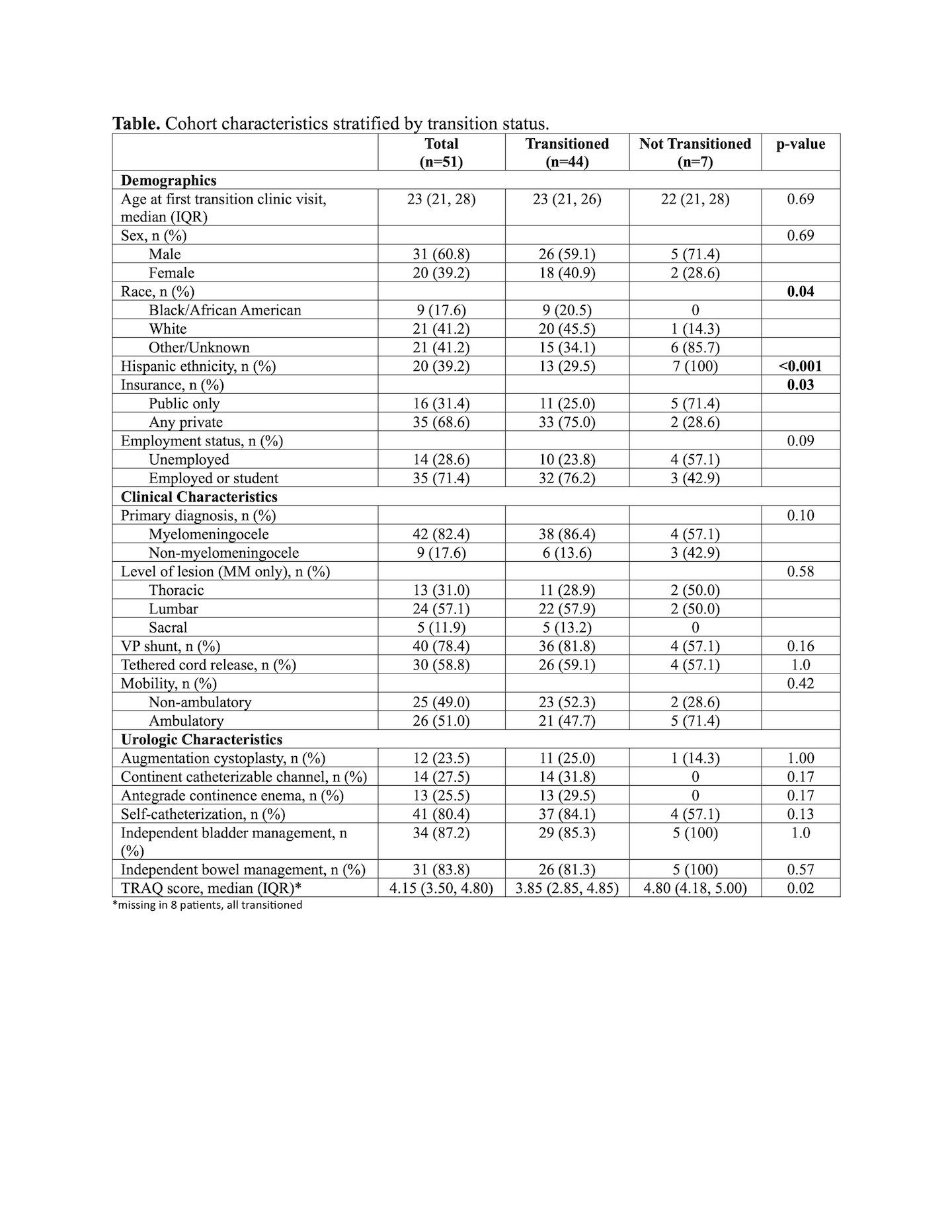
ResultsOf 51 patients, 44 (86%) completed a first adult urology visit (median age 23 [IQR 21, 28], median 13 months after last pediatric urology visit [IQR 11, 18]); 33/44 (75%) completed an ultrasound and 32/44 (73%) completed labs. All non-transitioned patients were Hispanic, compared to 30% of transitioned (p<0.001), and non-transitioned patients more often had public-only insurance (71% vs. 25%, p=0.02) (Table). On logistic regression, public insurance was associated with lower odds of transition (OR 0.13, 95% CI 0.02-0.79). Non-myelomeningocele diagnosis and absence of VP shunt were associated with longer time to transition (22 vs. 12 months, p=0.05; 18 vs. 12 months, p=0.05). Among 36 patients with available TRAQ scores, non-transitioned patients reported higher readiness than transitioned patients (median 4.8 vs 3.9, p=0.02).
ConclusionsAmong patients with SB seen at a dedicated multidisciplinary transition clinic, 86% successfully completed a first adult urology appointment at a median of 13 months after their last pediatric urology visit. Barriers specifically addressed by this structure include insurance at a financially separate adult clinic, a “warm hand-off” at time of pediatric transition with adult SW, and continuity of the urology provider. Hispanic patients and those with public only insurance were less likely to transition successfully, suggesting social determinants of health as continued barriers. In contrast, VP shunt and myelomeningocele diagnosis were associated with shorter time to transition, perhaps reflecting greater healthcare engagement in this population. Paradoxically, non-transitioned patients had higher TRAQ scores, though this likely reflects the small non-transition sample (n=7), it may suggest self-reported readiness does not reliably predict transition completion. Prospective studies are needed to validate predictors of transition failure and identify patients at highest risk.
Back to 2026 Abstracts


