Back to 2026 Abstracts
Anterior-posterior Renal Pelvis Diameter Velocity Dynamics Improves Pyeloplasty Decision-Making in Cases of Borderline Hydronephrosis: A Dynamic Complement to Static Threshold-Based Grading
Fabio Botelho, MD, Mandy Rickard, MN, NP, Samer Maher, MSc, Usman Kahloon, MSc, Joana Dos Santos, MD, Michael Chua, MD, Armando J. Lorenzo, MD.
SickKids, Toronto, ON, Canada.
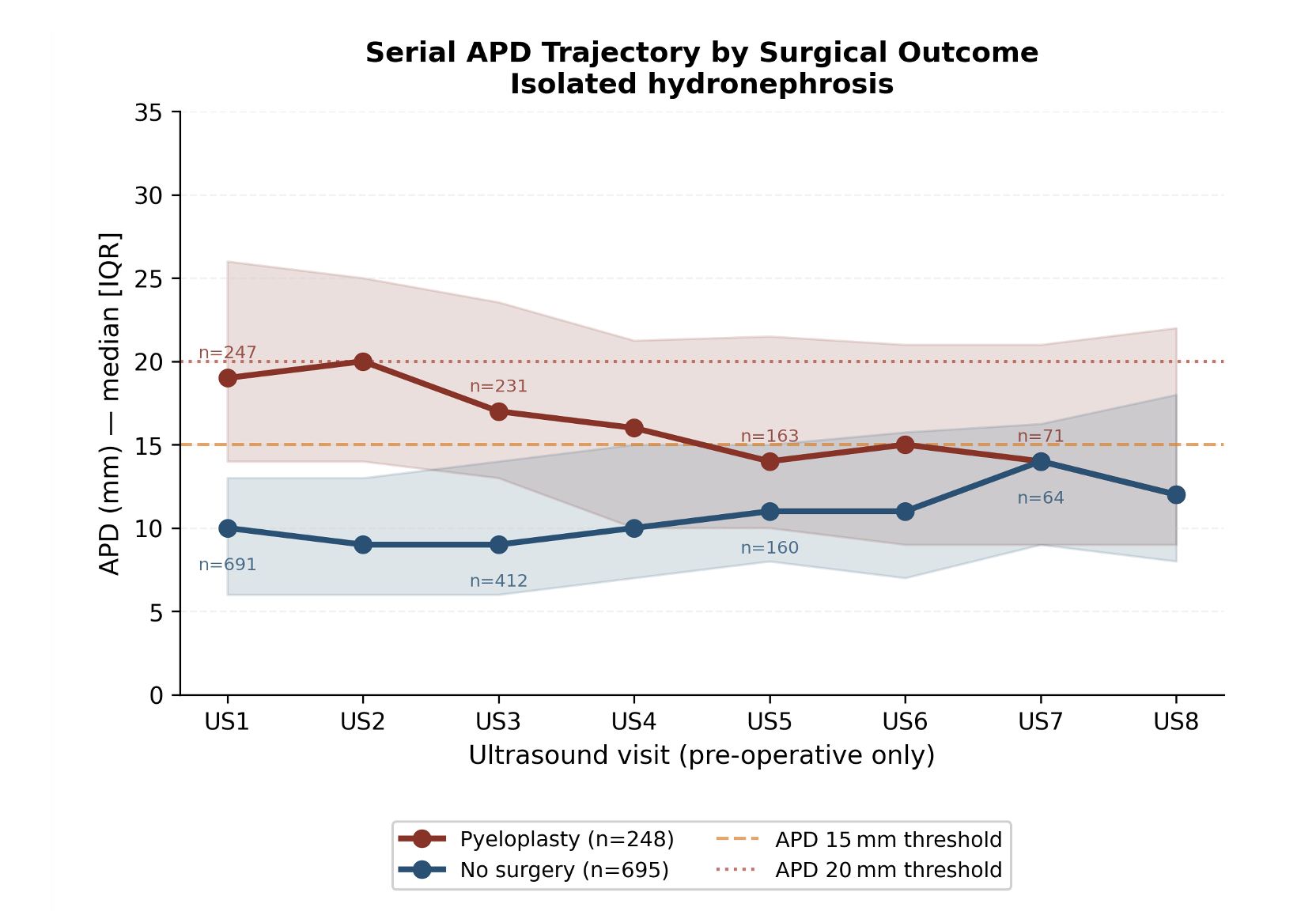
BACKGROUND: Current guidelines use static antero-posterior diameter (APD) thresholds to guide pyeloplasty decisions in children with isolated hydronephrosis. However, a single measurement captures only an ephemeral snapshot of a dynamic process. Serial ultrasounds, routinely obtained in these children, contain trajectory information that is largely discarded when only peak APD is considered. We hypothesized that APD velocity (rate of change across serial ultrasounds) would improve surgical prediction, particularly in children with borderline initial APD, where static thresholds provide weak discrimination.
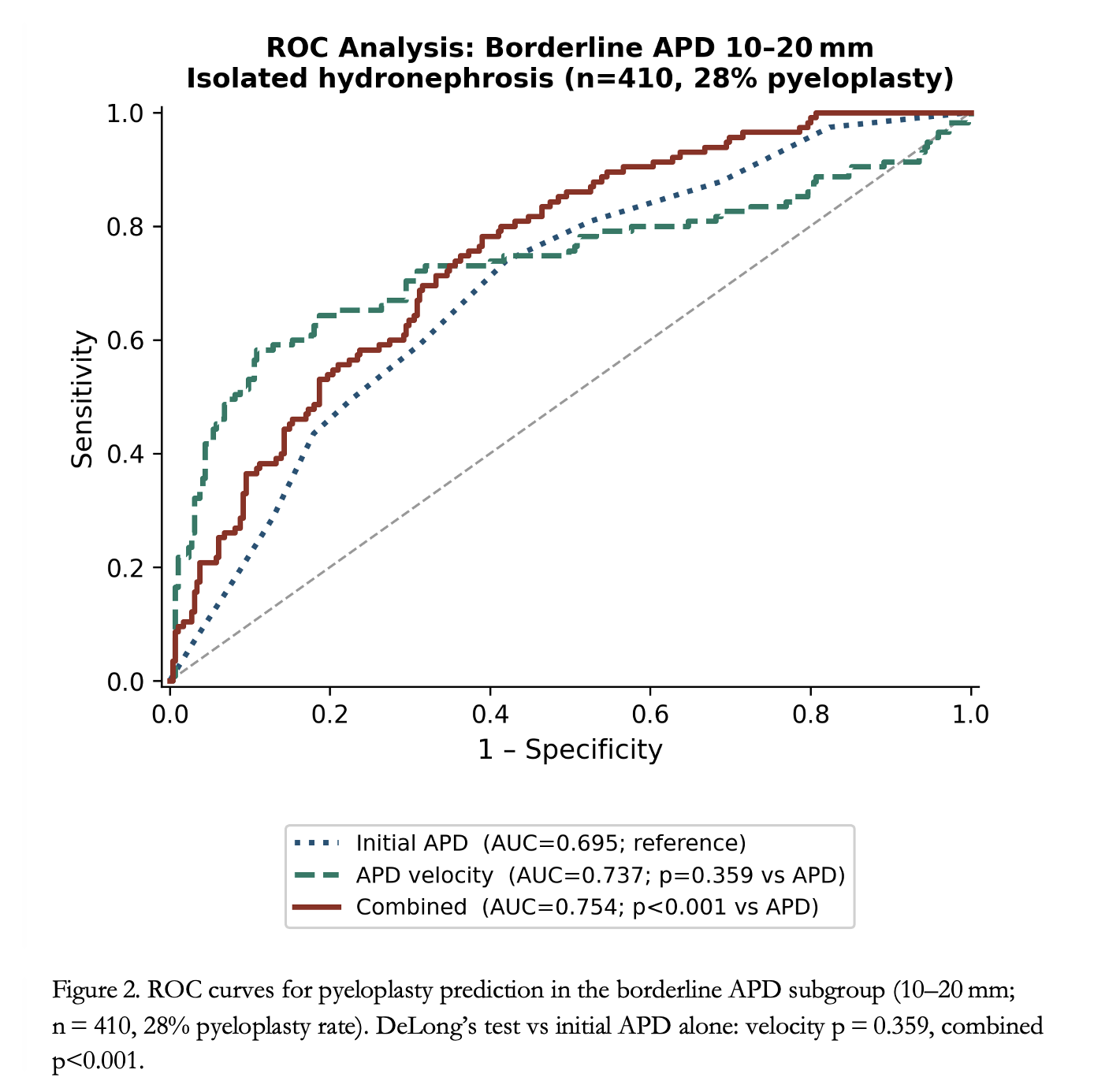
METHODS: A single-center retrospective cohort from a prospective hydronephrosis database. We included patients with isolated hydronephrosis who had ≥2 pre-operative ultrasounds (n = 849; 205 [24%] underwent pyeloplasty). Post-operative ultrasounds were excluded. APD velocity was calculated as the slope of linear regression of APD (mm) against time (days) across all pre-operative visits, then converted to mm/month. The predictive performance of (1) initial APD at US1, (2) APD velocity, and (3) their combination was compared using the area under the ROC curve (AUC). A pre-specified subgroup analysis examined children with borderline initial APD (10-20 mm), where static thresholds provide the most modest guidance (n = 410, 28% pyeloplasty rate).
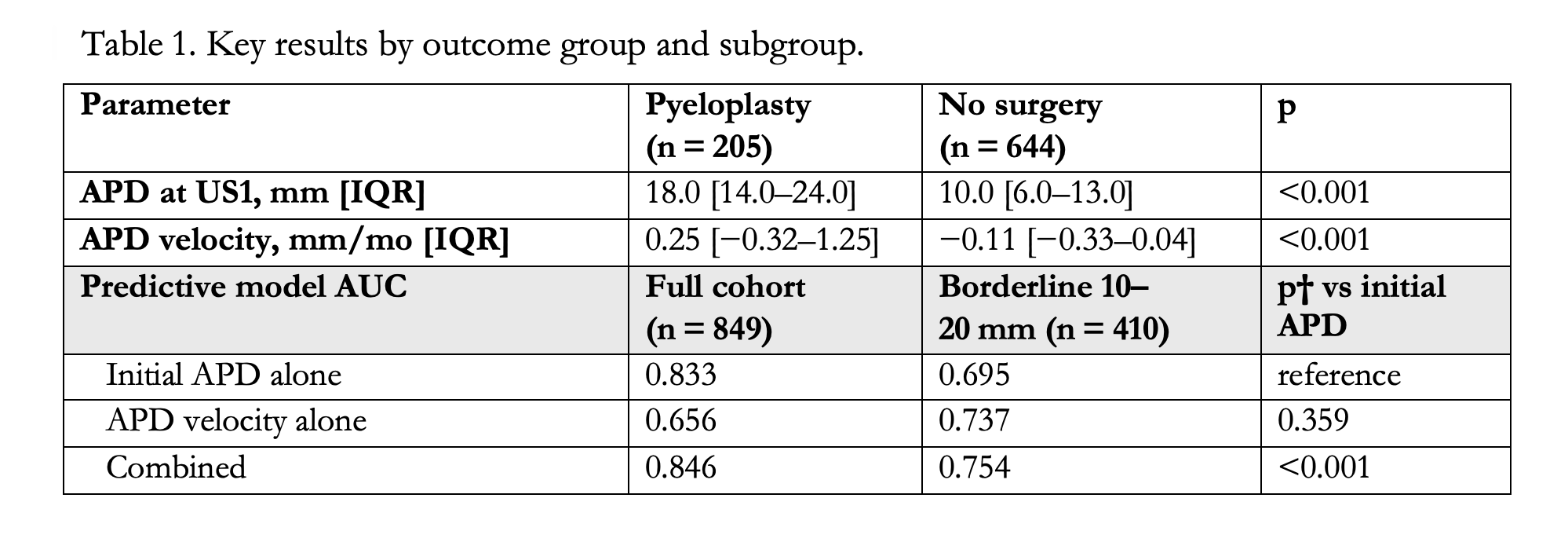
RESULTS: The median APD velocity was significantly higher in the pyeloplasty group (0.25 [-0.32-1.25] mm/month) than in the no-surgery group (-0.11 [-0.33-0.04] mm/month; p<0.001). Initial APD was also higher in the pyeloplasty group (18.0 [14.0-24.0] vs 10.0 [6.0-13.0] mm; p<0.001). Overall, the combined model (AUC = 0.846) outperformed initial APD (AUC = 0.833) and velocity alone (AUC = 0.656). In the borderline APD subgroup (10-20 mm, n = 410), APD velocity showed a numerically higher AUC than initial APD alone (0.737 vs 0.695, p = 0.359); the combined model significantly outperformed initial APD alone (AUC = 0.754, p<0.001). Among children with initial APD <15 mm who ultimately required pyeloplasty (n = 63), 73% had a rising trajectory (median velocity 0.55 mm/month). By trajectory category: rising APD (> 0.5 mm/month) had a 70% pyeloplasty rate (n = 121); stable (±0.5 mm/month) 13% (n = 576); falling (<-0.5 mm/month) 28% (n = 152; Table, Figures 1-2).
CONCLUSIONS:APD velocity provides complementary predictive information to the static initial APD for pyeloplasty decision-making in isolated hydronephrosis. Its advantage is greatest in the borderline APD range (10-20 mm), where the combined model significantly outperforms the initial APD alone. Among children with an apparently reassuring initial APD (<15 mm) who ultimately required pyeloplasty, 73% showed a consistently rising trajectory. Incorporating APD velocity into surveillance protocols may enable earlier identification of progressive obstruction and more confident conservative management of stable or improving cases.
Back to 2026 Abstracts


