Back to 2026 Abstracts
Why do we admit patients after pyeloplasty? An 18-Year ERAS Evolution Driving Same-Day Discharge for Infants and Young Children
Mandy Rickard, MN, NP, Michael Chua, MD, Samer Maher, MSc, Usman Kahloon, MSc, Fabio Botelho, MD, Derek Liu, BScN, Joana Dos Santos, MD, Joao Pippi Salle, MD, Armando J. Lorenzo, MD.
SickKids, Toronto, ON, Canada.
BACKGROUND: Same-day discharge (SDD) after open pyeloplasty was historically rare, especially in infants. We aimed to characterize the 18-year evolution of ERAS-aligned practice at a single center, identify independent predictors of SDD, and confirm that accelerated discharge did not compromise safety in a predominantly infant population
METHODS: Single-surgeon, single-center retrospective cohort of 353 consecutive open pyeloplasties (2008-2026). Median age 6.8 months [IQR 4.0-12.9]; 72% male. Cases were grouped into six time periods. Primary outcome: SDD (LOS ≤15 h). Secondary outcomes: ED bounce-back, readmission, reoperation (including redo surgery and stent dilations). Perioperative surgical and anesthesia variables included urethral catheter use, surgical drain, stent type (Salle vs. JJ), narcotic use, regional anesthesia, and operative time. We also documented the reason for non-SDD status.
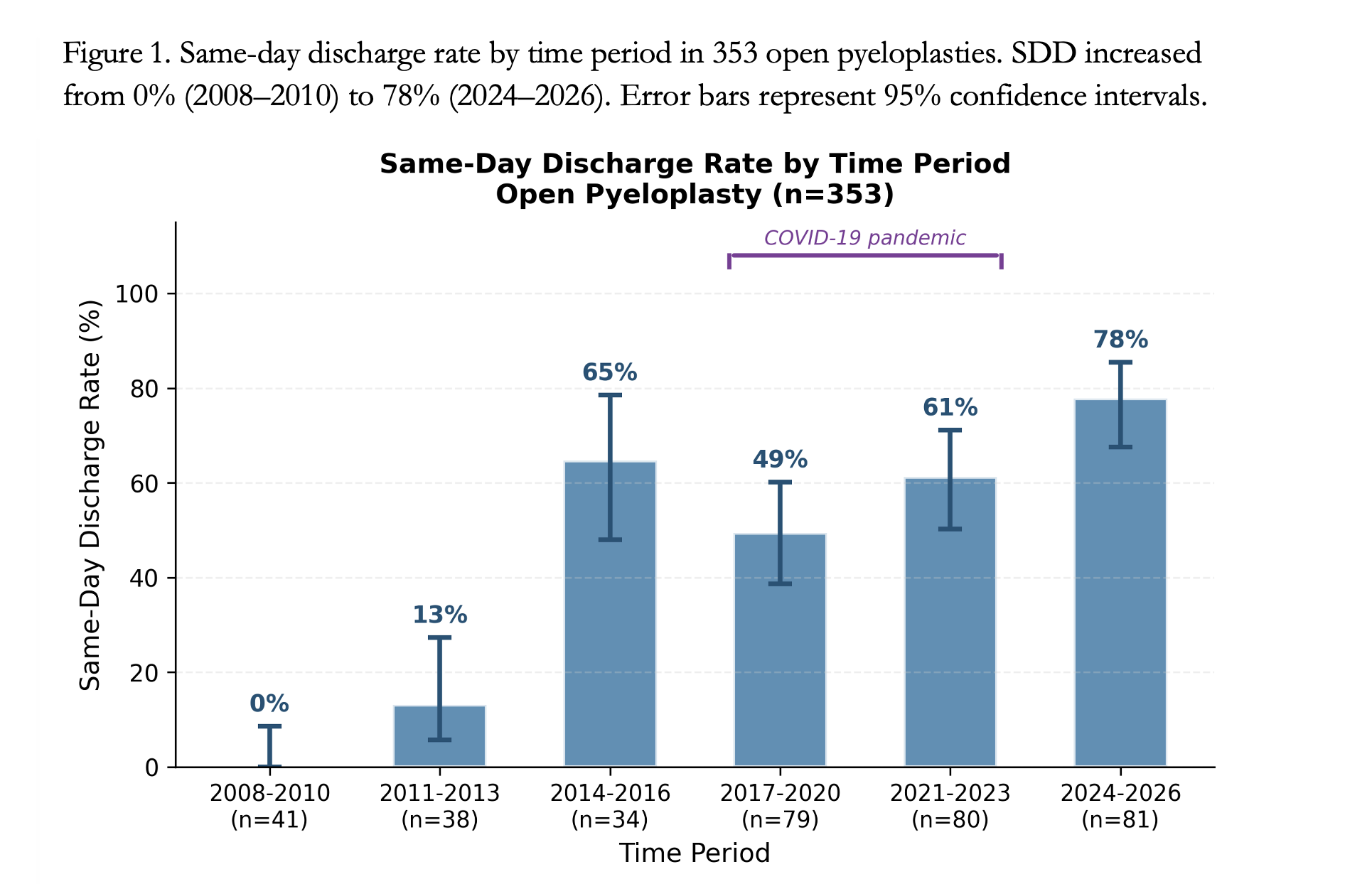
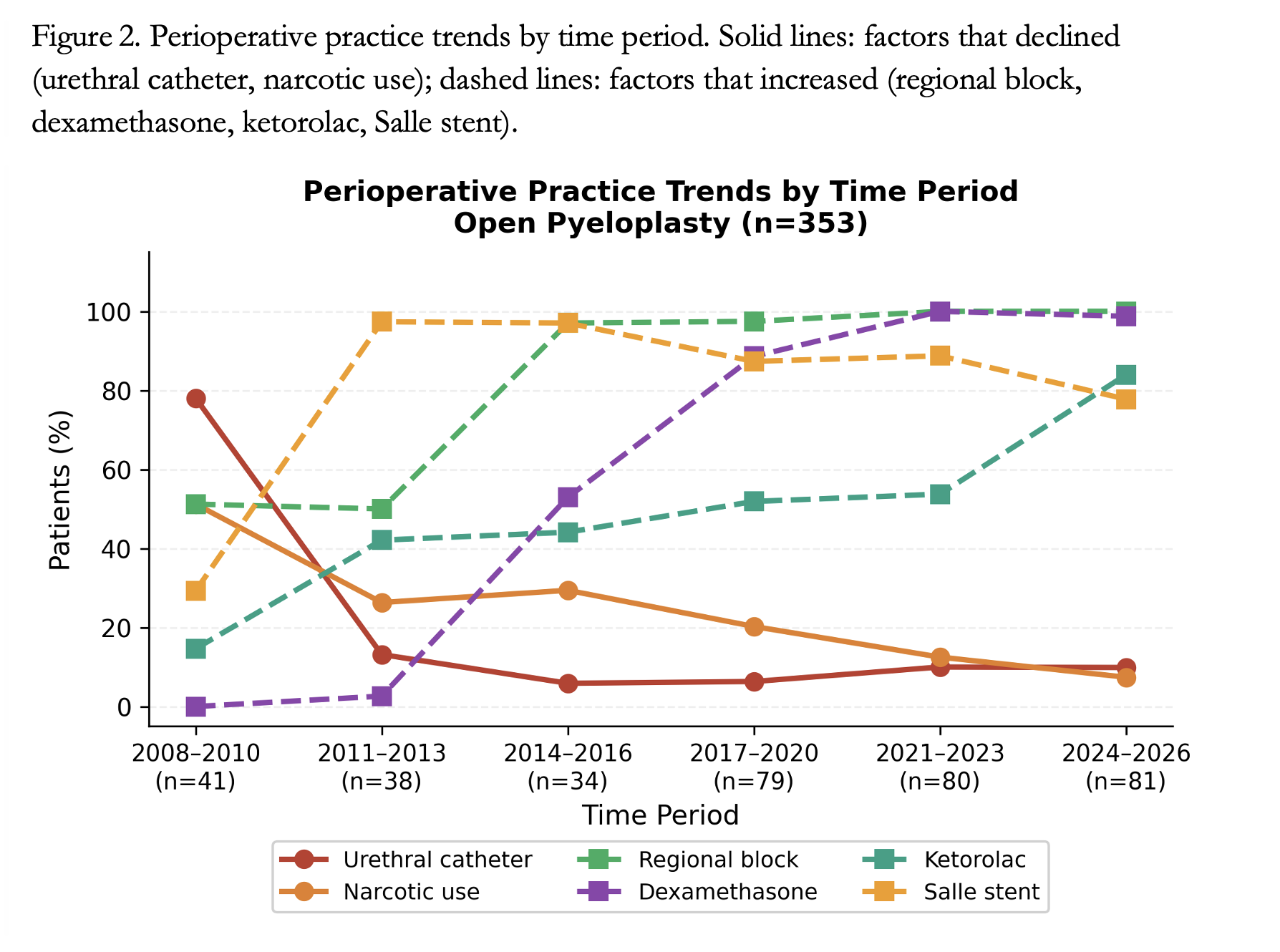
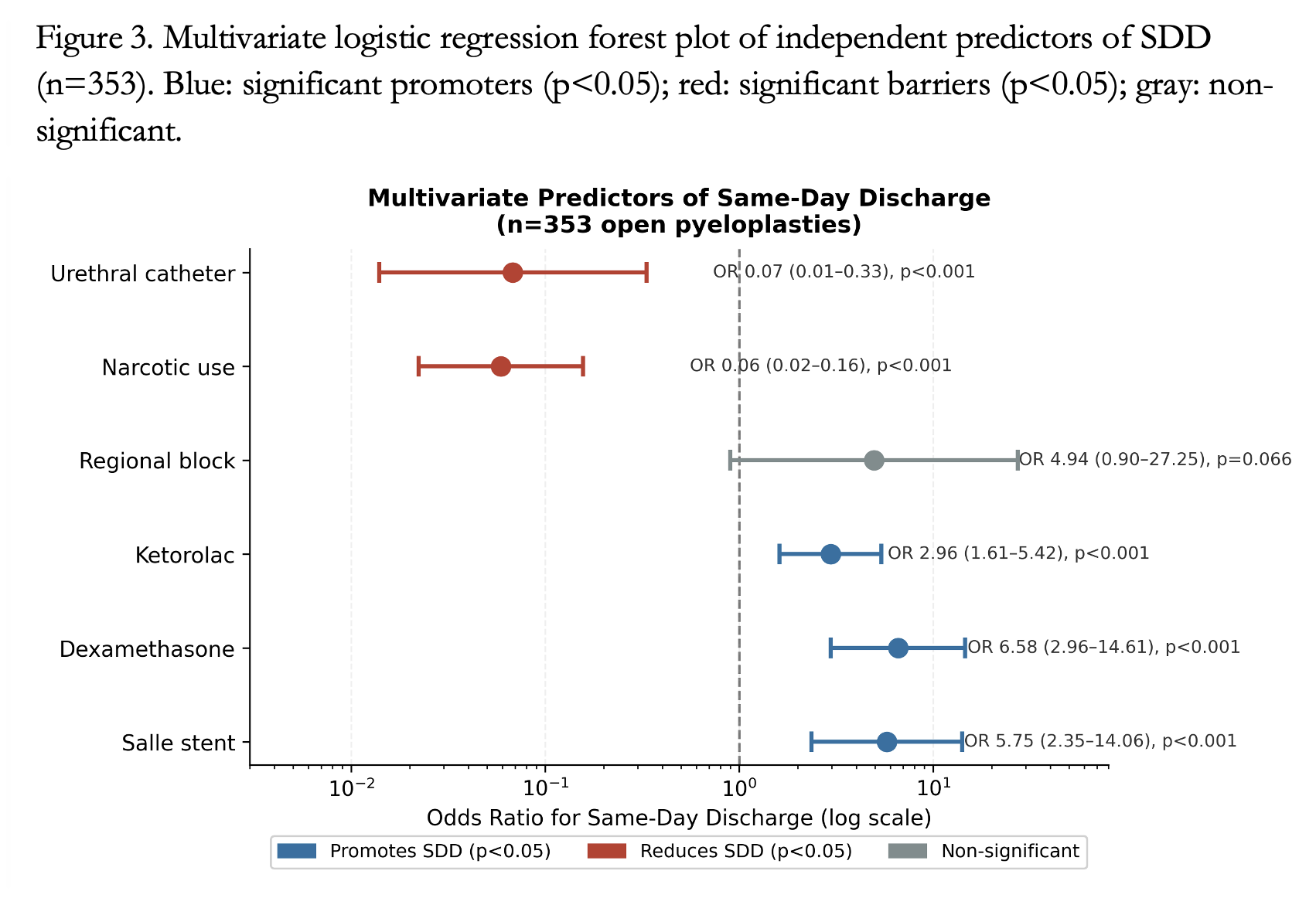
RESULTS: Overall, SDD was achieved in 178/353 (50.4%), rising from 0% (2008-2010) to 78% (2024-2026) (Figure 1). Over the same period: urethral catheter use declined from 78% to 10%; narcotic use from 51% to 8%; and regional anesthesia increased from 51% to 100%. Stent practice shifted from JJ-dominant (71%) to predominant use of Salle (78% in the most recent time period). JJ stents were selected for anatomically complex cases: any anatomic anomaly was present in 29% of JJ vs 16% of Salle cases (p = 0.008). SDD was lower with JJ stents (18% vs 58%, p<0.001), reflecting case complexity. Median OR time declined from 170 to 110 min (overall 121 min [IQR 105-145]); shorter OR time was associated with SDD (113 vs 135 min, p<0.001). Among 175 non-SDD cases, the dominant early barrier was surgeon/historical practice (83% of non-SDD in 2008-2010). In recent time periods, non-SDD was driven by non-modifiable factors such as distance from hospital, parent preference and medical complexity. On multivariate analysis, urethral catheter (OR = 0.07, 95% CI 0.01-0.33; p = 0.001) and narcotic use (OR = 0.06, 95% CI 0.02-0.16; p<0.001) were the strongest barriers to SDD, while dexamethasone (OR = 6.58, 95% CI 2.96-14.61; p<0.001), Salle stent (OR = 5.75, 95% CI 2.35-14.06; p<0.001), and ketorolac (OR = 2.96, 95% CI 1.61-5.42; p<0.001) independently promoted SDD (Figure 3). Safety was maintained throughout, with overall ED bounce-back 17.0%, readmission 6.5%, and re-operation 6.2%, with re-operation declining from 12% to 1% over time.
CONCLUSIONS:Systematic ERAS implementation has increased SDD rates from 0% to 78% for open pyeloplasty in infants without compromising safety. Eliminating the urethral catheter and opioids are the most impactful individual interventions, while dexamethasone, Salle stents, and ketorolac independently promote same-day discharge. These data demonstrate that day surgery is achievable and safe for most infants undergoing open pyeloplasty.
Back to 2026 Abstracts


