Back to 2026 Abstracts
Changing Practice Trends in Antibiotic Prophylaxis and Voiding Cystourethrogram Utilization for Prenatal Hydronephrosis: A 17 Year Multicenter Experience
Sarah H. Williamson, MD1, Carol A. Davis-Dao, PhD2, Alireza Alam, MD2, Luis H. Braga, MD, PhD3, Shannon Cannon, MD4, Joshua D. Chamberlin, MD5, Kai-Wen Chuang, MD2, Christopher S. Cooper, MD6, Anne G. Dudley, MD7, Janelle A. Fox, MD1, Daniel Han, MD8, C.D. Anthony Herndon, MD9, Nora G. Kern, MD10, Antoine E. Khoury, MD2, Heidi A. Stephany, MD2, Valre W. Welch, NP9, Rebecca S. Zee, MD9, Elias J. Wehbi, MD2.
1Children’s Hospital of the King’s Daughters, Norfolk, VA, USA, 2Rady Children’s Health, Orange County and University of California, Irvine, Orange, CA, USA, 3McMaster University, Hamilton, ON, Canada, 4University of Wisconsin, Madison, WI, USA, 5Loma Linda University Health, Loma Linda, CA, USA, 6The University of Iowa, Iowa City, IA, USA, 7Connecticut Children’s Medical Center, Hartford, CT, USA, 8Stanford University, Palo Alto, CA, USA, 9Children’s Hospital of Richmond at Virginia Commonwealth University, Richmond, VA, USA, 10University of Virginia, Charlottesville, VA, USA.
Background Management of prenatal hydronephrosis has evolved considerably over the past two decades, with growing debate around the utility of continuous antibiotic prophylaxis (CAP) and voiding cystourethrogram (VCUG) in isolated hydronephrosis. Using data from a multicenter cohort, our objective was to examine temporal trends in CAP prescription, VCUG utilization, and confirmed urinary tract infection (UTI) rates across distinct hydronephrosis subgroups.
Methods A multicenter cohort analysis was performed using data collected from 2007-2024. Patients with a history of prenatal hydronephrosis and at least 3 months of urology follow-up were included. Patients with posterior urethral valves, neurogenic bladder, or other rare anomalies were excluded. Patients were stratified into groups: isolated hydronephrosis (IH, n=1,636), divided further into isolated SFU grades 1-2 hydronephrosis (n=954), isolated SFU grades 3-4 hydronephrosis (n=682), and hydroureteronephrosis (HUN; ≥7mm ureteral dilation (n=308)). CAP was defined as any prescription during the follow-up period. Confirmed UTI was defined as fever, pyuria, a single-organism positive culture from a catheterized or clean-catch specimen, and antibiotic treatment. Temporal trends were analyzed by year of first urology visit, grouped into six cohorts spanning 2007-2024.
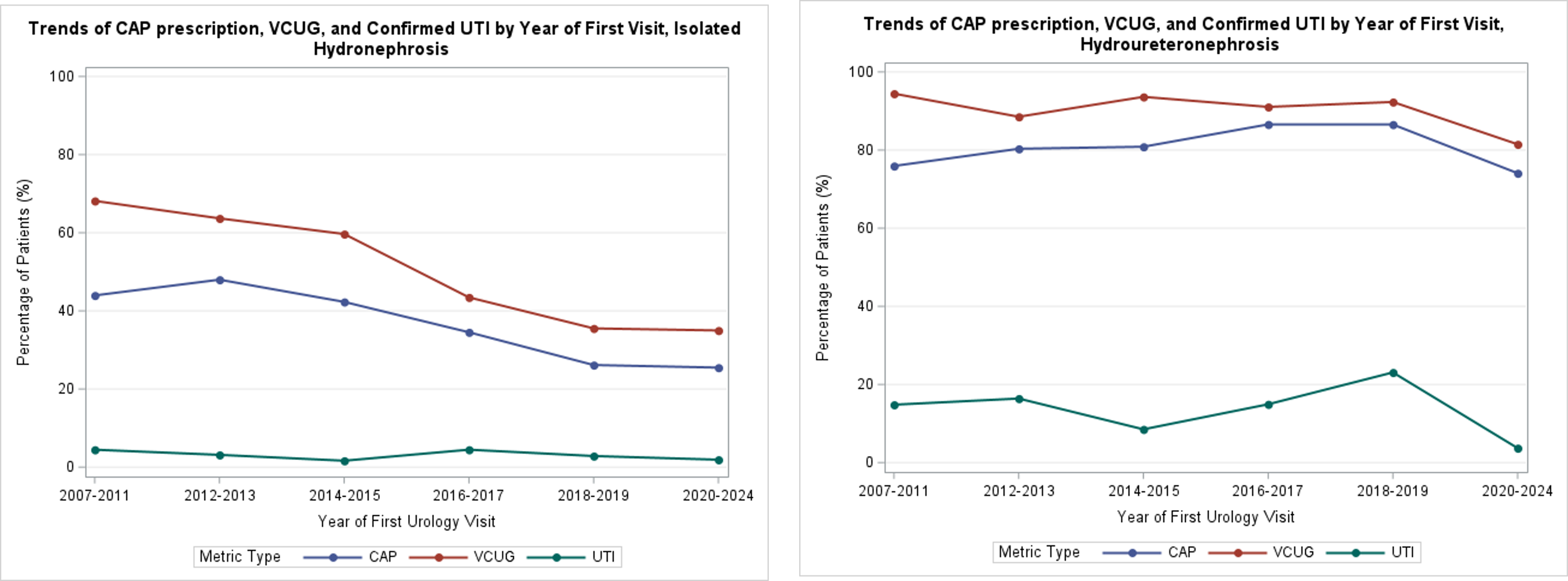
Results A total of 1,944 patients met inclusion criteria. Among patients with isolated hydronephrosis, there were significant decreasing trends in both CAP prescription (p<0.0001) and VCUG utilization (p<0.0001) over the study period (Figure 1a). These trends were consistent across both SFU grades 1-2 (CAP p=0.0001; VCUG p<0.0001) and SFU grades 3-4 (CAP p=0.01; VCUG p<0.0001) subgroups. Despite these practice changes, confirmed UTI rates remained stable throughout the study period for isolated hydronephrosis overall (range 1.6-4.5%; p=0.24), as well as for low-grade (range 0-1.7%; p=0.49) and high-grade (range 1.6-8.7%; p=0.26) subgroups. In contrast, among patients with hydroureteronephrosis, CAP prescription rates (p=0.52) and VCUG utilization (p=0.46) remained stable over time (Figure 1b). Confirmed UTI rates in this group were similarly unchanged (p=0.21), though this group had a substantially higher UTI rate throughout the study period (overall 14.6%).
Conclusions Over nearly two decades across multiple centers, CAP prescription and VCUG utilization have decreased significantly in patients with isolated hydronephrosis without a corresponding increase in confirmed UTI rates, supporting the safety of more conservative management in this population. Management of hydroureteronephrosis has remained consistent over time, reflecting the persistently higher infection rates in this group. These findings support targeted reduction of antibiotic prophylaxis and invasive imaging in isolated hydronephrosis while highlighting the continued need for surveillance in hydroureteronephrosis.
Back to 2026 Abstracts


