Back to 2026 Abstracts
Prune Belly Syndrome (PBS) Smooth Muscle Myosin Heavy Chain MYH11 R108W mutation: Molecular Dynamics Analysis and Drug Repurposing
Nixon Raj Nirmal, PhD, Nathalia G. Amado, PhD, Justin Wobser, MPH, Linda A. Baker, MD.
Nationwide Children's Hospital, Abigail Wexner Research Institute, Columbus, OH, USA.
BACKGROUND:Muscle requires actin-myosin crossbridge cycling coupled to ATP hydrolysis into ADP+P
i to generate force and contract. There are several myosin heavy chain (MYH) proteins, including the structurally homologous smooth muscle (MYH11) and cardiac (MYH7), each with the actin-binding head, neck and tail domain. PBS is characterized by significant detrusor underactivity and smooth muscle dysfunction. We identified a PBS male with a deleterious DNA mutation encoding MYH11 p.R108W near the ATP-binding pocket on the head domain. Knowing drugs have been created to treat dilated cardiomyopathy due to MYH7 head mutations [called cardiac myosin activator (CMA)], we sought to 1) Use
in silico molecular docking and molecular dynamics simulations (MDS) to investigate protein structural consequences of MYH11 R108W, and 2) Explore
in silico drug repurposing of cardiac myosin activator (CMA) as treatment for smooth muscle myosin dysfunction. We hypothesize that 1) the R108W mutation impairs contractility by altering ATP-associated conformational dynamics, and 2) the drug CMA could bind MYH11 and potentially restore molecular properties disrupted by R108W.
METHODS:Wild type (WT) and R108W MYH11 proteins (main bladder isoform) were modeled using AlphaFold2. MDS were performed in GROMACS v2021.3, including energy minimization and equilibration steps followed by 300 ns production runs (n=3). Docking of the drug CMA into the MYH11 head binding pocket was performed using MOE v2024.0604, followed by additional MDS analyses of ligand-bound complexes. Raw simulation trajectories were post-processed for structural stability analysis. To investigate long-range allosteric communication in the MYH11 head domain, inter-residue interaction strength and potential mechanical signal propagation from CMA to the ATP-binding site were evaluated using structure-mechanics statistical learning and rigidity graph analysis.
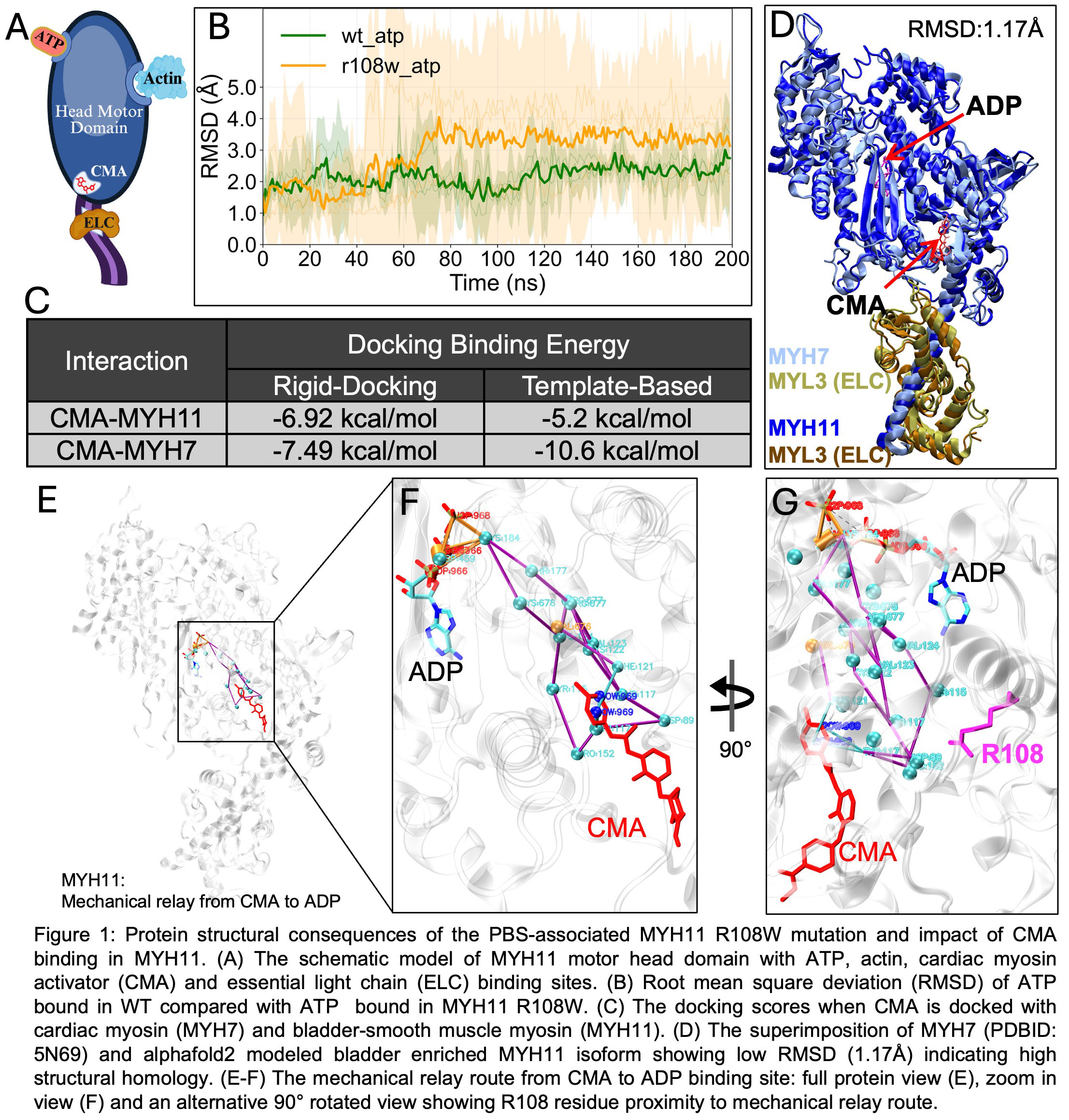
RESULTS:The model (Fig1A) shows the head domain with ATP, Actin, CMA and essential light chain (ELC) binding pockets. ATP-bound R108W exhibited a twofold increase in root mean square deviation (RMSD) compared with WT, indicating reduced stability of ATP binding and impaired catalytic alignment (Fig1B). Analysis of CMA binding to MYH11 demonstrated docking scores comparable to those observed for cardiac MYH7 (Fig1C). Structural comparison further revealed a high degree of homology between MYH11 and MYH7 (Fig1D), supporting the potential feasibility of CMA interactions with MYH11. Notably, the MYH11-ADP+P
i+CMA complex sampled a deeper binding pocket conformation relative to MYH7 and exhibited a potential mechanical relay linking CMA-associated allosteric interactions to the ADP-binding region, suggesting long-range propagation of structural signals from the allosteric pocket to the active site (Fig1E-F).
CONCLUSIONS:There are protein structural consequences of the PBS-associated MYH11 R108W mutation, altering ATP-binding dynamics and disrupting myosin motor function. By in silico trialing the cardiac drug CMA, we found CMA interacts with detrusor MYH11, modulating ATP-binding and MYH11 R108 interacting amino acids. Collectively, in patient-specific MYH11 mutations, MDS can explain the PBS bladder dysfunction and the cardiomyopathy drug CMA is a viable option for repurposing to target detrusor smooth muscle underactivity. Grants:NIH-R01DK100483,DK127589,AUA/UCF,NCH-OTA
Back to 2026 Abstracts


