Back to 2026 Abstracts
Antibiotic route shapes the urinary microbiome more than dose or duration in patients with spina bifida
Vijay K. Rings, MD1, Miozzottys Perez Rosario, BS1, Lauren E. Corona, MD1, Alexandra Borden, MPAS2, Maryellen S. Kelly, DNP, MHSc2, Douglass B. Clayton, MD1, Maria Hadjifrangiskou, PhD1, Brendan T. Frainey, MD1.
1Vanderbilt University Medical Center, Nashville, TN, USA, 2Duke Children's Health Center, Durham, NC, USA.
BACKGROUND: Distinguishing clinical urinary tract infections (UTI) from asymptomatic bacteriuria in individuals with spina bifida (SB) remains challenging, often leading to antibiotic overtreatment. The impact of repeated antibiotic exposure on urinary and fecal microbiomes in patients with SB is poorly understood. Therefore, we evaluated the impact of antibiotic exposure timing, route, and duration on urinary and fecal microbiome diversity in patients with SB, hypothesizing that recent, systemic, and longer durations of antibiotic exposure would be associated with reduced diversity.
METHODS: Patients with SB were prospectively enrolled from 10/2023 to 5/2026 from two institutions. Catheterized urine and stool samples were obtained during routine urodynamic testing or immediately after birth. Samples underwent 16S rRNA amplicon sequencing and reads were bioinformatically decontaminated prior to analysis. Antibiotic exposure was abstracted via chart review, categorized by recency (30-day, 6-month history), route (oral, intravenous, intravesical, mixed), and dose (treatment vs. low-dose, daily prophylaxis), and quantified in cumulative treatment-days. Microbial alpha (within-sample) diversity was evaluated using the Shannon index, and beta (between-sample) diversity was evaluated with Bray-Curtis dissimilarity. Diversities were compared across antibiotic exposures and correlated with cumulative antibiotic treatment-days stratified by recency. Genus-level compositional differences across exposure groups were assessed using relative abundance profiles from urine samples.
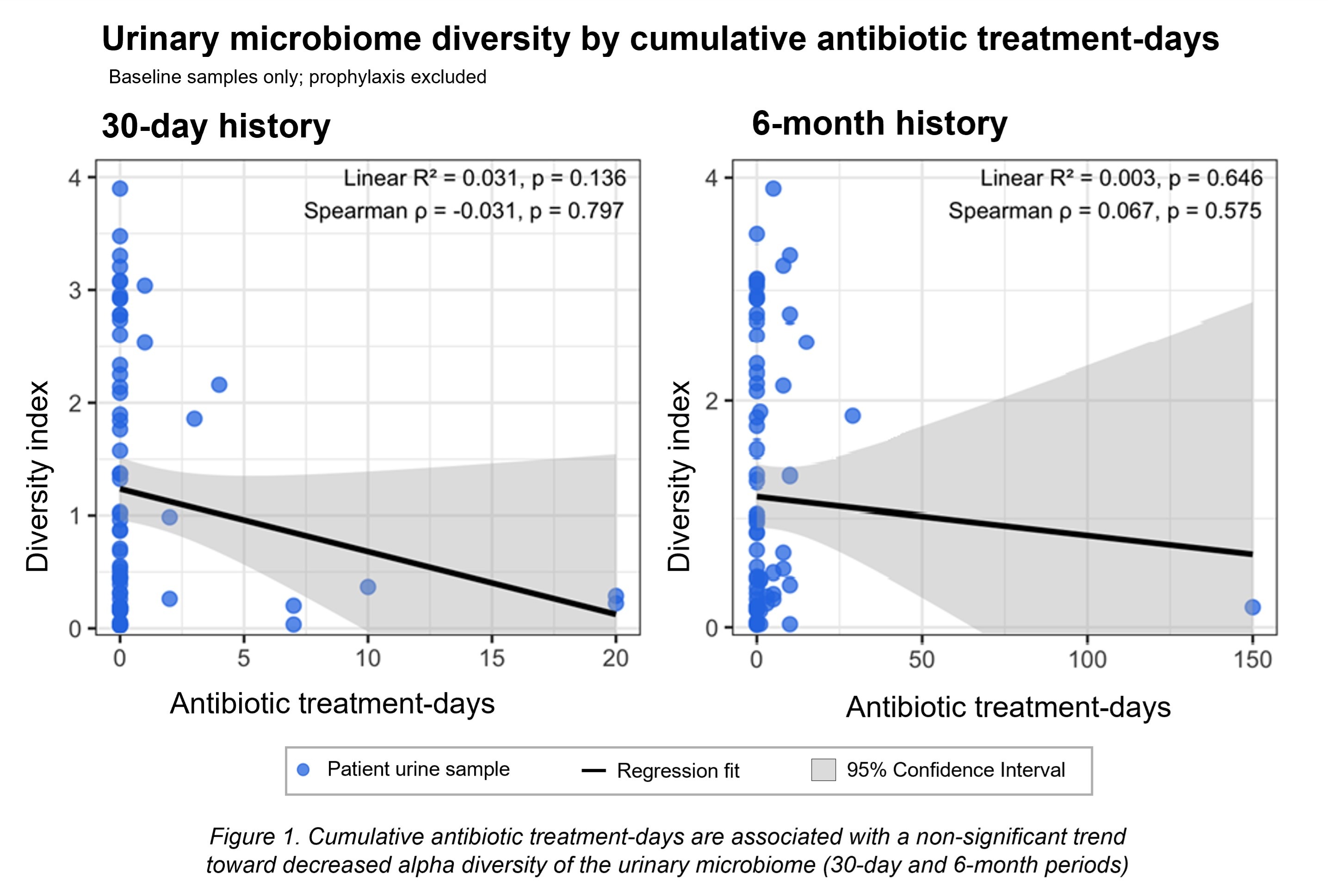
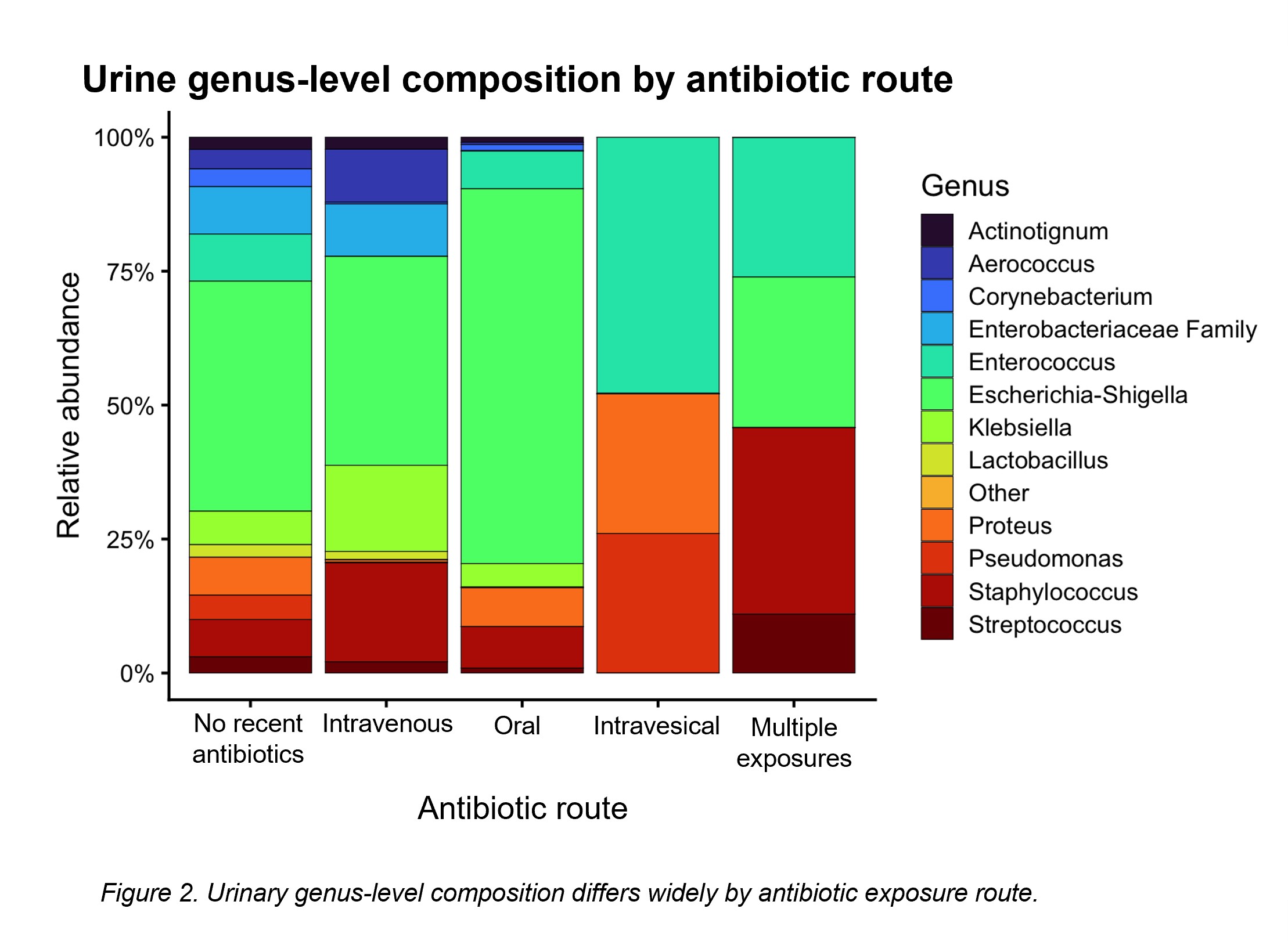
RESULTS: We enrolled 110 patients with a mean age of 7.37 (range 0-20.10) years. Fifty-eight (52.7%) subjects were male, and 63 (57.3%) used clean intermittent catheterization. Thirty-three (30.0%) received antibiotics within 30 days prior to samples and 52 (47.3%) within 6 months; 12 (10.8%) were on oral prophylaxis and 7 (6.3%) on intravesical prophylaxis. Antibiotic route in either recency window showed no significant impact on urinary/fecal alpha (urine p=0.48, stool p=0.8) or beta diversity (urine PERMANOVA R²=0.14, p=0.21; stool R²=0.13, p=0.27). Dose (treatment vs. prophylaxis) showed no impact on microbiome diversity. Cumulative antibiotic treatment-days displayed a non-significant, negative trend in urine alpha diversity in both recency windows (Figure 1). Notably, urinary genus-level composition showed Escherichia-Shigella generally predominated urine microbiomes but with highly variable abundance between antibiotic routes (Figure 2). Oral antibiotic exposure produced a near-monomicrobial Escherichia-Shigella profile (~80%), and intravesical exposure introduced a distinctive Enterococcus (~50%), Pseudomonas (~25%), and Proteus (~25%) profile, whereas patients without recent exposure retained a diverse, balanced community of Escherichia-Shigella, Klebsiella, Staphylococcus, and Lactobacillus.
CONCLUSIONS: In this SB cohort, recent antibiotic exposure, including prophylaxis, showed shifts in urinary genus-level composition. Antibiotic route comparisons showed strikingly distinct urinary microbiome profiles: oral exposure produced near-monomicrobial Escherichia-Shigella, intravesical exposure selected for Enterococcus, Pseudomonas, and Proteus spp., and no recent exposure preserved genus-rich profiles. Findings suggest that antibiotic route and, potentially to a lesser extent, duration, shape the urinary microbiome. Larger longitudinal cohorts are needed to link these compositional patterns to UTI risk and development of antimicrobial resistance.
Back to 2026 Abstracts


