Back to 2026 Abstracts
Early-Life Inflammation Alters Locus Coeruleus Neuronal Activity and Voiding Behavior in Adult Female Mice
Pragatee Narain, BS, Stephan Butler, BS, MS, Niser Babiker, BS, Joanna Fesi, BS, Amelia Eisch, PhD, Sanghee Yun, PhD, Stephen Zderic, MD.
Children's Hospital of Philadelphia, Philadelphia, PA, USA.
BACKGROUND: Lower urinary tract symptoms (LUTS), including urgency urinary incontinence and increased voiding frequency, affect a significant proportion of females across the lifespan. Survey studies suggest that early-life urological insults, including urinary tract infections and associated bladder inflammation, increase the risk of LUTS in later life. Pediatric urologists frequently encounter patients who describe voiding dysfunction characterized by sudden, overwhelming urgency with no antecedent warning, a pattern that is distinct from the graduated awareness of bladder filling that normally precedes micturition. Despite this well-described clinical phenotype, the brain-bladder mechanisms linking early-life inflammatory events to adult voiding dysfunction remain poorly understood. The Locus Coeruleus (LC), the brain's primary source of norepinephrine, activates 10 to 30 seconds before voiding and coordinates the behavioral transition from non-voiding to voiding in rodents. Bladder outlet obstruction has been shown to persistently elevate LC activity and increase voiding frequency in adult rats, yet whether early-life inflammatory insult produces lasting LC dysregulation has not been examined. We asked whether neonatal cyclophosphamide (CYP) exposure alters LC noradrenergic activity around voiding events in adult female mice. We hypothesized that CYP exposure would compress the window of antecedent LC activation into the final seconds before voiding.
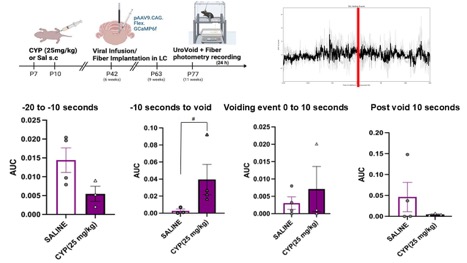
METHODS: TH-Cre female mice received subcutaneous CYP (25 mg/kg) or saline on postnatal days 7 and 10. At 6 weeks, mice underwent stereotactically guided injection of the calcium indicator pAAV9.CAG.Flex.GCaMP6f into the LC, followed by fiberoptic probe implantation at 9 weeks. At 11 weeks, voiding behavior and LC calcium dynamics were recorded simultaneously over 24 hours using the UroVoid system paired with fiber photometry in awake, freely moving animals. GCaMP6f emission spectra were analyzed in MATLAB and summarized as area under the curve (AUC) across a 120-second window centered around each voiding event (Figure 1 upper right panel).
RESULTS: As shown in Figure 1, from 20 to 10 seconds ahead of a voiding event, the AUC was higher in the saline controls. In sharp contrast these AUC patterns were reversed in the 10 seconds leading up to a voiding event with a higher AUC recorded for the CYP exposed mice. The AUC remained higher during the 10 second voiding event for the CYP group, and was reversed in the post void phase though these changes did not attain significance.
CONCLUSIONS:These findings demonstrate that early-life bladder inflammation produces lasting shifts in LC activation timing in adult females. The compressed antecedent window mirrors the sudden-onset incontinence episodes described clinically by patients who report no impending warning prior to the voiding event. This data supports LC TH+ neurons as a potential therapeutic target for LUTS.
Back to 2026 Abstracts


