Back to 2026 Abstracts
Pilot Cohort Trial of the WYSH Digital Health Intervention for Hypospadias: Acceptability and Feasibility for Improving Longitudinal Care
Vinaya Pavithra Bhatia, MD, Haley Lange, BS, Diana Gutierrez-Meza, MPH, Caitlyn McQuiston-Keil, BS, Kristin Ebert, MD, Shannon Cannon, MD, Jennika Finup, DNP, Esra Alagoz, PhD.
University of Wisconsin, Madison, WI, USA.
IntroductionHypospadias repair requires lifelong monitoring and follow-up for functional and psychosexual complications. However, clinicians lack infrastructure or guidelines to provide follow-up plans for hypospadias patients, and attrition from care is high at 40-88%. We developed the Worldwide Yearly Screening for Hypospadias (WYSH) web application to fill this unmet need within pediatric urology. In the WYSH tool, patients (or parents if < 15 years old) complete a screening measure with in-application interpretation of scores to deliver tailored care recommendations, a summary of recommended follow-up appointments, questions to ask at appointments, and reference material on expected outcomes after repair. We conducted usability, feasibility and acceptability testing of our proposed intervention to improve communication and follow-up care in hypospadias.
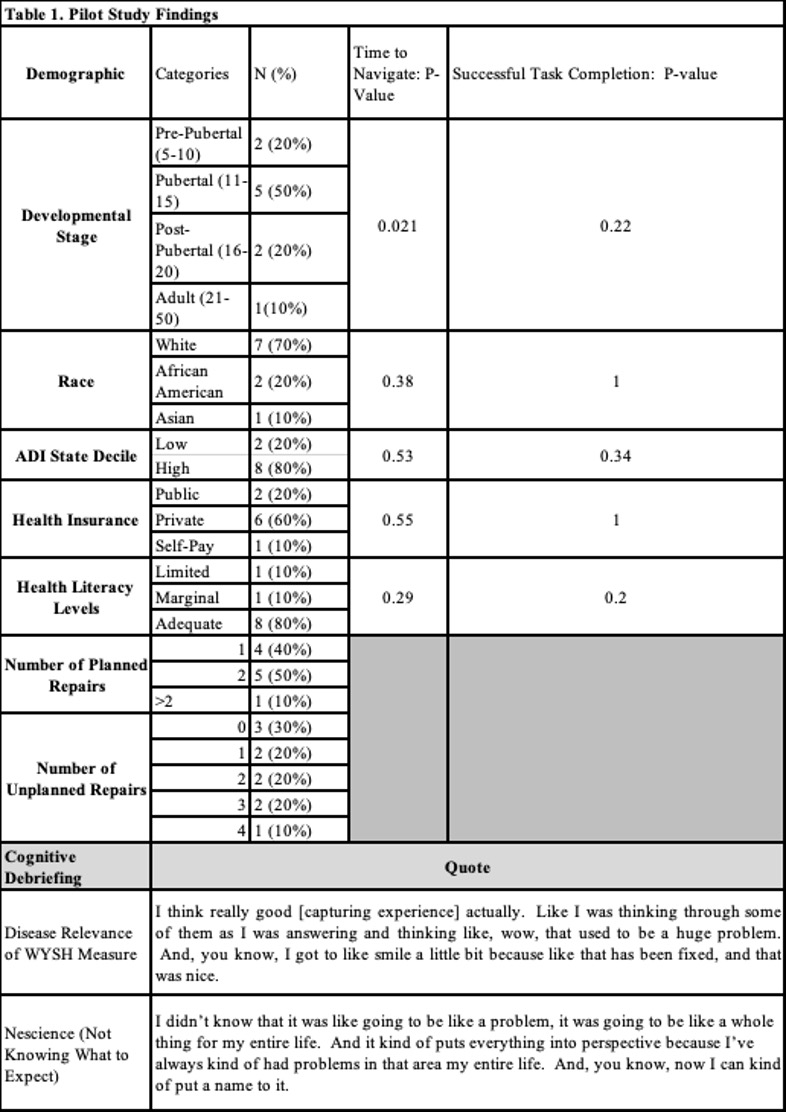
MethodsWe conducted a prospective cohort trial of The WYSH application. Utilizing purposive sampling, we recruited participants fitting our preset age-appropriate characteristics. The WYSH application is built around a Likert-Scale screening measure that is adapted for developmental stage -pre-pubertal, pubertal, post-pubertal, adult patients (Table 1). Qualitative assessment of acceptability and feasibility was performed using cognitive debriefing interviews to explore patient’s experiences with the WYSH measure and application navigation. Probes were modified based on early interviews and the screening measure was iteratively revised until thematic saturation was achieved. We utilized a hybrid deductive-inductive thematic analysis based on the four-stage model of Roger Tourangeau to complete data analysis. Quantitative assessments included time to navigate the application, task success, and participant-reported difficulty of tasks (system usability scale, 1-7). Non-parametric tests and Fisher’s exact analyses were used to assess group differences based on metrics of socioeconomic deprivation and health literacy, with p<0.05 considered significant.
ResultsAll patients spoke English and none identified as Hispanic. Across demographic and health literacy categories (Table 1), WYSH has surpassed feasibility and acceptability thresholds set prior to testing (Table 1). Mean time to complete tasks within the application was 80 seconds; the screening measure took an average of 6.4 minutes (range 2.33 minutes to 12 minutes), and 91% of tasks were completed correctly. Patients reported high ease of use on system usability scales (Median 6.38/7, range 4.78-6.88). Completion of the tool was quantitatively feasible and acceptable to patients regardless of prior health literacy, developmental stage, or access to care. Preliminary results, through ten comprehensive one-hour interviews, have returned themes of age-related screening adjustments and nescience (Table 1), as well as adaption of self-report vs proxy-report in pubescents, to support patients with hypospadias complications and post-surgical care needs.
Conclusions The WYSH application for hypospadias care demonstrated high feasibility and acceptability for longitudinal care delivery in hypospadias. Our next stage will include a clinical trial for effectiveness for improving communication and preventing attrition from care when compared to standard counseling.
Back to 2026 Abstracts


