Back to 2026 Abstracts
Sleep Deprivation Induces Voiding Dysfunction in Female Mice
Eleanor Burton, BS, Stephan Butler, BS, MS, Joanna Fesi, BS, Jason Van Batavia, MD, Amelia Eisch, PhD, Sanghee Yun, PhD, Stephen Zderic, MD.
Children's Hospital of Philadelphia, Philadelphia, PA, USA.
BACKGROUND: Lower urinary tract symptoms (LUTS), including urinary urgency, increased voiding frequency, and nocturia, affect up to 40% of adult women. LUTS is strongly associated with sleep disturbance and chronic stress in epidemiological studies. Activation of corticotropin-releasing hormone (CRH) signaling in Barrington’s nucleus, a pontine micturition center, has been implicated in stress-induced bladder overactivity in male rodents. Whether similar mechanisms operate in females is unknown, and the mechanistic relationship between chronic stress and female voiding dysfunction remains poorly understood. Existing preclinical models of stress-induced voiding dysfunction have been established primarily in male mice and have not been extended to females. We therefore asked whether sleep deprivation, as a model of chronic stress, is sufficient to induce voiding dysfunction in female mice, hypothesizing that it would produce significant alterations in voiding behavior accompanied by structural changes in the bladder.
METHODS: Female mice (n=7/group) were subjected to sleep deprivation by placement in cages with bedding removed and 8 mm of water on the floor during the light cycle (8am to 4pm) and returned to the home cage, 5 days per week for 2 weeks. Controls were placed in identical cages with bedding removed but without water during the light cycle. Voiding frequency and voided volumes were assessed using the UroVoid system over a 48-hour observation period following 2 weeks of sleep deprivation. Detrusor muscle strip contractility in response to electrical field stimulation (EFS) and KCl was measured. CRH mRNA expression in Barrington’s nucleus (BN) was quanitified by fluorescence in situ hybridization (FISH). Data are presented as mean ± SD; significance was determined by t-test.
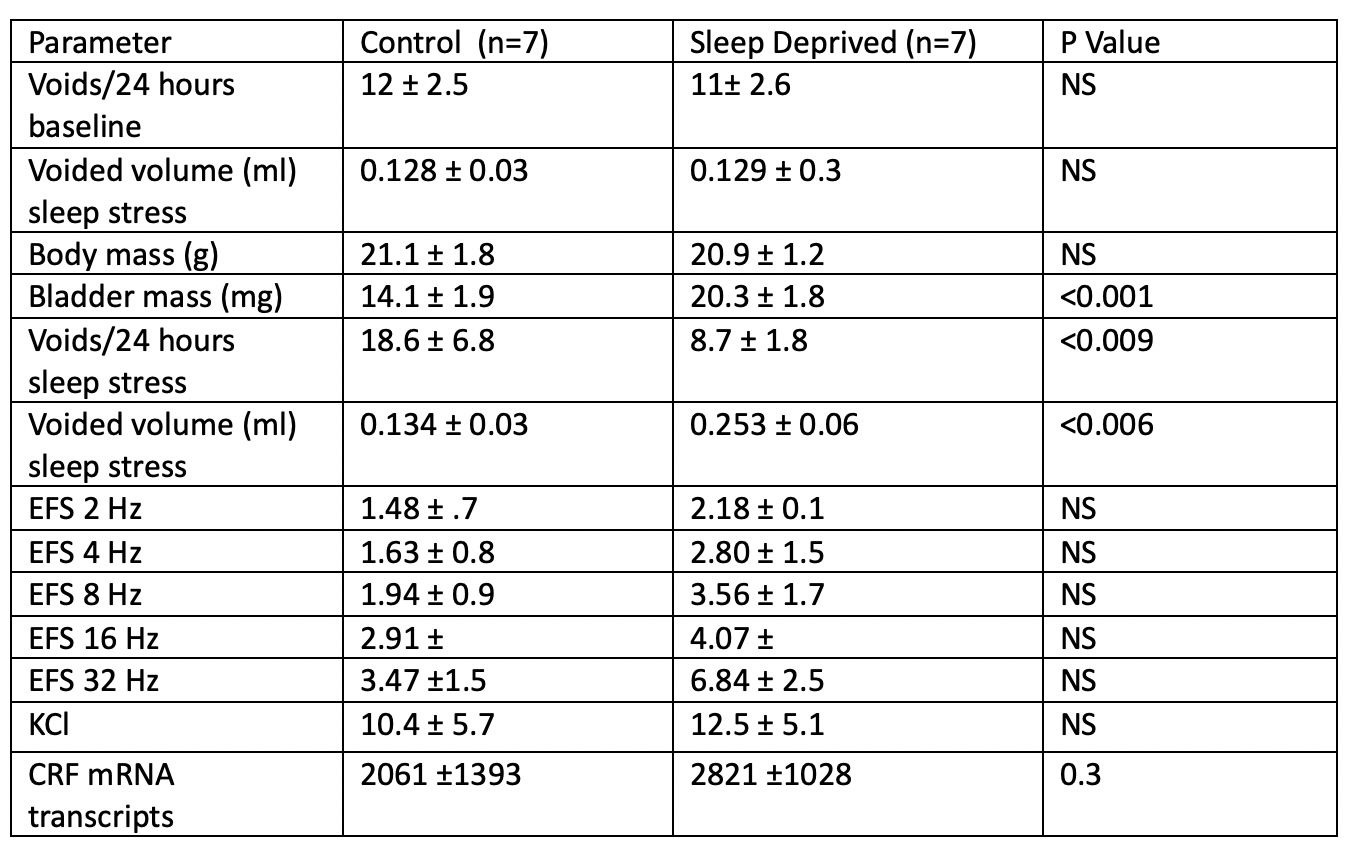
RESULTS: Following 2 weeks of sleep deprivation, body weight did not differ between groups. Bladder mass was significantly elevated in sleep-deprived mice, voiding frequency was significantly reduced, and voided volumes were significantly increased compared to control group (Table 1). Detrusor muscle strips trended toward greater force generation at all EFS frequencies in the sleep-deprived cohort, but these differences did not reach significance. CRH mRNA expression in Barrington’s nucleus (BN) did not differ between groups.
CONCLUSIONS:Our results indicate that sleep deprivation induced a significant shift in the voiding phenotype of female mice, accompanied by bladder hypertrophy, without changes in body mass. The absence of CRH upregulation in Barrington’s nucleus indicates this model operates through mechanisms distinct from the chonic social stress model in male mice. This model provides a reproducible, sex-appropriate preclinical model for investigating the relationship between chronic stress and voiding dysfunction in females.
Back to 2026 Abstracts


