Back to 2026 Abstracts
Differentiation of Human iPSCs into Bladder Smooth Muscle Cells
Karunya Albert, M.Sc., Ph.D, Chaitrali Atre, M.S., Cintia E. Gomez Limia, Ph.D, Linda A. Baker, M.D, Nathalia G. Amado, M.S., Ph.D.
Nationwide children's hospital, Columbus, OH, USA.
BACKGROUND: Induced pluripotent stem cell (iPSC) technology has transformed disease modeling by enabling generation of patient-specific cell lines for studying human disease. This approach offers a unique opportunity to model congenital bladder disorders using patient-derived cells and to investigate disease mechanisms. However, a major challenge in modeling detrusor underactivity disorders is the lack of robust and well-established protocols for generating bladder-specific smooth muscle cells (bSMCs). Existing differentiation n strategies predominantly yield generalized vascular SMCs but not bSMC. This limitation has hindered the development of physiologically relevant human models for congenital disorders associated with detrusor dysfunction. Therefore, establishing reliable protocols for generating bSMCs from patient-derived iPSCs represents a critical unmet need and would provide a powerful platform for investigating disease mechanisms, identifying pathogenic pathways, and developing targeted therapeutic strategies.
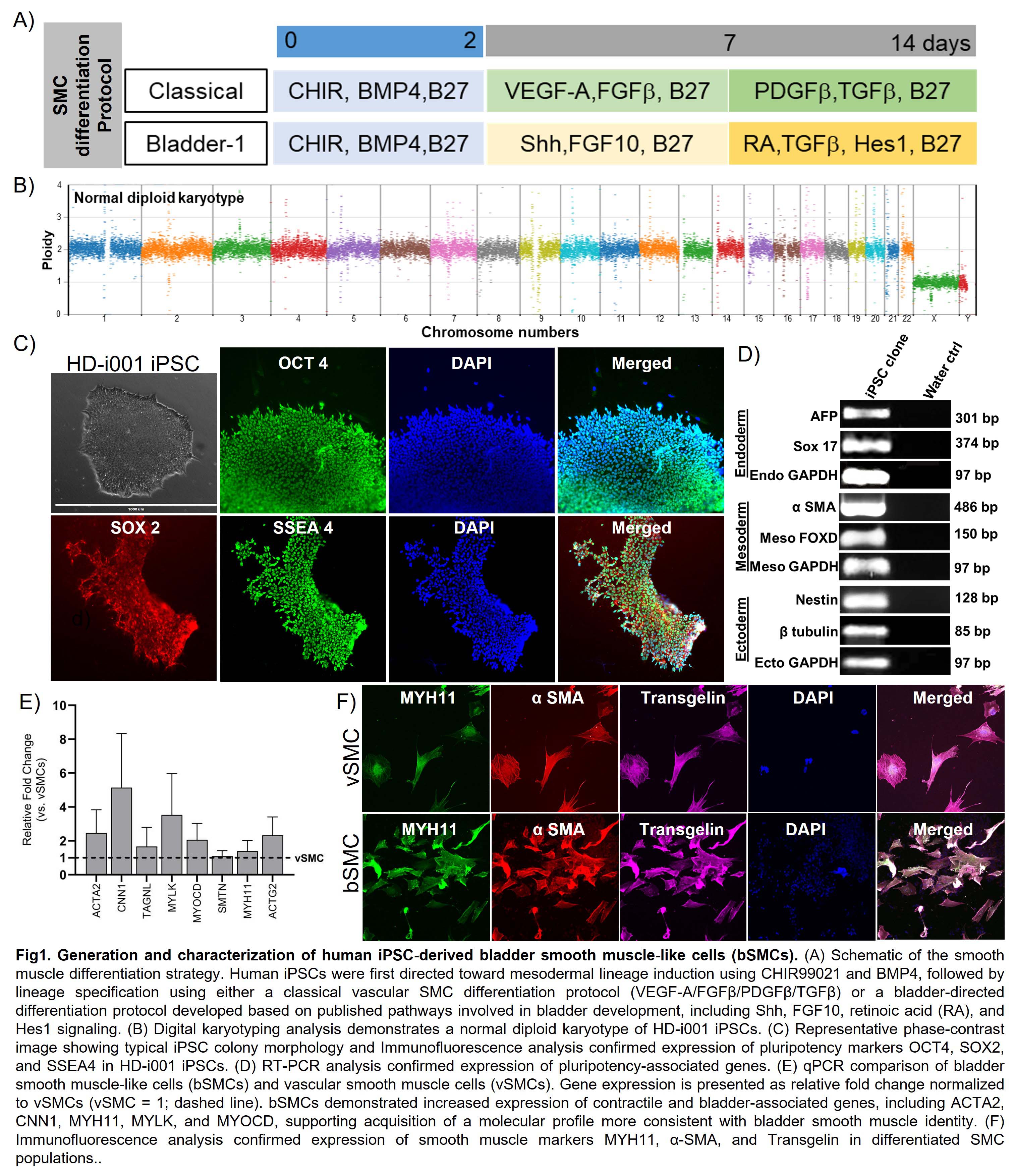
METHODS:Following Institutional Review Board (IRB) approval, skin biopsies from a healthy donor (HD) were used for fibroblast isolation and reprogramming into iPSCs using an integration-free Sendai virus system. Pluripotency, germ layer differentiation, cell identity, and genomic integrity were validated by RT-PCR, immunofluorescence (IF), STR analysis, and karyotyping. Differentiation into bSMC and vascular smooth muscle cells (vSMCs) was assessed by qPCR and IF for SMC markers. Based on published studies describing key gene regulatory pathways, growth factors, and transcription factors involved in bladder development, we developed a bladder-directed differentiation protocol and compared its performance with conventional vascular SMC differentiation approaches (Fig1A).
RESULTS:The identity and genomic integrity of HD-i001 iPSCs were confirmed by STR analysis and digital karyotyping (Fig1B). HD-i001 cells exhibited typical iPSC colony morphology and expressed pluripotency markers (OCT3/4, SOX2, and SSEA-4) (Fig1C). Trilineage differentiation into ectoderm, mesoderm, and endoderm was verified by immunofluorescence (IF) and RT-PCR, confirming bona fide iPSC status (Fig1D). qPCR (Fig1F) and IF (Fig1G) analyses confirmed successful differentiation of HD-i001 iPSCs into SMCs in triplicate. Both vSMCs and bSMCs expressed canonical SMC markers, consistent with acquisition of a SMC phenotype. Notably, bSMCs showed increased expression of several SMC bladder-enriched genes compared with vSMCs, including MYOCD (105%), MYH11 (39%), TAGLN (66%), CNN1 (414%), and ACTA2 (147%). The enrichment of MYOCD, a key regulator of bladder SMC development and differentiation, together with increased expression of contractile genes, is consistent with the specialized contractile program of bladder detrusor smooth muscle.
CONCLUSIONS:We successfully generated HD-i001 iPSCs from skin fibroblasts and differentiated them into bSMCs, establishing a novel human platform for modeling detrusor biology. Although additional studies are required to further validate the model and determine the extent to which these cells recapitulate the molecular and functional properties of native bladder SMC, these findings represent an important first step. This platform provides a valuable opportunity to investigate the mechanisms underlying detrusor smooth muscle dysfunction and may facilitate identification of novel molecular pathways and therapeutic targets aimed at improving bladder function and long-term renal outcomes in patients with detrusor underactivity disorders.
Back to 2026 Abstracts


