Back to 2026 Abstracts
Serotonergic Link Between Bladder, Bowel, and Anxiety-Like Behaviors: Evidence from Male Sert Knockout Mice
Marcela Ambrogi, Postdoctoral1, Laura Hernandez, PhD1, Kimberly K. Stietz, PhD1, Tamryn Jordan, PhD student1, Jennika L. Finup, MSN1, Vinaya Bhatia, MD1, Kristin Ebert, MD1, Shannon Cannon, MD1, Tayler Garvey, NP1, Brooke Schimit, Student1, Chad Vezina, PhD1, Walid Farhat, MD2.
1University of Wisconsin, Madison, WI, USA, 2Nemours Children's Health, Jacksonville, FL, USA.
BACKGROUNDBladder and bowel dysfunction (BBD) is a common and clinically challenging condition in pediatric urology, frequently presenting with lower urinary tract symptoms, constipation, recurrent urinary tract infections, and behavioral comorbidities. Serotonin (5-HT), largely produced in the gut and regulated by the serotonin transporter (SERT), plays key roles in urinary function, gastrointestinal motility, and neuropsychiatric regulation. However, the relationship between BBD, 5-HT signaling, and SERT remains poorly understood. This study examines the impact of SERT deletion on urinary, bowel, and behavioral phenotypes using a murine model (
Sert -/-) relevant to pediatric BBD.
METHODSUrinary function was evaluated in male
Sert -/-,
Sert heterozygous (+/-), and wild type (WT) mice (n = 8 -12/group, 6–7 weeks of age) using uroflowmetry and voiding spot assay (VSA). For uroflowmetry, mice were placed in chambers for 4 hours with access to water only, and urination and defecation events were recorded using video capture. For VSA, mice were placed individually in cages containing chromatography paper for 4 hours with access to food only. Anxiety-like behavior was assessed using the open field test and elevated plus maze. Statistical analysis was performed using one-way analysis of variance (ANOVA). Bladder, prostate, and intestinal tissues were collected for Hematoxylin and Eosin (H&E) staining.
RESULTSMale
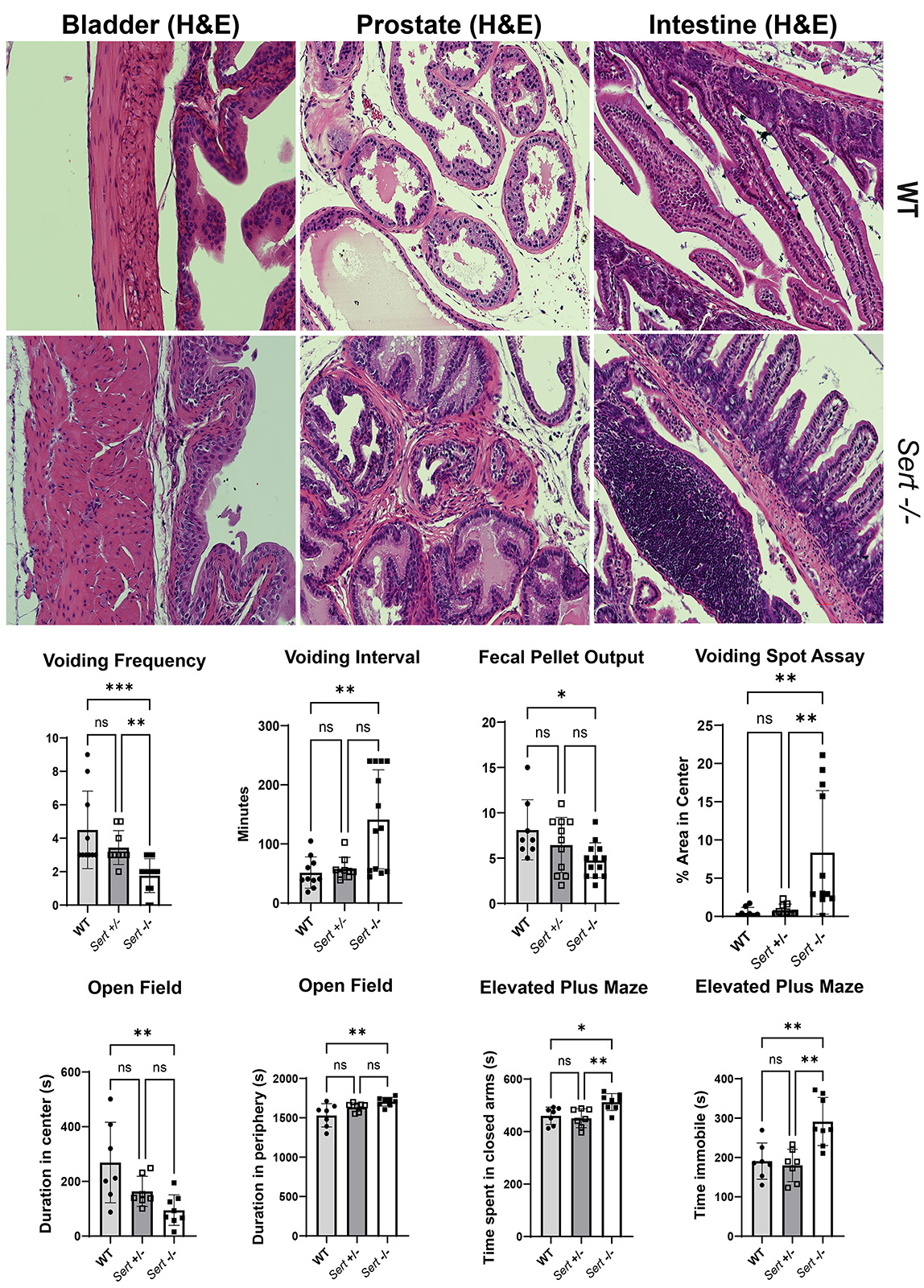
Sert -/- mice exhibited reduced urinary frequency (p = 0.0002) and fecal pellet output (p = 0.032), along with prolonged intervoid intervals (p = 0.0074), compared to WT and
Sert +/- mice. Total void counts in the VSA did not differ between groups (p = 0.6), however
, Sert -/- mice showed more urine spots in the center of the cage (p = 0.0029). In behavioral testing,
Sert -/- mice spent more time in the periphery (p = 0.007) and less time in the center of the open field (p = 0.007), showed increased immobility (p = 0.0006), and spent more time in the closed arms of the elevated plus maze (p = 0.004), consistent with increased anxiety-like behavior. Preliminary histological observations (n=2) suggest increased detrusor smooth muscle thickness in the bladder and prostate, as well as increased intestinal smooth muscle thickness in
Sert -/- mice, accompanied by evidence of tissue inflammation.
CONCLUSIONSSERT deletion produces coordinated urinary, bowel, and behavioral abnormalities that parallel key clinical features of pediatric bladder and bowel dysfunction, including impaired emptying patterns and anxiety associated behaviors. Associated smooth muscle changes with inflammation suggest a biologic link between serotonergic dysregulation and BBD pathophysiology. These findings support serotonergic pathways as a potential translational target in children with refractory or behaviorally complex BBD.
Back to 2026 Abstracts


