Back to 2026 Abstracts
Venting Distal Cutaneous Ureterostomy with Proximal Uretero-ureterostomy or Uretero-vesicostomy for Urinary Tract Reconstruction at the Time of Pediatric Kidney Transplantation in Children with Diminutive Bladders
Mandy Rickard, MN, NP, Kay Riviera, MD, Joana Dos Santos, MD, Ashlene McKay, MD, Nithiakishna Selvathesan, MD, Chia Wei Teoh, MD, Armando J. Lorenzo, MD.
SickKids, Toronto, ON, Canada.
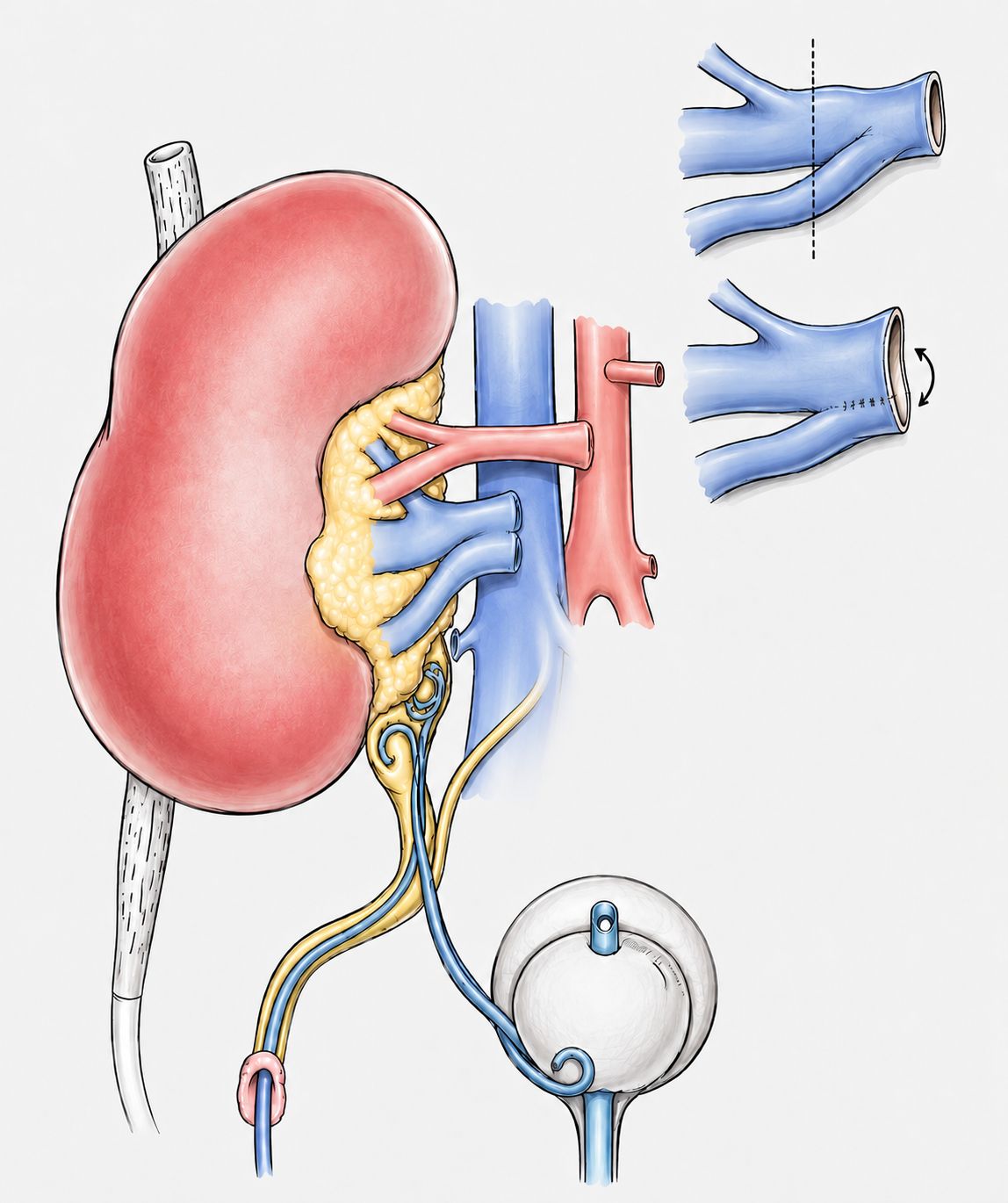
BACKGROUND: With advances in prenatal and postnatal care, a growing number of children with end-stage kidney disease and complex lower urinary tract dysfunction are being considered for transplantation. In children with small, high-pressure bladders, standard ureteral reimplantation can lead to early allograft deterioration, while major reconstruction with bowel segments commits the child to lifelong catheterization and the well-described complications of augmentation cystoplasty. We describe our institutional experience with a novel strategy: a venting cutaneous ureterostomy (VCU) distal to a side-to-side anastomosis between the donor and native ureter or bladder at the time of pediatric kidney transplantation, designed to provide a pressure pop-off while natural bladder cycling and rehabilitation are pursued.
METHODS: Single-centre retrospective series (2019-2025). The technique consists of a side-to-side anastomosis of the donor ureter to the native ureter or bladder, with externalization of the distal donor ureter as a cutaneous stoma (Figure 1). The procedure was offered to patients who would otherwise have required delayed transplantation, a conventional ureterostomy with later reconstruction, or pre-emptive augmentation cystoplasty. Concurrent bladder rehabilitation was pursued with anticholinergics, botulinum toxin injection, and clean intermittent catheterization, as tolerated.
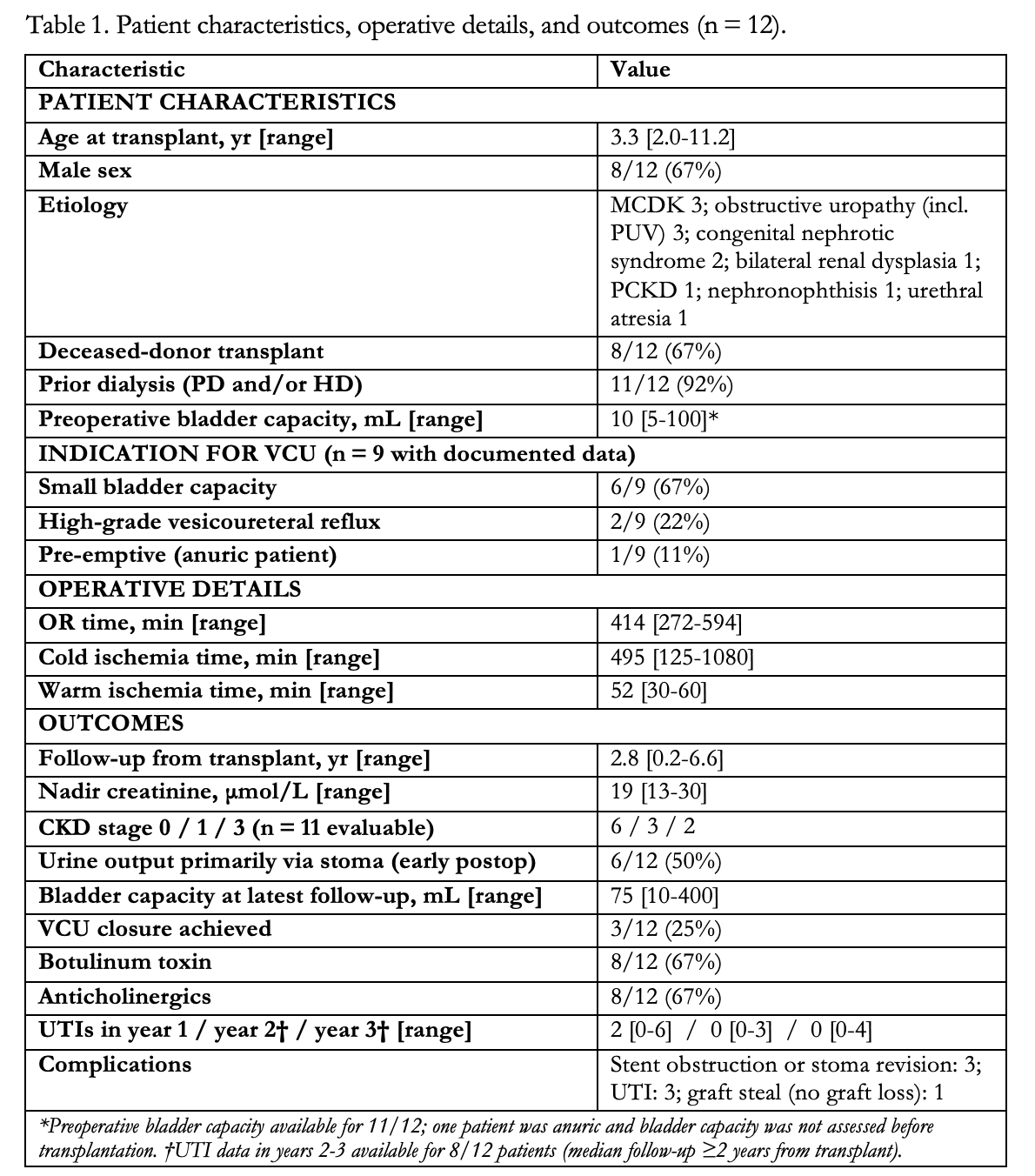
RESULTS: Twelve patients underwent VCU (8M:4F; median age at transplant 3.3 years [2.0-11.2]). Etiologies included MCDK (n=3), obstructive uropathy/PUV (n=3), congenital nephrotic syndrome with prior nephrectomies (n=2), bilateral renal dysplasia (n=1), PCKD (n=1), nephronophthisis (n=1), and urethral atresia (n=1). Eight patients received deceased-donor grafts, and 11/12 had been on dialysis prior to transplantation. Median preoperative bladder capacity was 10 mL [5-100] (Table 1). All grafts remain functional at a median follow-up of 2.8 years [0.2-6.6]. Median nadir creatinine was 19 μmol/L [13-30]; at last follow-up, CKD stage among 11 evaluable patients was 0 in 6, 1 in 3, and 3 in 2. In 6/12 patients, urine drained primarily via the stoma in the early postoperative period. VCU closure was achieved in 3/12. Bladder capacity improved from a median of 10 mL preoperatively to 75 mL at latest follow-up (Figure 2); 8/12 received botulinum toxin and 8/12 anticholinergics. UTI burden was highest in the first year (median 2 [0-6]) and declined thereafter (median 0).
CONCLUSIONS:VCU is a feasible technique for protecting the allograft in pediatric kidney transplant recipients with complex lower urinary tract dysfunction. It enables concurrent bladder rehabilitation while maintaining excellent graft function, and stoma closure is achievable in patients who respond. UTI burden is modest and declines over time. Larger series with longer follow-up are needed to define optimal closure timing and predictors of successful bladder rehabilitation.
Back to 2026 Abstracts


