Back to 2026 Abstracts
The Prevalence and Risk Factors for Priapism Among Children with Sickle Cell Disease
Mohammed Adel Alfawzan, MD1, Parul Rai, MD2, Yunus Olufadi, PhD2, Guolian Kang, PhD2, Clifford Takemoto, MD2, Mohamed Soltan, MD1, Dana W. Giel, MD1, Mary E. Killian, MD, EMBA1.
1University of Tennessee Health Science Center, Memphis, TN, USA, 2St. Jude Children's Research Hospital, Memphis, TN, USA.
BACKGROUND: Priapism, a painful, persistent erection unrelated to sexual stimulation, is a significant complication of sickle cell disease (SCD). Priapism is common in adults, however, reported prevalence in the pediatric population varies widely, likely due to underreporting, reporting bias, and varied research methodologies. All of these reasons prompt the need for further review allowing better diagnosis and treatment.
METHODS: A retrospective cohort study included a total of 464 males with SCD (Age: 2-18 years old) from St. Jude Children's Research Hospital who were enrolled in the Sickle Cell Clinical Research and Intervention Program (SCCRIP, NCT02098863). Cases of priapism were identified using ICD-9 and ICD-10 codes along with language modeling algorithm. We conducted a 1:3 age-matched case-control study to compare patients with priapism to those without. We analyzed demographic characteristics, SCD genotype, treatment history, and hematologic parameters. We also evaluated the association between priapism and the frequency of vaso-occlusive crises (VOC), acute chest syndromes (ACS), pulse oximetry values (O2sat) and tricuspid valve regurgitation peak velocity (TRV). The two-sample t-test or Wilcoxon rank sum test was used to compare quantitative variables and Chi-square test was used to compare categorical variables between cases and controls, respectively. Univariate and multivariate logistic regression identified risk factors, while conditional logistic regression assessed matched data.
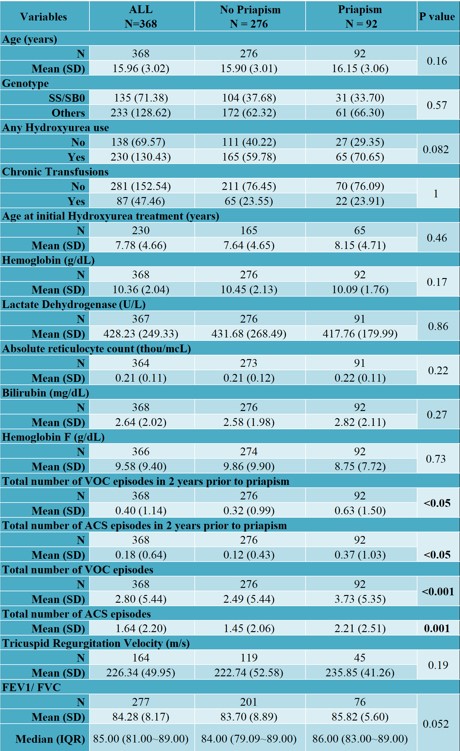
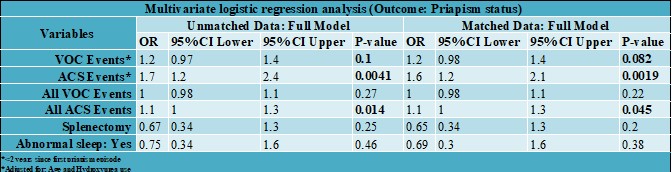
RESULTS: Of the 464 patients, 92 (20%) experienced at least one episode of priapism. Compared to controls, patients with priapism were significantly older (mean age 16.15 vs. 14.06 years, P<0.05), had more frequent VOC (P<0.05) and ACS events (P<0.05). Furthermore, the earlier initiation of hydroxyurea (p=0.003) appeared to protect from having priapism events. However, after matching for age, only a higher number of total VOC and ACS events were significantly associated with priapism (P≤0.05)). No significant associations were found between priapism and the other variables.
CONCLUSIONS: This study demonstrated a significant prevalence of priapism in children with SCD and indicates older age, increased frequency of VOC and ACS events as potential risk factors. These findings highlight the necessity of consistent surveillance for priapism, especially in older children with SCD and a history of recurrent VOC and ACS. Additionally, the role of early exposure of hydroxyurea therapy in preventing development of priapism events needs to be explored further.
Back to 2026 Abstracts


