Back to 2026 Abstracts
Multi-Institutional Validation of the Pyeloplasty Skills Assessment Rubric (PySAR) for Advancement of Competency-based Medical Education in Pediatric Urology
Hailey J. Silverii, MD1, Christy Nguyen, BS1, Tung Sung Tseng, PhD1, Gabrielle Gonzalez, PhD1, Ethan Leoni, BS1, Madelynn Chustz, BS1, Michael Ernst, MD2, Nicolas Fernandez, MD, PhD3.
1Louisiana State University Health Sciences Center, New Orleans, LA, USA, 2Stony Brook University, Stony Brook, NY, USA, 3Seattle Children's Hospital, Seattle, WA, USA.
INTRODUCTION: Competency-based medical education requires valid tools to assess surgical performance and entrustment. Few instruments provide structured, actionable feedback in pediatric urology training. We developed and evaluated the Robot-Assisted Laparoscopic Pyeloplasty Skills Assessment Rubric (PySAR), aiming to establish validity evidence and assess feasibility. MATERIALS AND METHODS:
PySAR was developed using a Delphi process with a 10-member expert panel of surgeon educators, establishing face and content validity. In this IRB-approved, multi-institutional study, faculty-trainee dyads used PySAR pre- and post-operatively to assess performance and provide structured feedback. Collected variables included faculty case experience, trainee postgraduate year (PGY), case complexity (1-10 scale), competency score (0-55), and entrustment score (0-55). Data were analyzed using SAS with descriptive statistics, Pearson correlation coefficients, and multivariable linear regression to evaluate associations between performance metrics and trainee/faculty experience and case complexity. RESULTS:
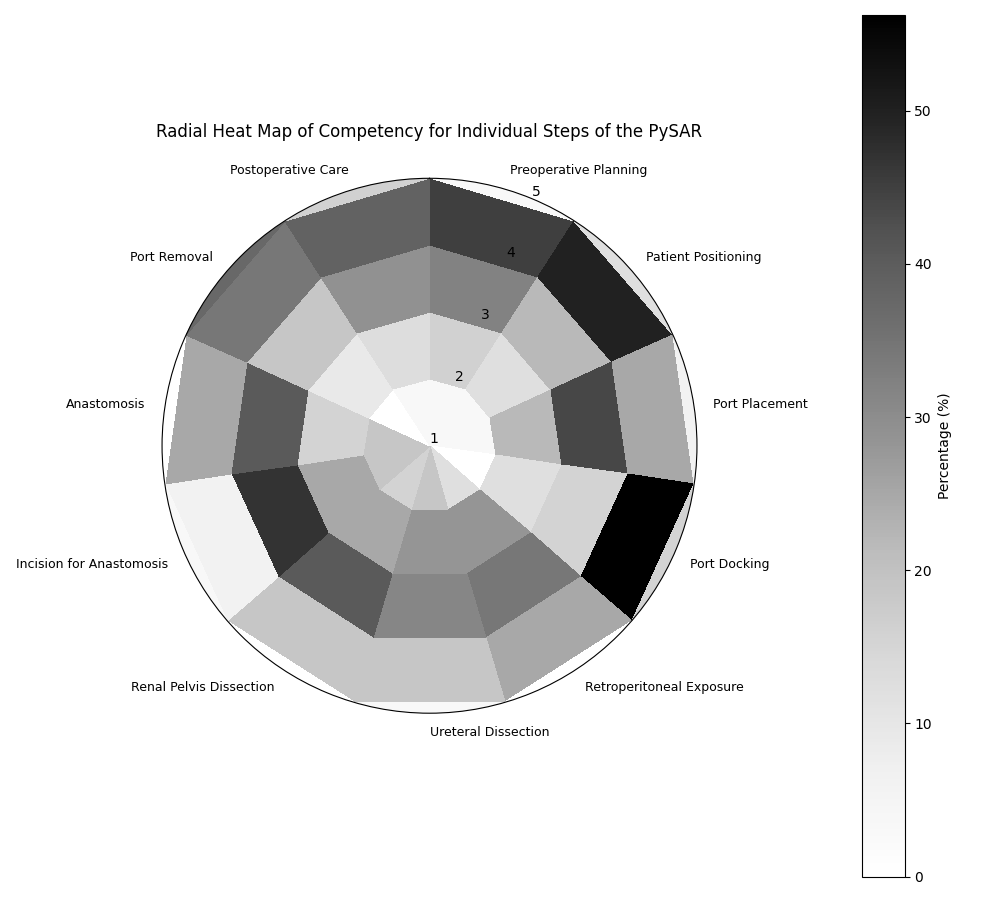
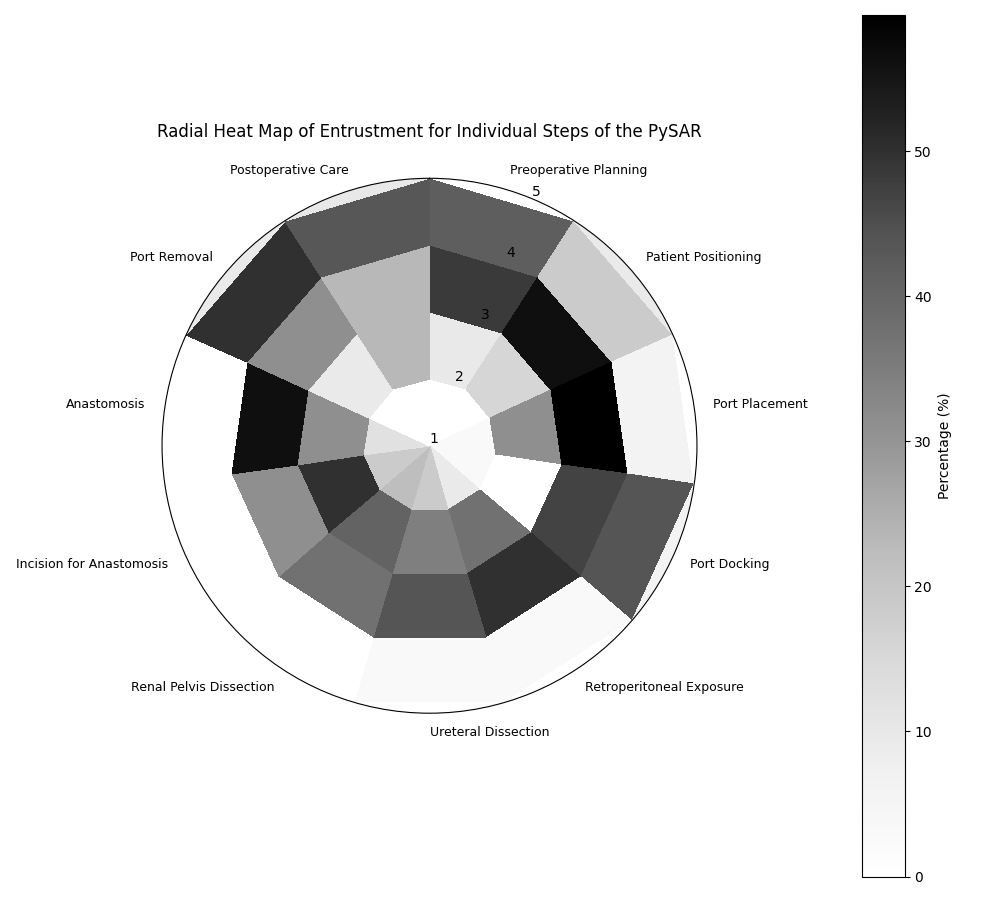
Thirty-two cases were completed across three institutions by six faculty surgeons. Faculty experience ranged from 0-5 to >100 prior cases, with most reporting >41 cases. Trainee PGY level ranged from 3 to 7. Mean competency score was 34.1 ± 8.7 (range 15-47), and mean entrustment score was 30.9 ± 8.7 (range 19-39). See Figures 1 and 2 for illustration of competency and entrustment scores per rubric step. Competency scores correlated significantly with trainee PGY level (r = 0.73, p < 0.001) and case complexity (r = 0.48, p = 0.005), but not with faculty experience (r = 0.31, p = 0.076). Entrustment scores correlated with faculty experience (r = 0.43, p = 0.012) and PGY level (r = 0.39, p = 0.025), but not with case complexity (r = 0.18, p = 0.307). Multivariable models were significant for both competency (R² = 0.64, adj R2=0.60, p < 0.001) and entrustment (R² = 0.36, adj R2=0.30, p = 0.004). Higher PGY level independently predicted greater competency (β = 4.44, p < 0.001) and entrustment (β = 1.86, p = 0.011). Faculty experience independently predicted greater competency (β = 1.21, p=0.018) and higher entrustment scores (β = 1.18, p = 0.005). Case complexity was not a significant predictor in adjusted models. For feasibility, preoperative review occurred in 74.2% of cases and postoperative review in 83.9%, with most encounters lasting under 10 minutes. CONCLUSION:
The PySAR demonstrates strong feasibility and preliminary validity evidence across multiple institutions. Significant associations between competency and entrustment scores with trainee PGY level support construct validity. PySAR provides a structured, time-efficient tool for robotic pyeloplasty assessment and formative feedback to advance competency-based surgical education within the field of pediatric urology.
Back to 2026 Abstracts


