Back to 2026 Abstracts
The Gender Pay Gap in Pediatric Urology
Hannah Agard Bachtel, MD1, Olivia Green, MD2, Grace Powderly, MS3, Michael Ernst, MD4, Benjamin Abelson, MD5, VInaya Bhatia, MD6, Albert Lee, DO7, Belinda Li, MD8, Karmon Janssen, DO9, Campbell Grant, MD10.
1Akron Children's Hospital, Akron, OH, USA, 2Northeast Ohio Medical University, Akron, OH, USA, 3A.T. Still University (ATSU) Kirksville College of Osteopathic Medicine, Kirksville, MO, USA, 4Stony Brook University Hospital, Stony Brook, NY, USA, 5Phoenix Children's Hospital, Phoenix, AZ, USA, 6University of Wisconsin-Madison-UW Kids, Madison, WI, USA, 7UC Davis Medical Center, Sacramento, CA, USA, 8Morgan Stanley Children's Hospital, New York, NY, USA, 9Madigan Army Medical Center, Tacoma, WA, USA, 10University of Kentucky, Lexington, KY, USA.
BACKGROUND: The gender pay gap is pervasive throughout medicine and surgery. Multiple studies show that female surgeons earn less than male surgeons even after accounting for factors like age, specialty, and experience. Urology is no exception, as recent census data from the American Urological Association suggests a significant gender pay gap within urology. The objective of this study was to explore the extent and implications of the gender pay gap within pediatric urology.
METHODS: This analysis includes responses from 222 pediatric urologists to a survey assessing compensation, RVU expectations, clinical FTE, and related clinician and institutional characteristics. RVU targets and base compensation were collected as ranges and summarized as the median (Q1, Q3) of the midpoint of each range. Continuous variables were compared using Wilcoxon rank-sum tests, and categorical variables using chi-square or Fisher’s exact tests, as appropriate. Multivariable linear regression was performed to evaluate independent predictors of compensation.
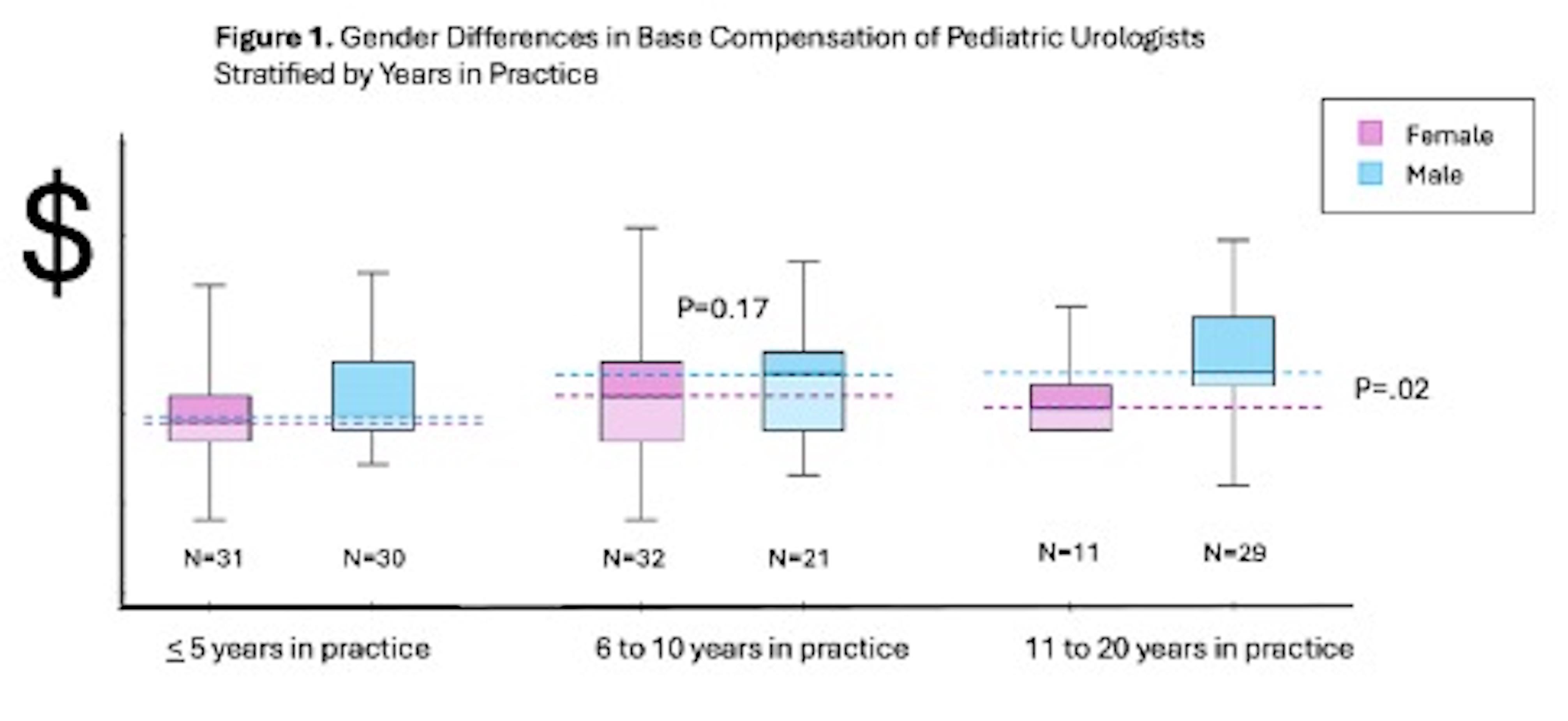
RESULTS: A total of 222 pediatric urologists responded (79 female, 142 male). Female pediatric urologists had fewer years in practice compared to males (median 7 years [5, 10] vs 17 years [7, 28], p < 0.001). Median base compensation was significantly lower among females, with a median salary $87,500 less than males (p=.003). There were no differences between genders in RVU targets, vacation days, clinical FTE, practice setting (academic vs. private) or call burden. In multivariable analysis, years in practice (p=0.009) and RVU target (p<.001) were independent predictors of base compensation. Among early career pediatric urologists (
< 10 years in practice, n=114), there was no significant difference in compensation between genders. In contrast, among mid-to late career pediatric urologists (11-20 years in practice), women experienced the greatest pay disparity, earning 58 cents per dollar per RVU (p=.08) for a median salary $100,000 less than men (p=0.02;
Figure 1). In the mid-to late career subgroup, multivariable regression demonstrated that male gender (p = 0.046) and RVU target (p = 0.0016) were independently associated with higher salary.
CONCLUSIONS: While pediatric urology is a unique field, it is similar to every other specialty and economic sector where a salary gap exists between men and women. Although early-career compensation appears equitable, a substantial gender pay gap emerges over time. These findings suggest that inequities develop during career progression rather than at entry into practice and may reflect differences in compensation growth, advancement opportunities, or systemic bias. It is also possible that gradual improvement in compensation equity among recent graduates have made historical pay inequities more apparent for late-career women. Regardless, these findings highlight the need for greater transparency in compensation models and targeted efforts to ensure equitable salary progression across career stages.
Back to 2026 Abstracts


