Back to 2026 Abstracts
Reduction in diagnostic imaging for cryptorchidism referrals - a quality improvement initiative
Alexandra Bain, MD, Kelly Kersey, BS, MHA, CPHQ, Linda Baker, MD, Christina Ching, MD, Daniel DaJusta, MD, Molly Fuchs, MD, Venkata R. Jayanthi, MD, Daryl McLeod, MD, Seth Alpert, MD.
Nationwide Children's Hospital, Columbus, OH, USA.
Background: Cryptorchidism is present in 1-4% of full-term infants (and up to 30% of premature males) and is one of the most common reasons for referral to Pediatric Urology. Many referring providers still order non-contributory diagnostic imaging, primarily scrotal ultrasound, prior to referral for a diagnosis of cryptorchidism. The aim of this quality improvement (QI) project was to reduce the rates of diagnostic imaging ordered by primary providers before cryptorchidism referrals.
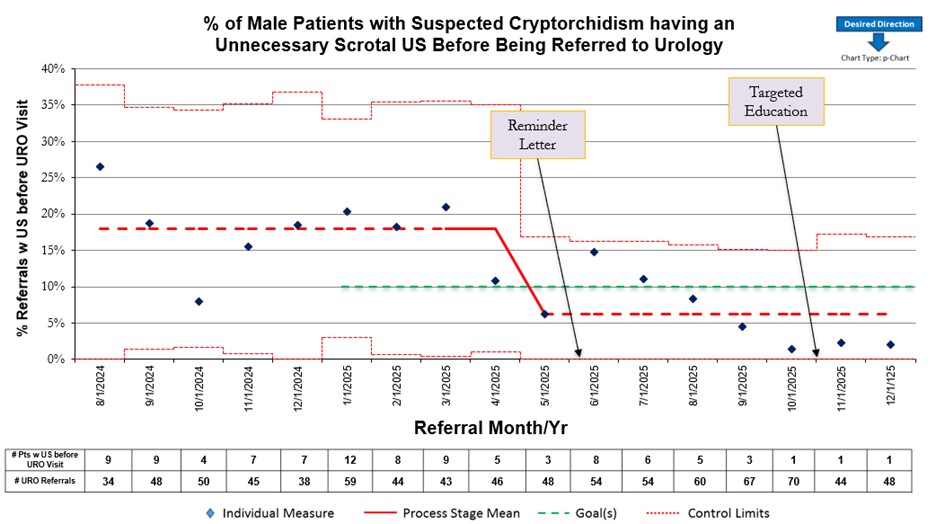
Methods: Rates of cryptorchidism referrals with and without diagnostic imaging were reviewed from August 1, 2024 - December 1, 2025 to establish a baseline rate. In May 2025, a standardized letter was created and sent to any referring primary providers who obtained imaging prior to urology referral for cryptorchidism. The letter stated the indications for cryptorchidism referral for surgical evaluation and the reasoning why diagnostic imaging is not necessary for this diagnosis. Additional educational sessions were arranged for frequent referrers and electronic order sets were modified to best reflect practice recommendations. Rates of patients who were referred with scrotal ultrasound were compared before and after implementation of study interventions. Statistical analysis was performed using chi-squared tests where appropriate and a control chart was created.
Results: A total of 852 cryptorchidism referrals were reviewed—34% from internal providers and 66% from external providers (Table 1). Overall, the rate of scrotal ultrasounds performed for cryptorchidism diagnosis significantly reduced from 16% to 6% (p<0.001) after the study interventions, and there was a significant reduction specifically in referrals from external providers (17% vs 5%, p<0.001). Control chart documenting the process shifts noted is shown in Figure 1.
Conclusions: Our novel QI intervention successfully led to a decrease in non-contributory diagnostic imaging for cryptorchidism referrals through a combination of several interventions. Reducing imaging done prior to urologic referral for cryptorchidism is challenging due to misconceptions and misunderstanding of current diagnostic guidelines. Combating this trend requires a multimodal approach to educating referring providers and other stakeholders.
Table 1. Total patients referred with suspected cryptorchidism before and after study interventions | Before Interventions | After Interventions | |
| Total patients Referred | Patients referred with US N (%) | Total patients referred | Patients referred with US N (%) | P-value |
| Overall | 455 | 73 (16) | 397 | 25 (6) | <0.001 |
| External Providers | 322 | 54 (17) | 243 | 13 (5) | <0.001 |
| Internal Providers | 133 | 19 (14) | 154 | 12 (8) | 0.077 |
Back to 2026 Abstracts


