Back to 2026 Abstracts
Bladder Exstrophy into Adulthood: Quantifying Long-Term Health Outcomes Using Real-World Data
Seyed Sajjad Tabei, MD, J. Patrick Mershon, MD, Eman N. Chaudhri, MD, Johana M. Paez-Cortes, MD, Juan Manuel Moldes, MD,
Pedro-Jose Lopez, MD, Shubham Gupta, MD.
University Hospitals Cleveland Medical Center, Cleveland, OH
BACKGROUND: Bladder exstrophy (BE) is a rare congenital anomaly requiring complex reconstruction, with some health sequelae that may persist into adulthood. While pediatric outcomes are well described, long-term adult data remain limited. Using the TriNetX database, a global federated electronic health record platform encompassing over 100 healthcare organizations, we characterize health outcomes in adults with BE compared to matched controls.
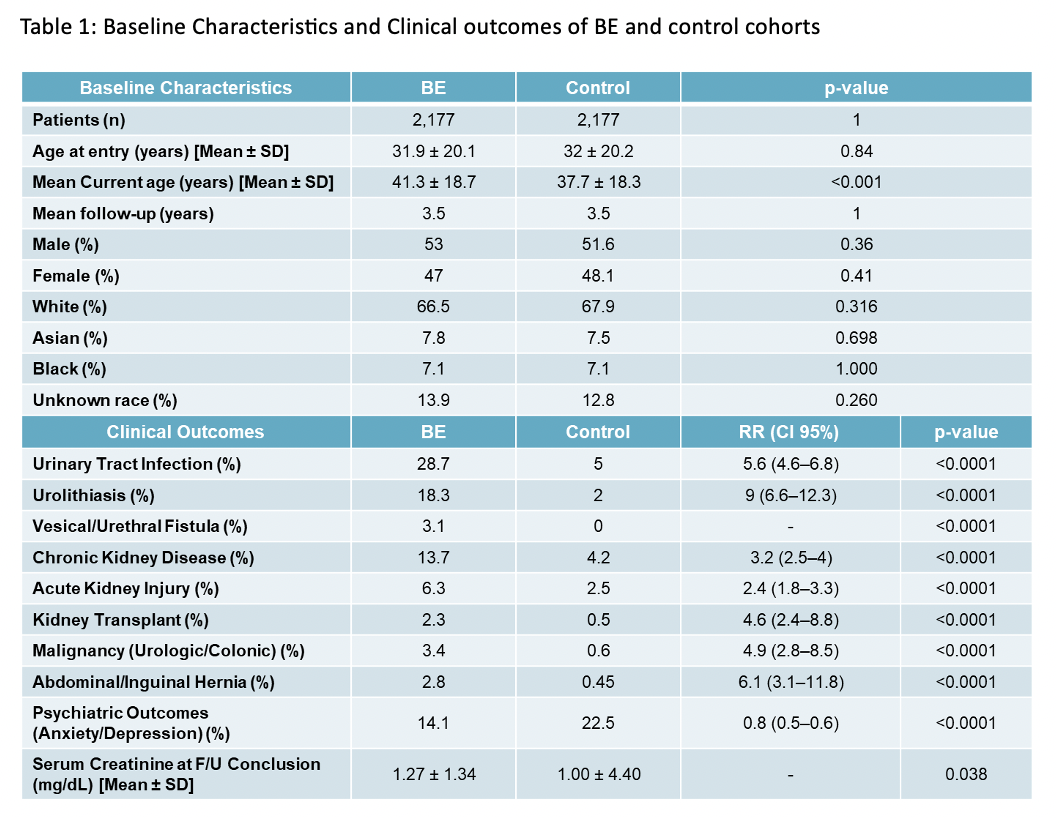
METHODS: A retrospective, propensity-matched cohort study (2006-2025) was performed in TriNetX. Adults (≥18 yr) with isolated BE were identified using diagnosis and procedure (CPT) codes. A control cohort without BE with a recorded well-child visit before the age of 18 was generated and matched 1:1 by age, sex, and race, yielding 2,177 patients per group. Both cohorts were evaluated for urinary tract infection (UTI), urolithiasis, chronic kidney disease (CKD), acute kidney injury (AKI), kidney transplant, hernia, urologic or colonic malignancy, and psychiatric diagnoses (anxiety/depression). Outcomes reflect total disease burden, not incident cases, and outcomes were compared using risk ratios (RR) with 95% confidence intervals (CI).
RESULTS: Baseline characteristics were comparable after matching. Mean age at first record was 32 years, with an average follow-up of 3.5 years for BE and control groups. BE patients showed higher risks of UTI (28.7% vs 5%; RR 5.6, 95% CI 4.6-6.8), urolithiasis (18.3% vs 2.0%; RR 9.0, 95% CI 6.6-12.3), CKD (13.7% vs 4.2%; RR 3.2, 95% CI 2.5-4), AKI (6.3% vs 2.5%; RR 2.4, 95% CI 1.8-3.3), hernia (2.8% vs 0.45%; RR 6.1, 95% CI 3.1-11.8), vesical/urethral fistula (3.1% vs 0%) and malignancy (3.4% vs 0.6%; RR 4.9, 95% CI 2.8-8.5) (all
p<10⁻⁴). Mean serum creatinine was higher among BE patients (1.27
+ 1.34 vs 1.00
+ 4.4 mg/dL, p=0.038). Anxiety/depression diagnoses were less common (14.1% vs 22.5%; RR 0.8, 95% CI 0.5-0.6; p<0.001).
CONCLUSION: This cohort represents the largest real-world study of adults with bladder exstrophy. Quantified risk estimates from matched population data validate prior unmatched small-cohort findings and clarify the long-term morbidity profile of this condition. As improved pediatric care has significantly extended life expectancy in BE, it is increasingly important for adult providers to understand the unique sequelae of this diagnosis in an older population.
Back to 2026 Abstracts


