Back to 2026 Abstracts
Sperm cryopreservation and semen parameters in adolescents and young adults undergoing gonadotoxic therapy
Dylan D. Hutchison, MD, MS1, Motassem Bayyoud, BS2, Abbey Riazzi, MSPAS, PA-C1, Elizabeth Spitznagel, MSN, APRN, CPNP1, Olivia J. Frias, MSN, RN IV, CNL1, Mickey R. Daugherty, MD, MHI1, Brian A. VanderBrink, MD1, W. Robert DeFoor, MD, MPH1, Eugene Minevich, MD1, Pramod P. Reddy, MD1, Krista J. Childress, MD1, Karen C. Burns, MD, MS1, Andrew C. Strine, MD, MPH1.
1Cincinnati Children's Hospital, Cincinnati, OH, USA, 2Wright State University Boonshoft School of Medicine, Dayton, OH, USA.
Sperm cryopreservation and semen parameters in adolescents and young adults undergoing gonadotoxic therapyDylan Hutchinson, Motassem Bayyoud, Abbey Riazzi, Elizabeth Spitznagel, Olivia J. Frias, Mickey R. Daugherty, Brian A. VanderBrink, W. Robert DeFoor, Eugene Minevich, Pramod P. Reddy, Krista J. Childress, Karen C. Burns, Andrew C. Strine
Background:Sperm cryopreservation (SCP) is the most established option for fertility preservation and should be offered to all pubertal patients prior to the initiation of gonadotoxic therapy. However, the current infrastructure for fertility preservation is variable but largely inadequate, and many patients are not being routinely counseled on the risk of infertility or offered the appropriate options based on the existing guidelines. Our objective was to review our experience with SCP and to assess the semen parameters in a young cohort of patients undergoing gonadotoxic therapy.
Methods:A single-center retrospective cohort study was performed for patients who were evaluated for fertility preservation between 2013 and 2025. SCP was offered to all patients who were pubertal and did not have any exposure to chemotherapy within the past 3 months. The number of patients who were eligible for and attempted SCP and those who were able to provide a specimen were determined. For patients who provided a specimen at our affiliated laboratories, an analysis of semen parameters was performed by age, diagnosis, and prior therapy. Age was stratified into early adolescence (<15 years), mid adolescence (≥15 to <18 years), and late adolescence/young adulthood (≥18 years). Diagnosis was stratified into leukemia and other hematologic disorders, non-Hodgkin’s lymphoma, Hodgkin’s lymphoma, sarcoma, testicular germ cell tumor, and other solid tumors.
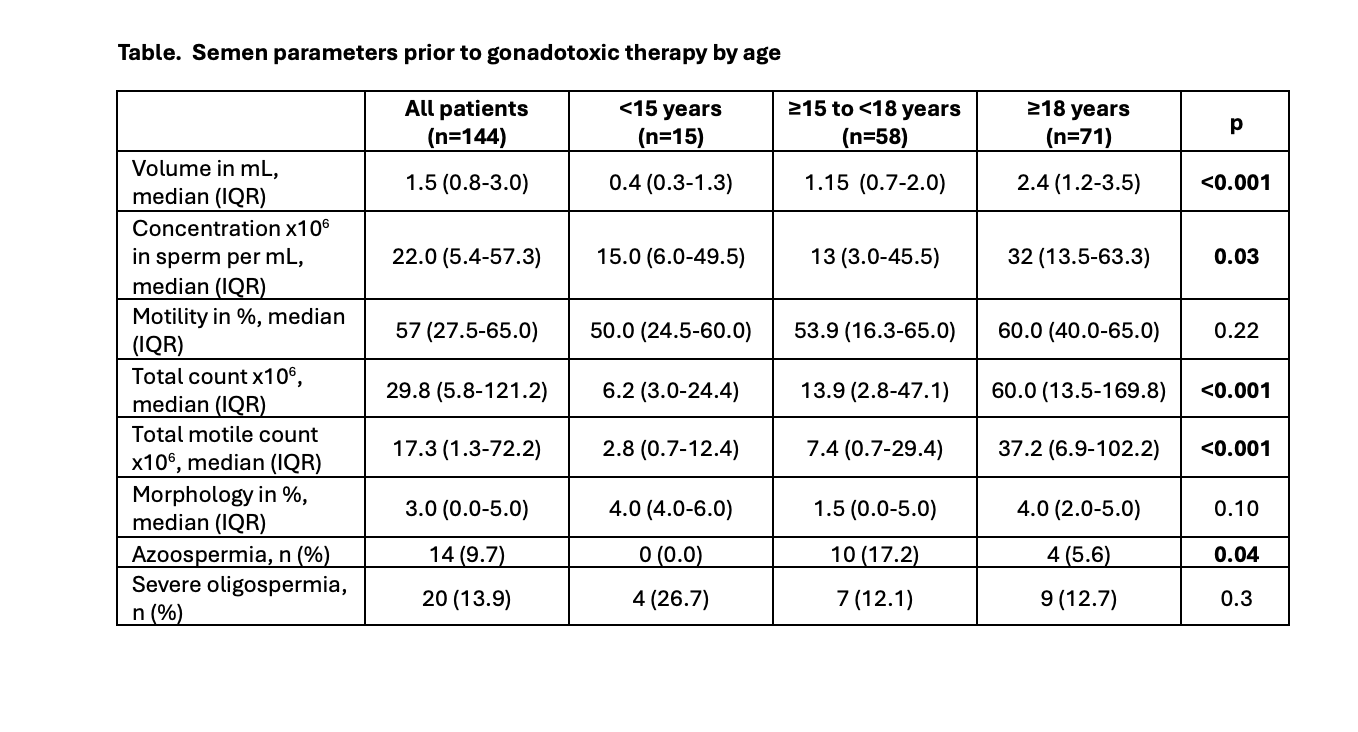
Results:Of 329 patients who were eligible for SCP during the study period, 198 (60.2%) attempted and 175 were able to provide a specimen for a success rate of 88.4%. An outpatient setting was associated with a higher likelihood of providing a specimen than an inpatient setting (97.7% vs. 74.1%, p<0.001). Age, diagnosis, and risk of infertility were not associated with likelihood of providing a specimen. Prior therapy was associated with a lower concentration (p=0.001), motility (p<0.001), total sperm count (p<0.001), total motile sperm count (p<0.001), and normal morphology (p=0.004). Azoospermia was also associated with a higher odds of prior therapy (OR 6.6, 95% CI 2.0-21.9). The quality of semen parameters improved with an increasing age in patients without a history of prior therapy (Table). The volume, concentration, and motility favorably compared with the World
Health Organization reference values, meeting them in 75 (52.1%), 83 (57.6%), and 93 (64.6%) patients, respectively.
Conclusions:SCP was feasible in a young cohort of patient undergoing gonadotoxic therapy. It should ideally be obtained in an outpatient setting if feasible and prior to any exposure to chemotherapy or radiation. Although the semen parameters improved with an increasing age, a majority of patients were able to provide an adequate specimen for SCP.
Back to 2026 Abstracts


