Back to 2026 Abstracts
Readmission rates following repair of persistent cloaca: Evaluating impacts of hospital volume, variation, and urinary tract anomalies using the Pediatric Health Information System
Christopher Staniorski, MD, LiJin Joo, PhD, Butool Hisam, MBBS, MPH, Melanie Bowser, BS, Andrea Badillo, MD, Christina Feng, MD, Marc Levitt, MD, Christina Ho, MD, Briony Varda, MD, MPH.
Children's National Hospital, Washington, DC, USA.
Background: The relationship between experience, surgical complexity and outcomes following persistent cloaca repair remains poorly understood. Given that urinary tract anomalies (UTA) are highly prevalent and potentially complicate reconstruction, we evaluated associations between hospital volume, UTA diagnosis, and readmissions following repair using the Pediatric Health Information System (PHIS).
Methods: PHIS was used to identify patients undergoing primary cloaca repair between 2012-2025. Abstraction criteria included persistent cloaca diagnosis, rectal and urethral/vaginal repair procedure, encounter <3 years of age, and female gender. The outcome was readmission within 30 days including inpatient, observation, ED or uncategorized hospital-based encounters (clinic and ambulatory surgery encounters were excluded). Covariables of interest included hospital volume determined by clustering analysis and UTA diagnosis. Mixed-effects logistic regression was performed.
Results: 412 patients were identified with repair encounters. 227 (55%) underwent surgery <1 year of age. 45 hospitals performed repairs; 197 (48%) of repairs were performed at 5 high-volume centers. Care at high-volume compared to low-volume institutions was associated with surgery <1 year of age (63% v. 48%, p<0.01), higher median household income (>$70,000 in 18% v. 8%, p=0.01), and fewer prolonged procedures (>570 min in 22% v. 34%, p<0.01). UTA was diagnosed in 70% with similar rates of diagnosis at high- and low-volume centers. Patients with UTA had higher rates of comorbidities (59% v. 41%, p<0.01) and prolonged procedures (>570min in 34% v. 14%, p<0.01) compared to those without.
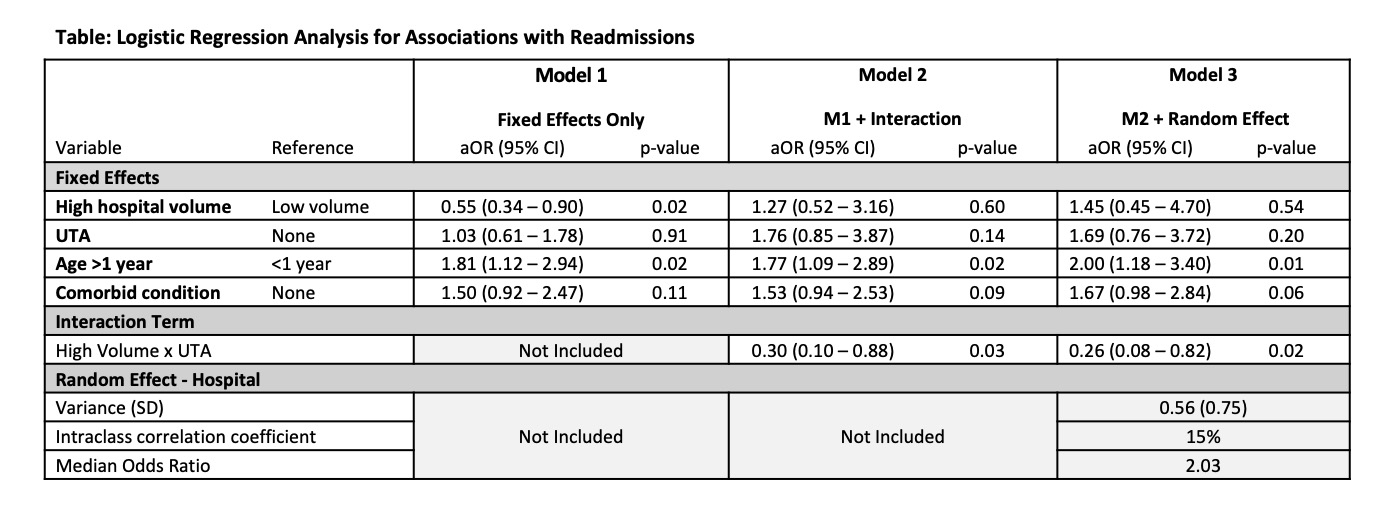
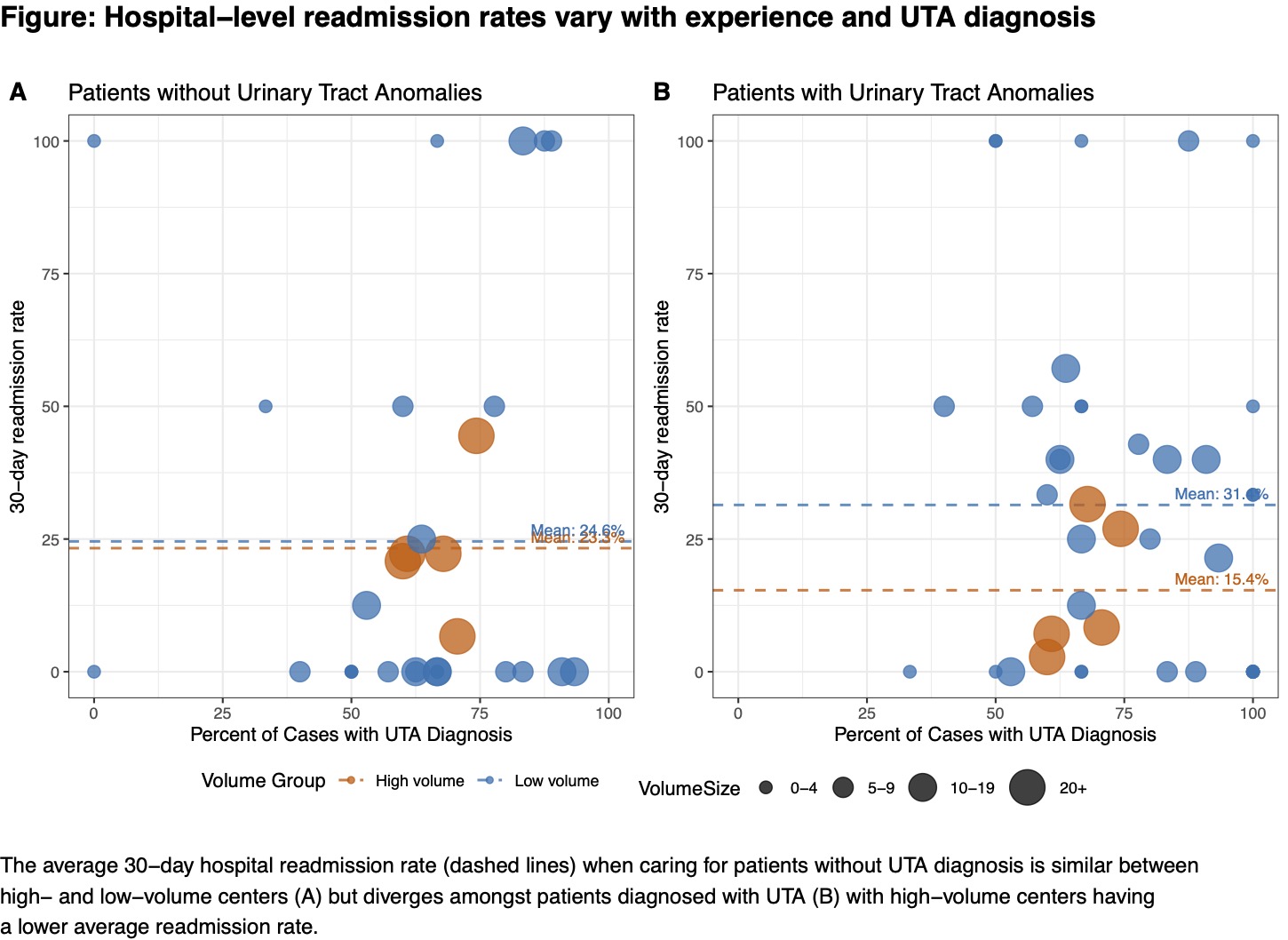
Readmission occurred following 23% (92/412) of encounters. Readmission rates were higher with reconstruction >1 year of age (29% v. 17%, p=0.01), comorbid conditions present (26% v. 18%, p=0.04), and care at low-volume hospitals (28% v. 16%, p<0.01). On multivariate logistic regression controlling for these factors and UTA, high-volume was associated with decreased odds of readmission (aOR 0.55, 95%CI 0.34-0.90, p=0.02) while reconstruction >1 year of age was associated with higher odds of readmission (aOR 1.81, 95%CI 1.12-2.94, p=0.02). Subsequently, an interaction term was included to evaluate the potential for differing effects of UTA on readmissions at low and high-volume centers, with a random intercept to assess interhospital variability. Doing so demonstrated a significant interaction between UTA and hospital volume (p=0.02) such that high hospital volume mitigated an increase in readmission rate in patients with UTAs seen at low-volume centers (Figure). Variability was present in readmission rates between hospitals with a variance of 0.56 and median odds ratio of 2.03.
Conclusions: Readmissions occur frequently following repair of persistent cloaca with considerable variation between centers. High-volume care is associated with an improved readmission rate, which is particularly apparent in patients with urinary tract anomalies.
Back to 2026 Abstracts


