Back to 2026 Abstracts
Survival Outcomes of Cryptorchid-Associated Testicular Germ Cell Tumors: A Population-Based SEER Analysis
Austin Schults, MD1, Christine Do, DrPH1, Melissa Noxon, MPH2, Andy Chang, MD1, Victoria K. Cortessis, PhD2.
1Children's Hospital Los Angeles, Los Angeles, CA, USA, 2University of Sothern California/Norris Comprehensive Cancer Center, Los Angeles, CA, USA.
BACKGROUND: Cryptorchidism is the most established risk factor for testicular germ cell tumors (TGCT), yet comparative survival outcomes between TGCT arising in cryptorchid versus descended testes remain poorly characterized. We sought to evaluate population-level survival and mortality differences associated with cryptorchid-associated TGCT using the National Cancer Institute Surveillance, Epidemiology, and End Results (SEER) database.
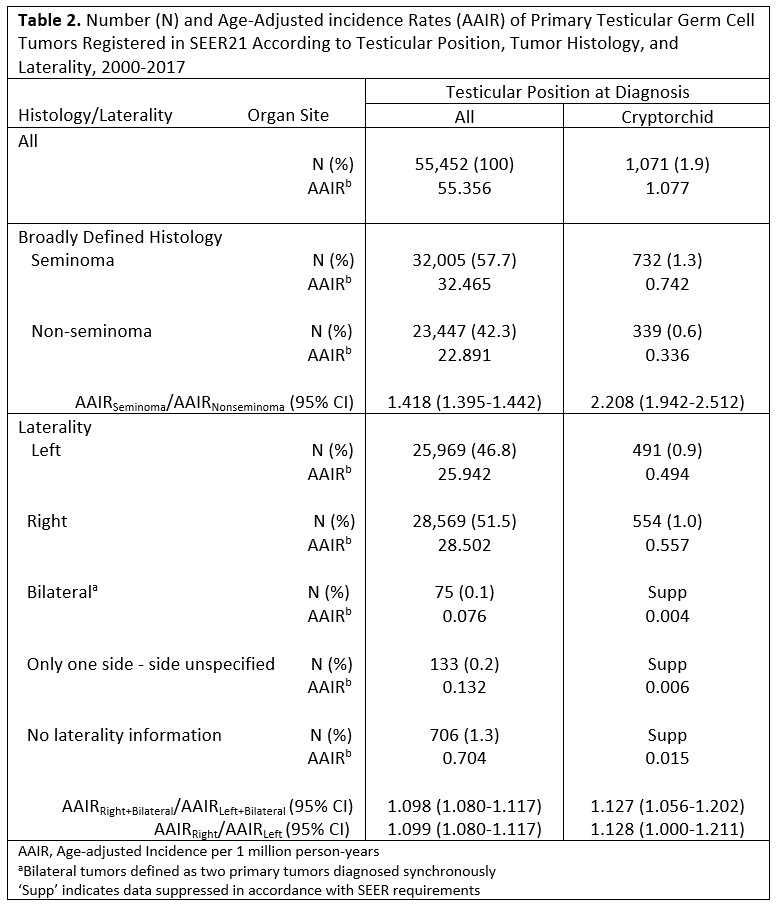
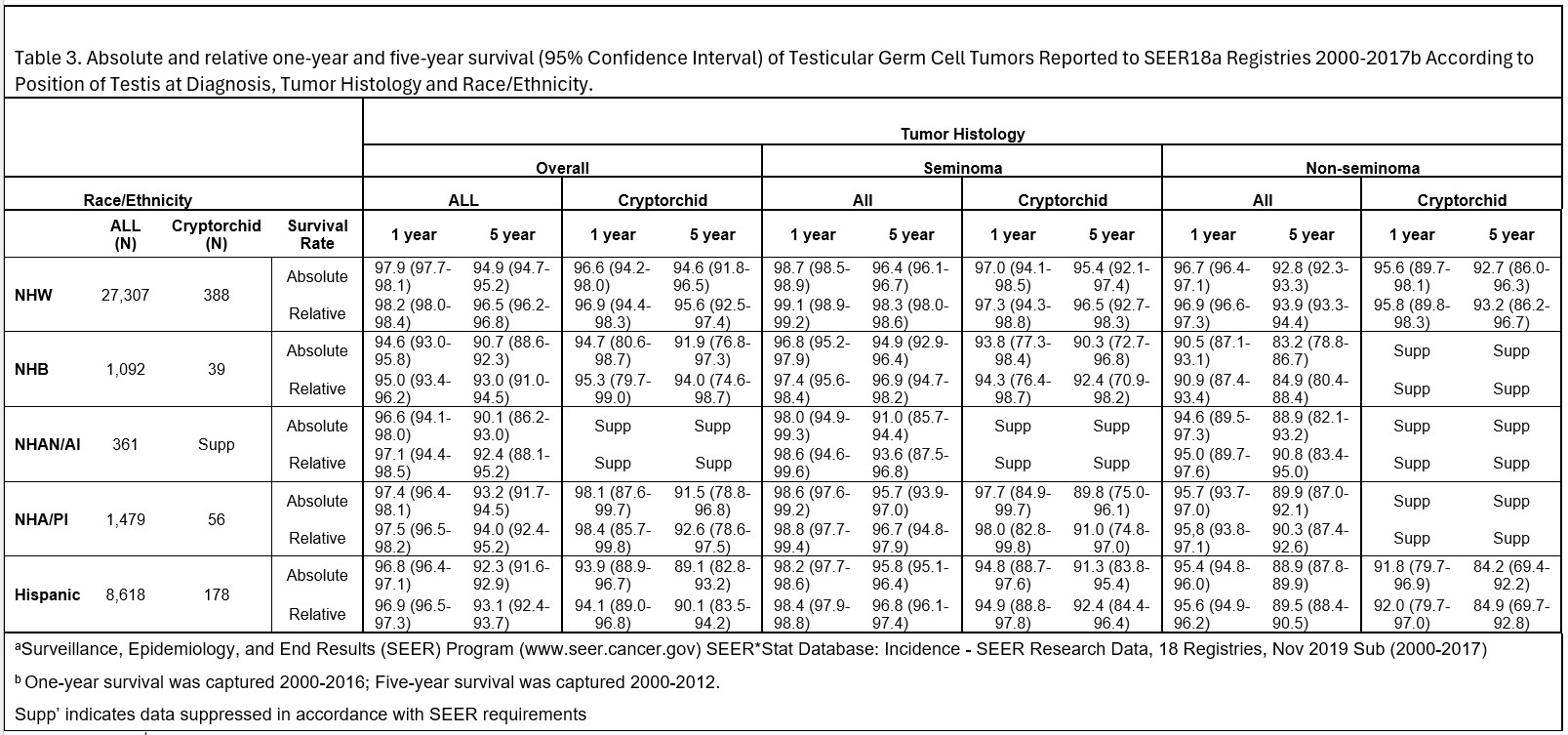
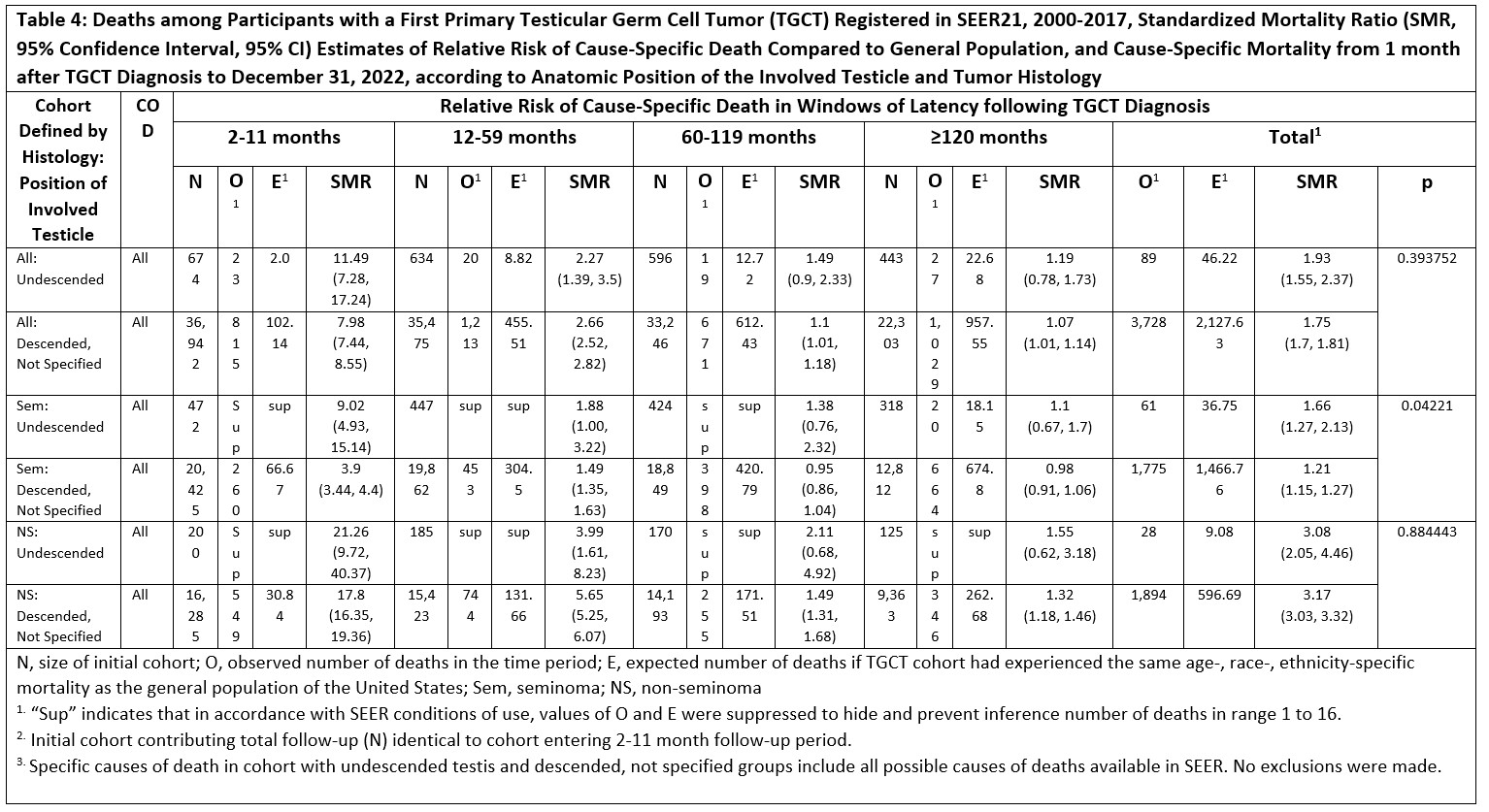
METHODS: Among TGCT diagnoses registered in SEER 2000-2017 we compared incidence, survival and relative risk of mortality between tumors arising in undescended testes (ICD-O-3 anatomic site code C62.0) and tumors arising in descended or unspecified testes. Histology was stratified into seminoma and non-seminoma groups. Age-adjusted incidence rates (AAIR), incidence rate ratios (AAIRR) and standardized mortality ratios comparing TGCT patients to the general population were estimated in SEER21 and 1- and 5-year absolute and relative survival in SEER18 data using SEER*Stat software. Relative risk and survival analyses were stratified by race/ethnicity and histology. Statistical comparisons were performed using Wald testing with Bonferroni correction.
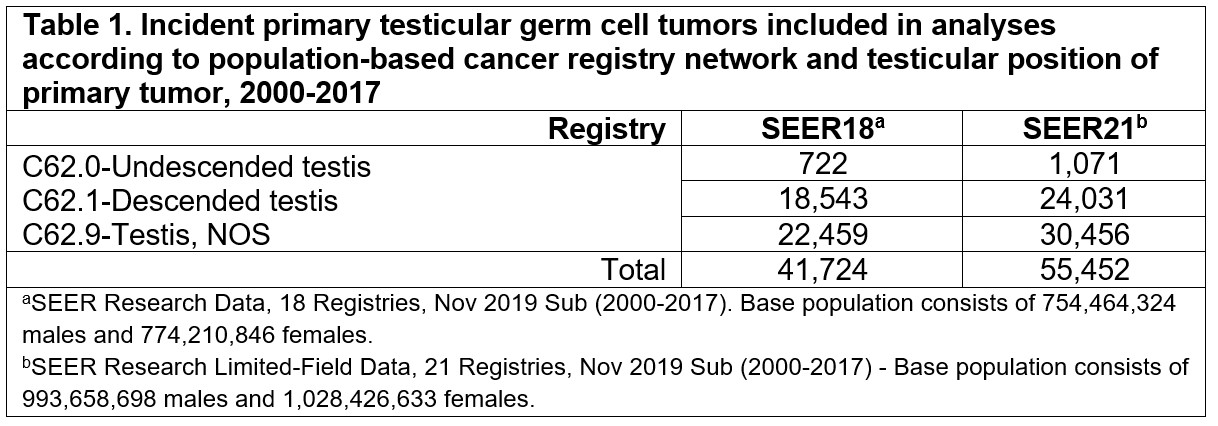
RESULTS:SEER18 identified 41,724 TGCT patients, including 722 (1.73%) arising in undescended testes. SEER21 identified 55,452 TGCT patients, including 1,071 (1.93%) cryptorchid-associated tumors. Seminoma was significantly more predominant in cryptorchid-associated TGCT compared with non-cryptorchid TGCT (AAIRR seminoma/non-seminoma 2.208 [95% CI 1.942-2.512] vs 1.418 [1.395-1.442], p<0.0001), and both groups demonstrated right-sided predominance. Across nearly all racial/ethnic and histologic subgroups, cryptorchid-associated TGCT demonstrated lower point estimates for both 1- and 5-year observed and relative survival compared with non-cryptorchid TGCT. Compared to the general population, relative risk of all-cause mortality was most notably elevated in cryptorchid versus non-cryptorchidism patients with seminoma (SMR 1.66 [95% CI 1.27-2.13] vs 1.21 [1.15-1.27], p=0.0422).
CONCLUSIONS: Patients with cryptorchid-associated TGCT, particularly seminoma, experienced consistently poorer survival and elevated mortality despite modern systemic therapy. Despite limited statistical power, these findings suggest cryptorchidism may remain oncologically relevant after TGCT develops and supports heightened surveillance and long-term follow-up in this population.
Back to 2026 Abstracts


