Back to 2026 Abstracts
Trends in Bladder Cancer Admissions Among Individuals with Spina Bifida
Evalyn Ione George, MD, Rui Qu, MS, Hasan Jhaveri, MD, Emily Yamashita, BS, Claire Yu, BS, Jonathan C. Routh, MD.
Duke University Hospital, Durham, NC, USA.
BACKGROUND: Bladder cancer in patients with neurogenic bladder, such as spina bifida (SB), is a rare, albeit morbid, condition. While there exists a small subset of literature on oncologic outcomes of patients with SB with or without augmentation, there is a lack of comprehensive data examining the trends of bladder cancer diagnosis and management in this unique patient population. Using the Healthcare Cost and Utilization Project (HCUP) data base National Inpatient Sample (NIS), we aimed to determine the temporal trends of bladder cancer (BC) admissions in individuals with SB and to compare demographic and clinical characteristics between BC admissions with varying causes of neurogenic bladder; specifically, we compared BC admission rates between SB and spinal cord injury (SCI). We hypothesized that SCI admissions would be markedly higher than SB, due both to the larger number of patients with SCI and the increased reliance on indwelling catheters rather than intermittent catheterization for urinary drainage.
METHODS: We performed an exploratory, retrospective descriptive analysis utilizing the 1998-2023 NIS database of the HCUP to evaluate trends and variations BC among patients with SB with and without augmentation. Data were extracted using SAS analytic software. Admissions were included if they had a diagnosis of SB in the specified time frame. Patients with SCI were included in the analysis as a control group representing non-spina bifida related neurogenic bladder.
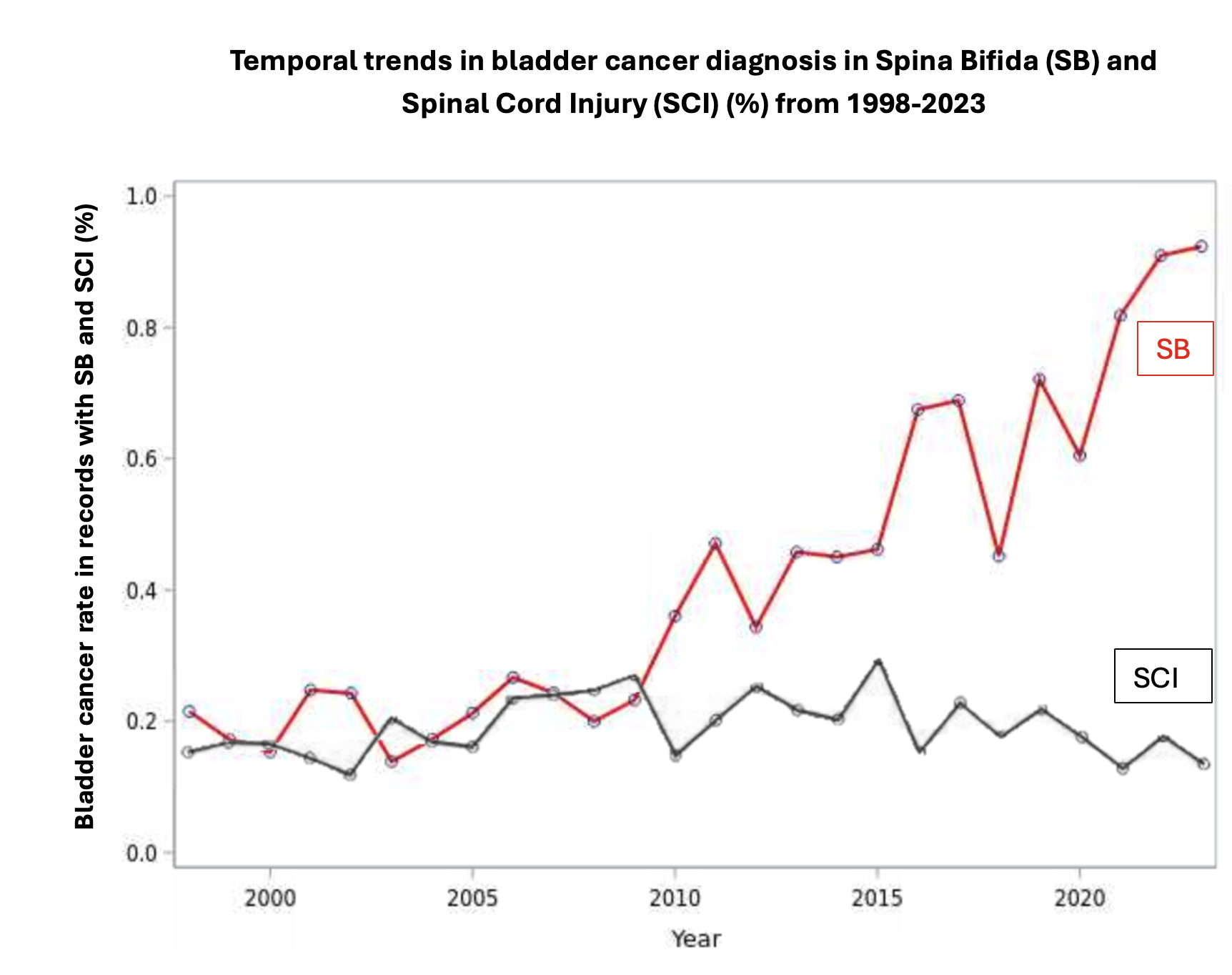
RESULTS: This study identified 722,109 patients with SB and 1,398,183 patients with SCI between 1998 and 2023. While rates of bladder cancer are low in both patients with SB and SCI, BC-related admission was twice as likely to occur in patients with SB than SCI (0.41% vs 0.20%, p<0.0001). The BC admission rate among individuals with SCI remained relatively stable throughout the study period, however the rate among SB patients ranged from 0.21% to 0.92% between 1998 and 2023 and generally increased over time (p<0.0001) with noticeable year-to-year fluctuations (figure 1).
CONCLUSIONS:Admissions for BC in the SB population have increased significantly during the study period, even when compared to BC admissions in SCI patients. The upward pattern in admissions for BC in patients with SB may reflect changes in disease detection, coding practices, healthcare utilization, or underlying patient characteristics. However, the temporal trend should be interpreted cautiously, as changes in the NIS sampling design, the transition from ICD-9 to ICD-10, and differences in data capture across years may also have influenced the estimated rates.
Back to 2026 Abstracts


