Back to 2026 Abstracts
User-Centered Development and Alpha Testing of Preoperative Educational Materials for Pediatric Kidney Stone Surgery
Eugene C. Chen, BS1, Katherine Sheridan, MS1, Samantha Jacklin, BS1, Hunter Beck, BS2, Christina B. Ching, MD3, Michael E. Chua, MD, MASc4, Pankaj P. Dangle, MD5, Kathryn E. Flynn, PhD1, Kim Hollander, BS6, Neha R. Malhotra, MD7, Carswell Ouimet, BS1, Kristi Ouimet, BS1, Annabelle Pleskoff, BS8, Francisco R. Lopez-Guerna, MD9, Lauren Schutz, PA-C10, Chris Zellers, BS2, Kate Zellers, BS2, Gregory E. Tasian, MD, MSc, MSCE11, Jonathan S. Ellison, MD, FACS1.
1Medical College of Wisconsin, Milwaukee, WI, USA, 2Kidney Stone Engagement Core, Milwaukee, WI, USA, 3Nationwide Children's Hospital, Columbus, OH, USA, 4The Hospital for Sick Children, Toronto, ON, Canada, 5Riley Children's Hospital, Indianapolis, IN, USA, 6Oxalosis and Hyperoxaluria Foundation, New Paltz, NY, USA, 7Icahn School of Medicine at Mount Sinai, New York, NY, USA, 8The Children's Hospital of Philadelphia, Philadelphia, PA, USA, 9Hospital Dr Exequiel Gonzalez Cortes, San Miguel, Chile, 10Children's Hospital of Philadelphia, Philadelphia, PA, USA, 11Perelman School of Medicine at the University of Pennsylvania, Philadelphia, PA, USA.
BACKGROUND: Preoperative counseling for pediatric nephrolithiasis is variable and may not consistently address outcomes most important to patients and caregivers. Educational materials may help standardize counseling, but existing resources are often inconsistent or not tailored to the needs of pediatric patients and caregivers. We aimed to develop and alpha-test user-centered educational materials for pediatric kidney stone surgery.
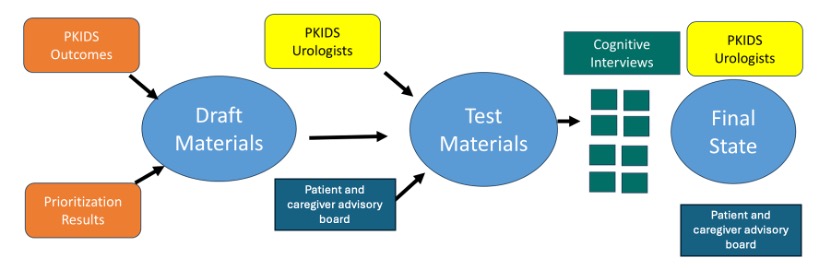
METHODS: We conducted a user-centered design study engaging patients, caregivers, and clinicians through the Pediatric Kidney Stone (PKIDS) Care Improvement Network to develop preoperative educational materials for pediatric kidney stone surgery (Figure 1). Materials addressed ureteroscopy, shockwave lithotripsy, percutaneous nephrolithotomy, ureteral stent management, and postoperative expectations.
Alpha-testing was performed in a separate cohort of patients and caregivers using semi-structured interviews to assess comprehension. Materials were divided into discrete segments and scored on a 3-point comprehension scale (1=low, 3=high), with acceptable comprehension defined as an average score ≥2.6 across three consecutive interviews. Techniques such as readback and probing for clarity were utilized to ensure adequate understanding. Revisions were guided by participant feedback after each interview cycle. Iterative revisions were performed until this threshold was met. Readability was evaluated using standardized software.
 RESULTS:
 A total of 22 participants (19 patients, 3 caregivers) completed alpha-testing interviews (Table 1). The median age of patients was 16 years (IQR 14-20). Participants represented diverse prior surgical experiences, including ureteroscopy, shockwave lithotripsy, open stone surgery, and multiple prior procedures. Patients and caregivers preferred materials that were concise, visually supported, and brief (~1 page or 3-5 minutes). Several material components required one to three rounds of revision before meeting predefined comprehension thresholds, highlighting the importance of user-centered refinement. Materials ultimately met predefined comprehension thresholds with consistently accurate participant readback across all topics and a Flesch-Kincaid reading level below Grade 7. Common areas requiring revision included procedural terminology among patients and postoperative expectations and ureteral stent management among caregivers. Revisions focused on simplifying language and reducing medical jargon, improving visual formatting, and clarifying recovery expectations.
Table 1. Cohort Demographics| Characteristic | Patient (n=19) | Caregiver (n=3) |
| Age, years | | |
| Median (IQR) | 16 (14-20) | 59 (39-59) |
| Surgery type, n (%) | | |
| Ureteroscopy | 11 (57.9) | 0 (0) |
| Open stone surgery | 4 (21) | 0 (0) |
| Shockwave lithotripsy | 1 (5.2) | 0 (0) |
| Multiple surgery modalities | 3 (15.8) | 0 (0) |
| None | 0 (0) | 3 (100) |
CONCLUSIONS: User-centered design and iterative alpha-testing produced educational materials that were accessible, comprehensible, and aligned with patient and caregiver priorities. This framework demonstrates how patient-identified priorities can be translated into practical tools to standardize preoperative counseling and improve care in pediatric kidney stone surgery. It may also provide a scalable approach for standardizing pediatric stone surgery counseling across institutions. Future beta-testing will evaluate the impact of these materials on patient understanding and clinical outcomes.
Back to 2026 Abstracts


