Back to 2026 Abstracts
What is the Significance of Vesicoureteral Reflux on Risk of Urinary Tract Infection in Patients with History of Prenatal Hydronephrosis?
Carol A. Davis-Dao, PhD1, Sarah H. Williamson, MD2, Rebecca S. Zee, MD3, Valre W. Welch, NP3, Elias J. Wehbi, MD1, Heidi A. Stephany, MD1, Antoine E. Khoury, MD1, Nora G. Kern, MD4, C.D. Anthony Herndon, MD3, Daniel Han, MD5, Janelle A. Fox, MD2, Anne G. Dudley, MD6, Christopher S. Cooper, MD7, Kai-Wen Chuang, MD1, Joshua D. Chamberlin, MD8, Shannon Cannon, MD9, Alireza Alam, MD1, Luis H. Braga, MD, PhD10.
1Rady Children’s Health, Orange County and University of California, Irvine, Orange, CA, USA, 2Children’s Hospital of the King’s Daughters, Norfolk, VA, USA, 3Children’s Hospital of Richmond at Virginia Commonwealth University, Richmond, VA, USA, 4University of Virginia, Charlottesville, VA, USA, 5Stanford University, Palo Alto, CA, USA, 6Connecticut Children’s Medical Center, Hartford, CT, USA, 7The University of Iowa, Iowa City, IA, USA, 8Loma Linda University Health, Loma Linda, CA, USA, 9University of Wisconsin, Madison, WI, USA, 10McMaster University, Hamilton, ON, Canada.
Background The clinical significance of vesicoureteral reflux (VUR) identified during evaluation of prenatal hydronephrosis remains controversial. A recent randomized trial of high grade VUR reported febrile urinary tract infection (fUTI) rates of 36% in untreated patients vs. 21% in those receiving continuous antibiotic prophylaxis (CAP), with male sex as a strong predictor, likely reflecting high predominance of uncircumcised boys. However, these findings may have been influenced by regional circumcision patterns. We evaluated the impact of VUR on fUTI risk in a large multicenter prenatal hydronephrosis cohort, accounting for hydronephrosis type, severity, sex, and circumcision status.
Methods Patients with asymptomatic prenatal hydronephrosis who underwent voiding cystourethrogram VCUG within the first three months of life with minimum three months of subsequent follow-up were included. Those with PUV, neurogenic bladder, major anomalies, or missing post-natal ultrasound data were excluded. Patients were stratified into four groups: (1) isolated hydronephrosis (HN), VUR-negative; (2) isolated HN, VUR-positive; (3) hydroureteronephrosis (HUN), VUR-negative; and (4) HUN, VUR-positive. UTI required fever, pyuria, positive urine culture, and antibiotic treatment. Cox regression was adjusted for age, sex, circumcision status, and time-dependent antibiotic prophylaxis, with surgical intervention treated as a competing risk. Cumulative incidence functions accounting for surgical intervention were used to assess fUTI risk over time.
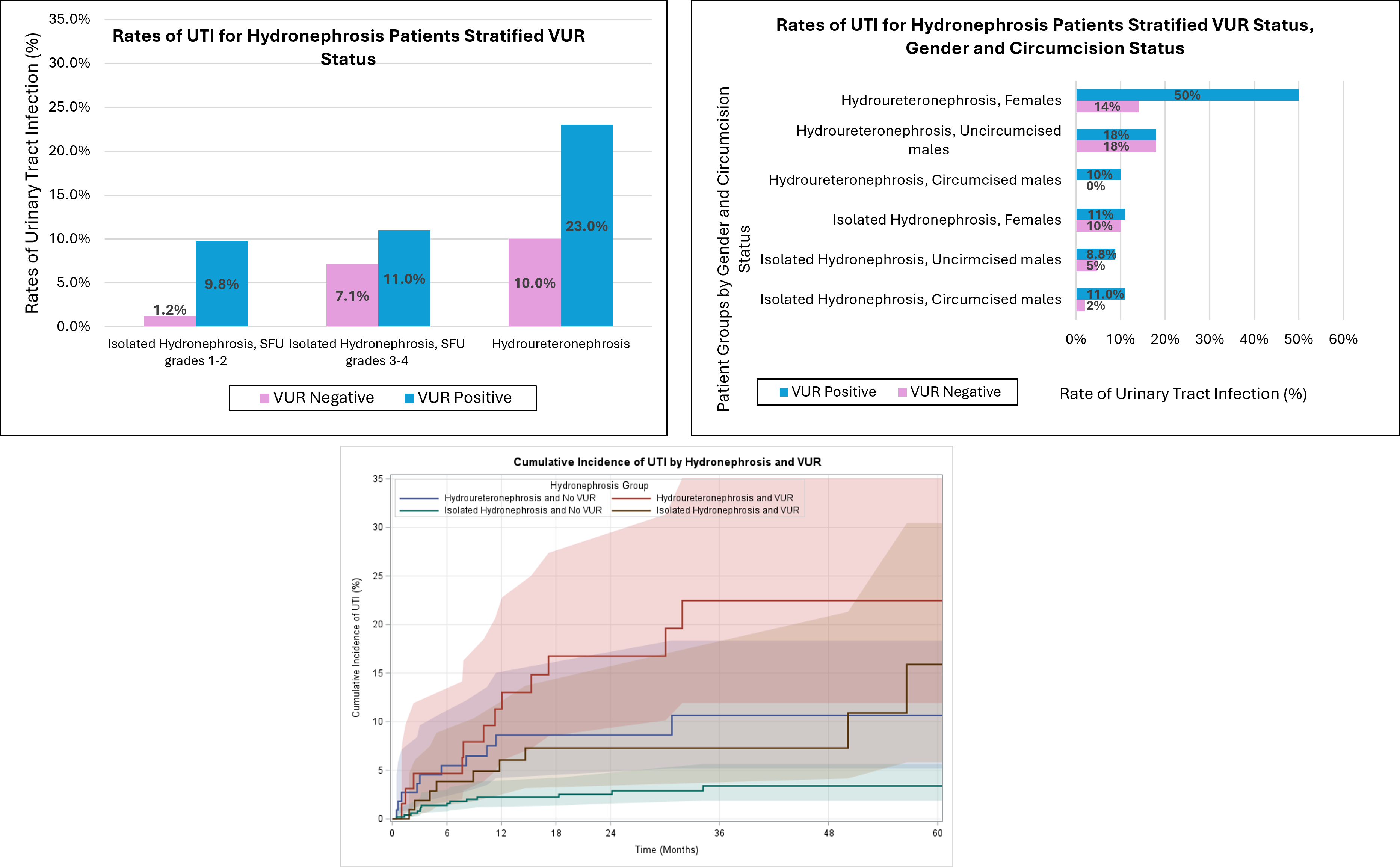
Results Among 784 patients, the overall confirmed fUTI rate was 8.0%. Median age at VCUG was 1.1 months; median time to first fUTI was 7.8 months. VUR-positive patients had significantly higher UTI rates than VUR-negative patients (15% vs. 6.0%, p<0.0001) (Figures 1a and 1b). Among VUR-negative patients, rates were 5.2% for isolated HN and 10% for HUN (p=0.07). In VUR-positive patients, rates were 10% for isolated HN and 23% for HUN (p=0.03), identifying HUN with VUR as the highest-risk subgroup. Among isolated HN patients, high-grade hydronephrosis was associated with markedly increased UTI risk only in the absence of VUR. Competing risk analysis confirmed progressive divergence in cumulative fUTI incidence over time, with VUR-positive HUN patients carrying the highest infection burden throughout follow-up (Figure 1c). Cox regression identified four significant independent risk factors: female sex (HR=4.4, 95% CI: 1.6-12), uncircumcised status (HR=3.2, 95% CI: 1.1-9.5), hydroureter (HR=2.2, 95% CI: 1.1-4.1), and VUR (HR=2.2, 95% CI: 1.1-4.5). The effect of CAP was not significant (HR=1.1, 95% CI: 0.53-2.7). These HRs changed when VUR was excluded from the analysis.
Conclusions VUR is a major determinant of fUTI risk in children with prenatal hydronephrosis, particularly when associated with hydroureteronephrosis. The combination of HUN and VUR identifies a distinctly high-risk subgroup, with nearly one in four patients developing fUTI. Sex and circumcision status significantly modify infection risk. These findings support identification of VUR in selected patients with prenatal hydronephrosis to improve risk stratification and guide individualized management.
Back to 2026 Abstracts


