Back to 2026 Abstracts
Diagnostic Accuracy and Safety of Urinalysis with Reflex Culture Strategy in Children ≤ 24 Months
Vijay K. Rings, MD, Sophie E. Katz, MD, MPH, Ritu Banerjee, MD, PhD, Lauren Johansen, MPH, Milner Staub, MD, MPH, Minhua Zhang, MS, Lauren E. Corona, MD.
Vanderbilt University Medical Center, Nashville, TN, USA.
BACKGROUND Overuse of urinalyses (UA) and urine cultures (UCx) in patients without urinary tract infection (UTI) symptoms leads to unnecessary antibiotic exposure with increasing antimicrobial resistance and healthcare utilization. UA with reflex UCx, where UCx is sent if specific UA criteria are met, is a diagnostic stewardship strategy that has demonstrated success and safety in adults. However, uncertainty remains in populations with atypical inflammatory responses or those unable to reliably report symptoms, such as young children. Accordingly, at our institution, clinicians may bypass the algorithm in children ≤24 months(m) of age and obtain UCx regardless of UA findings. It is unclear whether this practice is warranted. Therefore, we sought to evaluate the diagnostic accuracy and safety of UA with reflex UCx in children ≤24m at our institution.
METHODS We retrospectively evaluated outpatient and emergency department encounters among children ≤24m in our healthcare system with UA and UCx testing. Index test was pyuria defined as ≥10 white blood cells per high-power field (WBC/hpf) on centrifuged urine microscopy. Reference standard was growth of ≥10,000 colony-forming units/mL (CFU) of a single uropathogenic organism on UCx. Patients with urologic or immunocompromising conditions were excluded. We evaluated the performance of the index test by calculating sensitivity, specificity, positive predictive value (PPV), and negative predictive value (NPV). We performed a receiver operating characteristic (ROC) analysis to identify the optimal WBC/hpf threshold for pyuria and sensitivity analyses to evaluate index test performance across age groups. We assessed safety by identifying potential missed clinical UTIs among false-negative cases: all cases meeting the reference standard with <10 WBC/hpf (negative index test) were further reviewed for evidence of a clinical UTI, defined as (1) temperature ≥38°C or <36.5°C, and (2) no other identifiable infectious source.
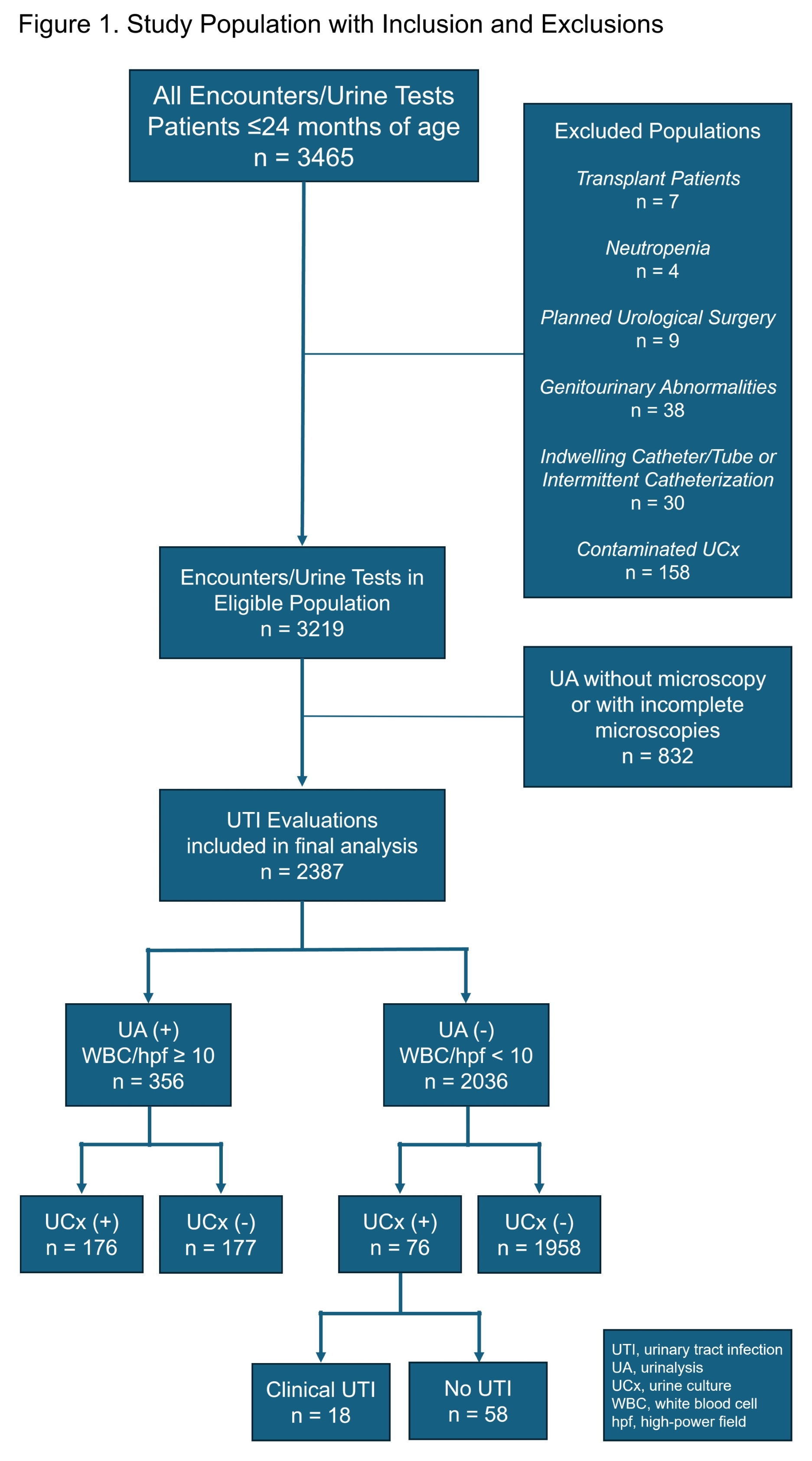
RESULTS A total of 2387 patients were included (
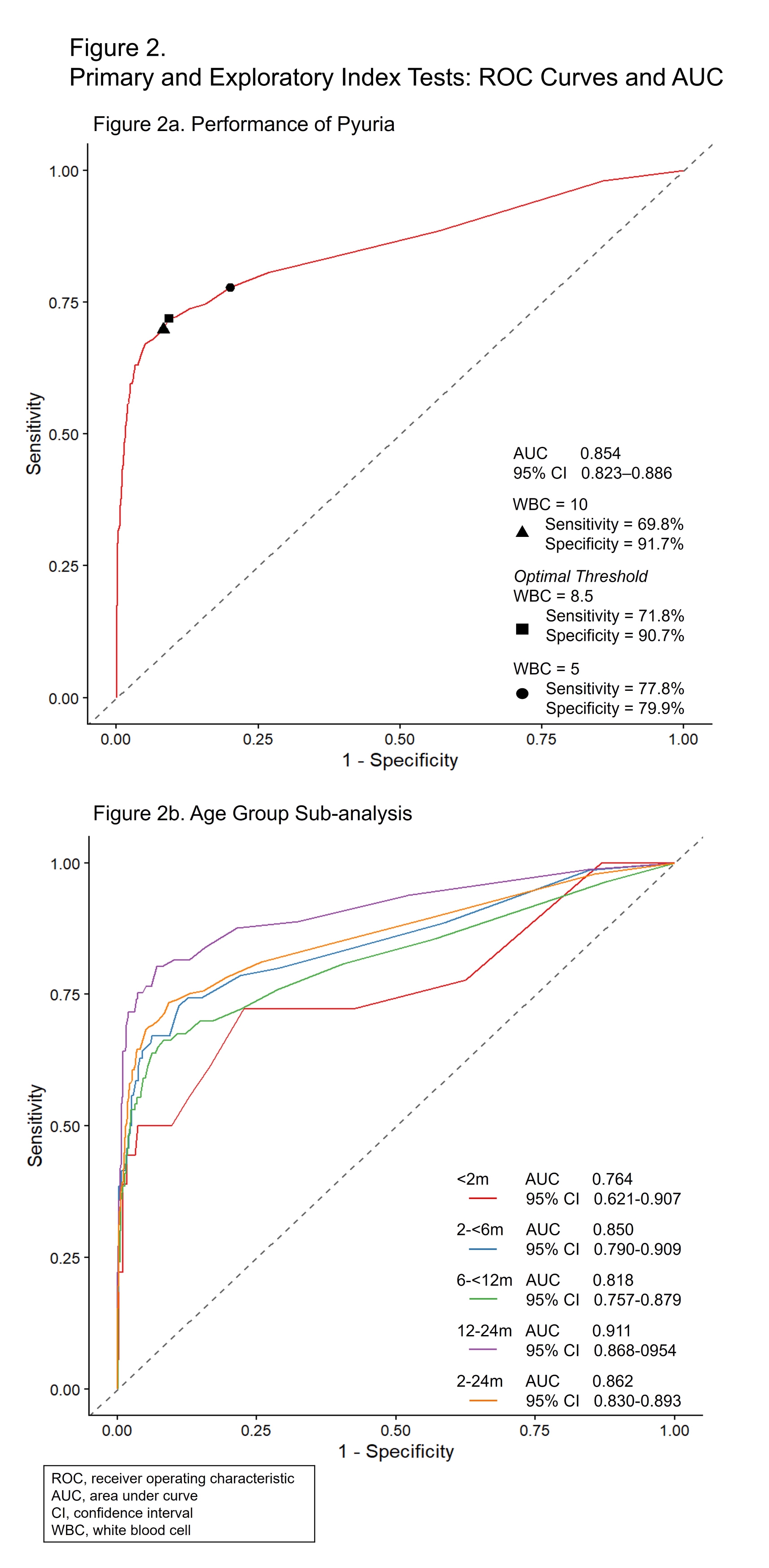
Figure 1). The index test of pyuria (≥10 WBC/hpf) demonstrated a sensitivity of 69.8%, specificity of 91.7%, PPV of 49.9%, and NPV of 96.3% compared with the reference standard. ROC analysis identified an optimal threshold of 8.5 WBC/hpf for pyuria, with a sensitivity of 71.8% and specificity of 90.7% (
Figure 2a). Sensitivity analysis demonstrated no significant differences in index test performance between age groups (
Figure 2b). In the safety analysis, among 76 patients without pyuria (negative index test) but positive UCx (positive reference standard), 18 met criteria for clinical UTI; none required hospitalization and 14 (82%) received antibiotics within 1 day of culture results. Overall, this represents a 0.8% rate of potential missed clinical UTI.
CONCLUSION UA-based reflex UCx demonstrates high NPV and a low rate of potential missed clinical UTI in children ≤24m. These findings suggest that UA with reflex UCx may be safely applied in this population, which could reduce unnecessary UCx and antibiotic exposure.
Back to 2026 Abstracts


