Back to 2026 Abstracts
Digital Uroflowmetry For Home or Office Applications
Stephen Zderic, MD1, Emma Walsh, BA1, Kate Filler, BS1, Roman Fedorovsky, BS, MS2, Matt Bell, BS3, Alexander Numann, BS3, Matthew Starfield, BS3, Alex Spektor, BS, MS2, Dima Nosenko, BS2, Caleb Kovell, MD1, Tom Kolon, MD1, Jason Van Batavia, MD1.
1Children's Hospital of Philadelphia, Philadelphia, PA, USA, 2UroGenie LLC, Sinking Spring, PA, USA, 3Solid Product Design, Philadelphia, PA, USA.
BACKGROUND: Uroflowmetry is a standard office based procedure which produces valuable data for the management of voiding dysfunction, one of the most common reasons for pediatric urology consultation. Structured interviews with practicing urologists revealed the most common pain point is the patient who arrives at the office unable to void. Enthusiasm exists for a device and software suite capable of delivering digitized uroflow data from home in advance of an office visit. We present our experience with UroGenie, a hardware and software suite that can deliver digital uroflowmetry data from office or home settings.
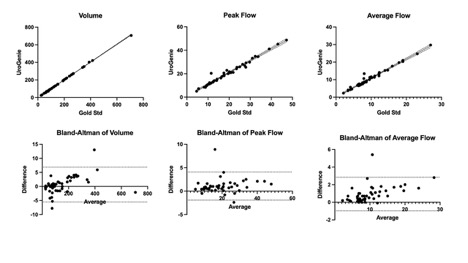
METHODS: This device consists of a load cell integrated into a circuit board containing an analog to digital converter with its output signal delivered to a blue tooth transmitter. It is powered by a rechargable 9 volt battery system using a micro USB port. The device is paired via blueooth to the UroGenie application on an iPhone or tablet. The patient starts by pushing a green start button prior to voiding, and the session ends after voiding is complete when the patient double taps a red stop button. The data transmits from phone to the cloud where the UroGenie server processes the data to deliver the standard parameters of volume, peak flow, and average flow as well as graphical display of the data. We tested this device for accuracy in clinic by placing it on top of the current gold standard such that a single patient’s uroflow would be recorded simultaneously on both devices. Data were analyzed in Graph Pad Prism using regression analysis as well as Bland Altman testing. The results for our first 48 clinical uroflow studies are presented in Figure 1.
RESULTS: Linear regression analyses comparing the gold standard device versus UroGenie reveals strong correlation across the parameters of voided volume (R
2 = 0.99), peak (R
2 = 0.97)and average (R
2 = 0.97) flow rates. Bland Altman testing revealed 95% confidence intervals with the data skewed toward higher values reported by UroGenie. While volumes were accurate to under 1%, peak and average flow rates were 8% and 10% higher in the UroGenie system.
CONCLUSIONS:This inexpensive device demonstrates an accuracy equivalent to the existing gold standard. We are currently testing the device in the home setting and working to integrate this data into EPiC such that physicians can see all the results without having to log into the UroGenie website. While hospitals are currently reluctant to accept incoming data from smaller applications, we anticipate this will change as the demand for in home and remote care increases.
Back to 2026 Abstracts


