Back to 2026 Abstracts
Measuring the Pelvic Floor: Electrical Impedance Myography as a Novel Biomarker for Pediatric Voiding Dysfunction
HsinHsiao Scott Wang, MD, MPH, MBAn1, Anh-Dao Cheng, MD1, Scarlett Cai, MSc1, Buket Sonbas, PhD2, Seward Rutkove, MD2.
1Boston Children's Hospital, Boston, MA, USA, 2Beth Israel Deaconess Medical Center, Boston, MA, USA.
Background:Voiding dysfunction is among the most common pediatric urologic conditions, yet objective measures of pelvic floor muscle involvement remain limited. Electrical impedance myography (EIM) is a noninvasive technique that measures muscle electrical properties and may provide quantitative information about pelvic floor structure and function. We explored the feasibility and potential clinical utility of pelvic floor EIM as an objective biomarker in children undergoing evaluation for voiding dysfunction.
Methods:We included patients younger than 18 years who underwent uroflowmetry with surface electromyography testing between November 2023 and July 2025 at our institution. Four surface electrode patches were placed perineally at standard pelvic floor EMG recording sites. Patients with poor electrode adhesion or inadequate EIM signal quality were excluded. EIM parameters, including resistance, reactance, and phase angle across the frequency spectrum, were evaluated in relation to clinical and urodynamic measures, including sex, urinary symptoms, Dysfunctional Voiding Scoring System (DVSS) score, uroflowmetry parameters, and post-void residual (PVR) volume.
Results:A total of 116 patients were enrolled, of whom 69 were excluded due to inadequate signal quality or artifact. The median age was 10 years (IQR 7-13), and 71% were female.Across the frequency spectrum, females demonstrated higher resistance and reactance values than males (Figure 1). Patients with urinary incontinence showed similarly elevated resistance and reactance (Figure 2), whereas other symptoms (urgency, UTI, dysuria) were not significantly associated with EIM parameters. Higher DVSS scores (greater severity) correlated with lower phase angles across frequencies (r = -0.2 , p=0.01-0.03). Patients with higher maximal flow rates (r~ -0.2, p = 0.02-0.04) and lower PVRs (r~ 0.2, p=0.01-0.04), even stronger association if normalized by bladder total volume (r~0.25, p=0.002-0.008) exhibited lower resistance and reactance values. These trends remained similar when stratified by sex.
Conclusions:Pelvic floor EIM is a feasible, noninvasive technique that may provide objective physiologic biomarkers for pediatric voiding dysfunction. Differences in EIM parameters by sex, urinary incontinence, flow rate, PVR, and DVSS score suggest that pelvic floor muscle electricalproperties may reflect clinically relevant variation in voiding function. Although signal quality remains an important technical limitation, these preliminary findings support further investigation of pelvic floor EIM as an adjunct to uroflowmetry and symptom-based assessment in children with voiding dysfunction.
Figure 1- the EIM measurements across frequency spectrum by sex: female (red) versus male (green)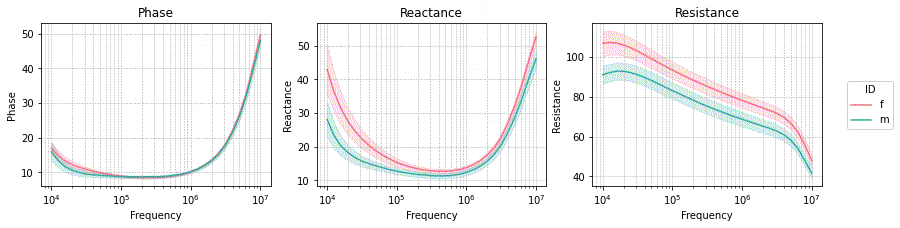 Figure 2- the EIM measurements across frequency spectrum by having urinary incontinence (red) or not (green)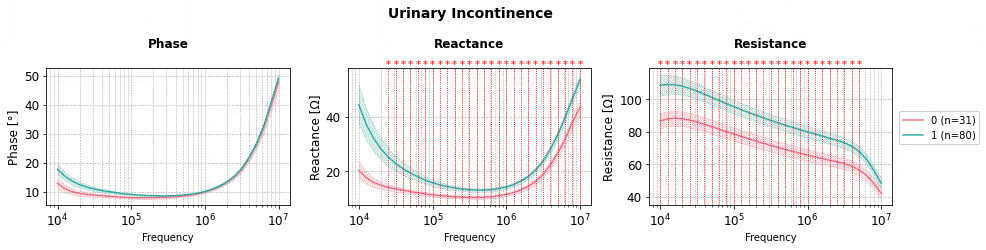
Back to 2026 Abstracts


