Back to 2026 Abstracts
Patterns of Disuse of Continent Catheterizable and MACE Channels in People with Neuropathic Bladder and Bowel
Nikhil V. Batra, MD, Lydia V. Hermann, BS, Rosalia Misseri, MD, Joshua D. Roth, MD, PhD, Benjamin M. Whittam, MD, Kirstan K. Meldrum, MD, Martin Kaefer, MD, Mark P. Cain, MD, Richard C. Rink, MD, Konrad M. Szymanski, MD.
Riley Hospital for Children at Indiana University Health, Indianapolis, IN, USA.
Background: Previous studies have evaluated long-term outcomes of urinary continent catheterizable channels (CCC) and Malone antegrade continence enema (MACE) channels individually. Few have examined outcomes in parallel in those with both channels. We aimed to assess the long-term utilization of CCCs and MACEs in people with both channels and to identify potential risk factors for disuse of either channel.
Methods: All people undergoing CCC and MACE procedures at our institution were retrospectively reviewed (1992-2024). Primary outcome was channel disuse: no longer using it for intermittent catheterizations or surgical excision. Patterns of first and second channel disuse were analyzed with multi-state survival analysis. Shared frailty Cox proportional hazards modelling was used to account for the disuse of one channel loss increasing the risk of disusing the other.
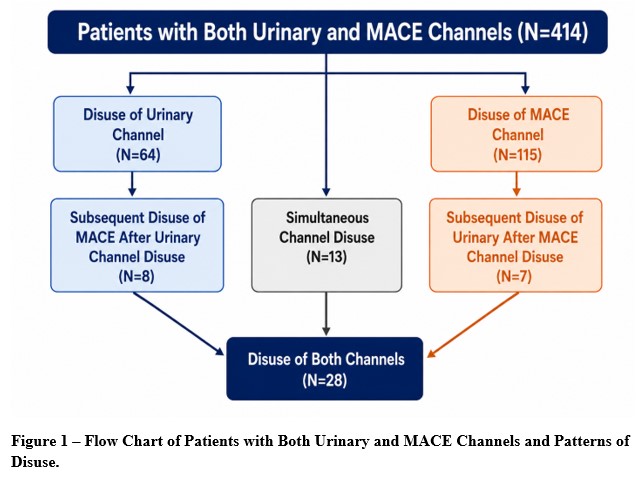
Results: Overall, 414 people (56% female, 90% spina bifida, 71% shunted) underwent CCC (35% APV, 65% Monti) and MACE creation at median age of 7.7 years. Regarding stomal location, 65% had a RLQ CCC stoma with umbilical MACE, 23% had the opposite configuration, and 12% having an alternative configuration. At median follow-up of 15.5 years after surgery, 64 people stopped using their CCC, 115 stopped using their MACE, and 28 stopped using both (
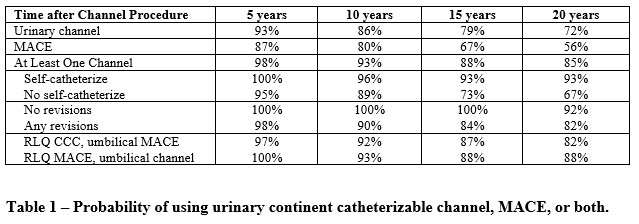
Figure 1). On survival analysis, 72% used their CCC, 56% used their MACE, and 85% used at least one channel at 20 years (
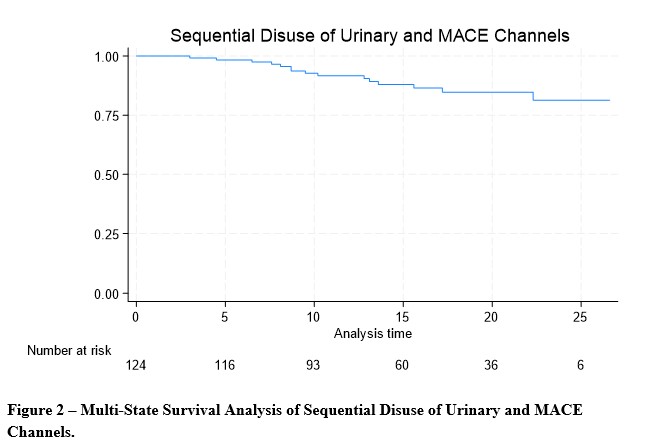
Table 1). At this point, 66% of patients were using both channels. MACEs demonstrated a higher rate of disuse relative to CCC (HR 2.29, 95% CI 1.61-3.27, p<0.0001). On multivariate analysis, depending on others for catheterization was a risk factor for isolated disuse of CCC (HR 2.64, 95% CI 1.2-5.9, p=0.017) and MACE channels (HR 1.9, 95% CI 1.1-3.2, p=0.015). Channel configuration and history of revision surgery were not consistently associated with disuse. Considering the 128 people who stopped using a CCC or MACE, rates of disusing the second channel were not statistically different regardless of which channel was discontinued first (log-rank p=0.09). On multivariate analysis, disusing the second channel was associated with depending on others for catheterizations (HR 5.15 95% CI 1.4-19.5, p=0.016,
Figure 2), but not channel configuration (HR 0.41, p=0.20) or history of channel revisions (HR 3.69, p=0.22).
Conclusions: Most people with both CCC and MACE channels continue to use at least one channel at long-term follow-up. When it occurs, people stop using MACEs at higher rates. The risk of disusing the second channel is not related to which channel is disused first. Self-catheterization appears to be a protective factor against channel disuse.
Back to 2026 Abstracts


