Back to 2026 Abstracts
Urinary Continence After Fetoscopic Versus Open Prenatal Myelomeningocele Repair: School Age Outcomes
Alexandra R. Siegal, MD, Kathleen Hosek, MS, Hosek McClugage, III, MD, Michael Belfort, MD, Magdalena Sanz-Cortes, MD, Rebecca Johnson, MS, Luc Joyeaux, MS, Paul F. Austin, MD, William Whitehead, MD, Nicolette Janzen, MD.
Texas Children's Hospital, Houston, TX, USA.
BACKGROUND: Following the Management of Myelomeningocele Study (MOMS), prenatal repair of myelomeningocele (MMC) has become increasingly common due to its fetal neurologic benefits. Fetoscopic repair offers maternal health benefits over open repair, but comparative urinary continence outcomes at school age remain poorly defined. This study compares school-age urinary continence outcomes after fetoscopic versus open MMC repair.
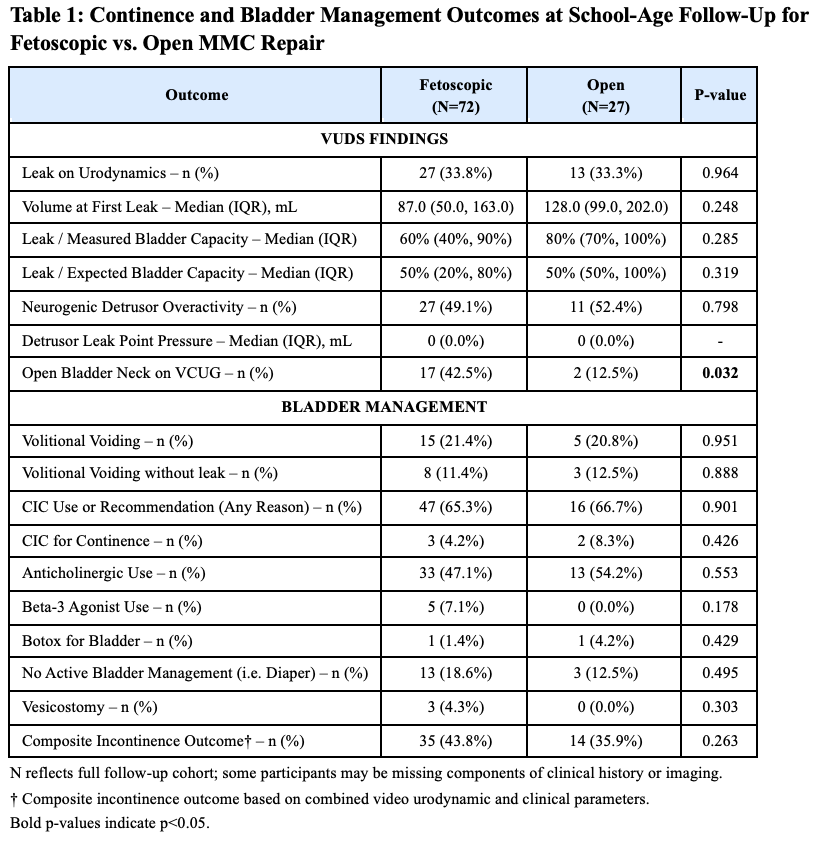
METHODS: This single-institution retrospective cohort study included children who underwent prenatal fetoscopic or open MMC repair between December 2011 and December 2020. School-age urological evaluation at 5 years included clinical history and video urodynamic study. Outcomes included volitional voiding without urodynamic leak,leak volume as a percentage of measured and age-expected bladder capacity, detrusor overactivity (NDO), detrusor leak point pressure (DLPP), open bladder neck, and management. A composite “incontinence outcome” was defined as urodynamic leak, open bladder neck, or clean intermittent catheterization (CIC) initiation for social continence. Logistic regression was adjusted for perinatal and anatomic covariates.
RESULTS: 119 children underwent prenatal repair (fetoscopic [F] n=80, open [O] n=39). In the study period, 8 fetoscopic and 12 open patients were lost to follow-up; reasons included transfer of care and 1 death in the fetoscopic group. Aside from the obstetric differences inherent to each technique, fetoscopic and open patients were well-matched with anatomic lesion level, prenatal motor function, ventricular size, hydrocephalus treatment, and ambulatory status (all p>0.05). At 5-year follow-up (median 61 months), volitional voiding without urodynamic leak was comparable between fetoscopic and open hysterotomy groups (F 11.4% vs. O 12.5%; OR=0.90, 95% CI 0.22-3.72; p=0.888). Bladder management including CIC use or recommendation (F 65.3% vs. O 66.7%; p=0.901), CIC for social continence (F 4.2% vs. O 8.3%; p=0.426), and bladder medications or botox were all similar (p>0.05). Urodynamic leak rates did not differ (F 33.8% vs. O 33.3%; p=0.964), nor did leak relative to measured bladder capacity (median F 60% vs. O 80%; p=0.285) or age-expected capacity (both median 50%; p=0.319). Rates of NDO (F 49.1% vs. O 52.4%; p=0.80) and median DLPP (F 45 cmH2O vs. O 13 cmH2O; p=0.108) were similar. Open bladder neck was significantly more prevalent in the fetoscopic group (F 42.5% vs. O 12.5%; OR=5.17, 95% CI 1.04-25.85; p=0.032). However, the composite incontinence outcome did not differ on logistic regression (OR=1.39, 95% CI 0.63-3.06; p=0.415), and no significant predictors were identified.
CONCLUSIONS: Fetoscopic MMC repair produces comparable urinary continence outcomes and bladder management intensity to open repair at early school age. For either prenatal approach, parents should be counseled that 11-12% of five-year-olds will achieve volitional voiding without any leak. Approximately one-third will leak regardless of repair type or management intensity, typically at 50% of expected bladder capacity, which may be due to the high rates of NDO in both cohorts. The higher rate of open bladder neck after fetoscopic repair did not appear to affect management at this age but warrants further follow-up and investigation
Back to 2026 Abstracts


