Back to 2026 Abstracts
Preoperative Predictors of Postoperative Urodynamic Risk Classification after Bladder Augmentation: A Coincidence Analysis
Tatjana Heisinger-Heidler, MD1, Reiping Huang, PhD, MS2, Ilina Rosoklija, MPH1, Elizabeth B. Yerkes, MD1.
1Lurie Children's Hospital, Chicago, Chicago, IL, USA, 2Northwestern University Feinberg School of Medicine, Chicago, IL, USA.
Background: Bladder augmentation (BA) reliably delivers the intended clinical improvements for upper tract preservation and improved continence. Correspondingly, then, post-BA urodynamics (UDS) would demonstrate improved capacity and compliance and reduced contractility. Despite favorable clinical outcomes, some bladders do not meet all urodynamic expectations. No consensus exists regarding the role of postoperative UDS or predictors of suboptimal post-BA UDS patterns. Coincidence Analysis (CNA) is a data analysis method that identifies causal pathways by assessing combinations of predictors that are jointly sufficient or necessary for an outcome. We hypothesized that the post-BA UDS pattern would depend on specific combinations of patient characteristics and preoperative clinical features rather than isolated variables.
Methods: This single-institution retrospective cohort study included patients who underwent BA (2007-2023) with at least one available UDS pre- and post-BA. Bladders were classified as low- (detrusor leak point pressure (DLPP)/end-fill pressures (EFP) < 25 cmH20 and no contractions ≥ 15 cmH2O above baseline), intermediate- (DLPP or EFP 25-39 cmH20 and/or contractions ≥ 15 cmH2O above baseline) and high- (DLPP or EFP ≥ 40 cmH2O) risk. For CNA, the primary outcome was intermediate-risk pattern on post-BA UDS, with a low-risk post-BA pattern as secondary outcome. Fifteen demographic (e.g., sex, age), clinical (e.g., diagnosis, preoperative botulinum toxin injection), surgical (e.g., bladder incision, prior or concomitant bladder neck surgery) and urodynamic variables (e.g., preoperative urodynamic pattern, bladder pressure, bladder capacity) were included in the analysis and primarily coded as binary. CNA models were assessed and selected based on consistency and coverage, along with criteria of result robustness, model simplicity, and clinical interpretability. Consistency describes how reliably a CNA pathway predicts the outcome, whereas coverage reflects how many outcome cases are explained by the pathway. Both measures range from 0 to 1.
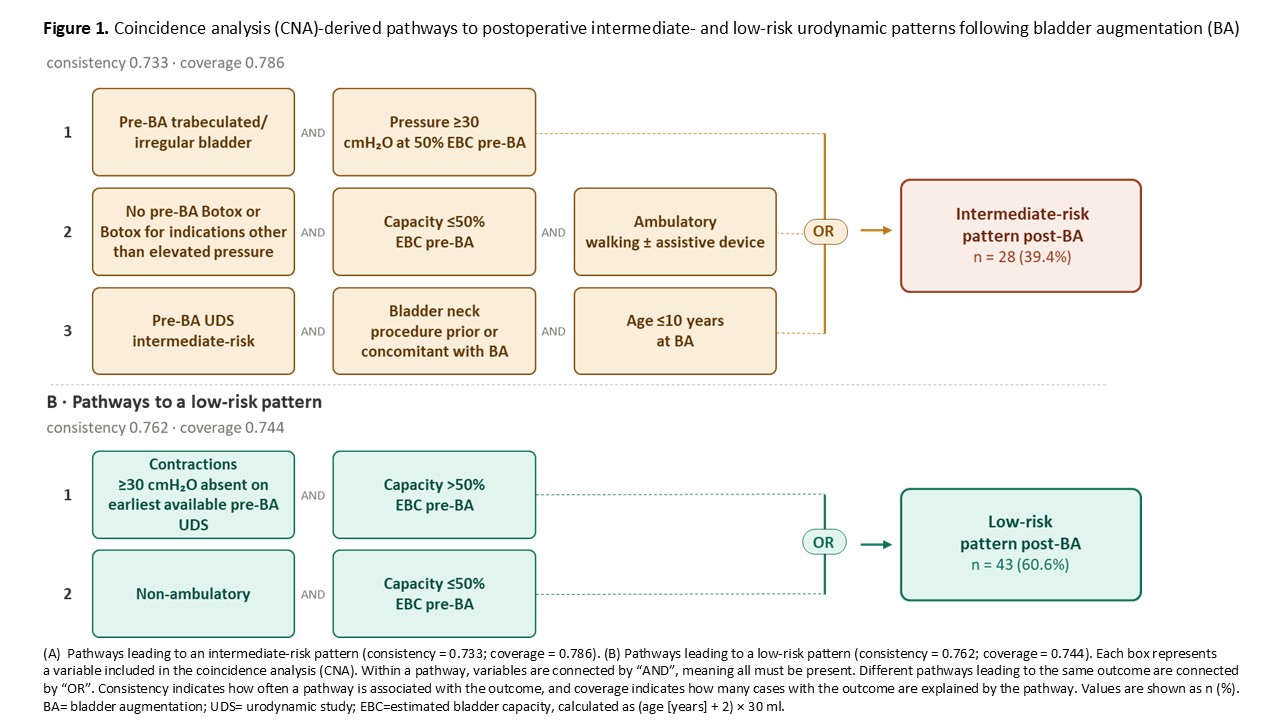
Results: Of 71 patients, 28 (39.4%) had an intermediate-risk and 43 (60.6%) a low-risk pattern on post-BA UDS. No single preoperative variable explained the outcomes; instead, CNA identified combinations of variables associated with post-BA UDS patterns. For the intermediate-risk outcome, CNA identified three pathways, shown in Figure 1, with a consistency of 0.733 and coverage of 0.786, meaning that 73.3% of patients with one of these pathways had an intermediate-risk post-BA UDS pattern and that the identified pathways explained 78.6% of intermediate-risk cases. For the low-risk outcome, CNA identified two pathways, also shown in Figure 1, with a consistency of 0.762 and coverage of 0.744, meaning that 76.2% of patients with one of these pathways had a low-risk post-BA UDS pattern and the pathways explained 74.4% of low-risk cases.
Conclusion: Post-BA UDS pattern was better explained by combinations of preoperative patient characteristics and heterogeneous scenarios than by individual variables. CNA-derived profiles may enable preoperative risk stratification to guide post-BA surveillance, including routine post-BA UDS to establish new baselines and to support decisions for intervention. Multicenter validation is needed to confirm the generalizability and clinical utility of these findings.
Back to 2026 Abstracts


