Back to 2026 Abstracts
Patient reported bowel outcomes among pediatric patients with spinal dysraphism managed with antegrade versus retrograde enema programs
Jamie Michael, MD1, Lynn Huang, MS1, Ilina Rosoklija, MPH2, Danielle Herrera, BS2, James T. Rague, MD2, N Valeska Halstead, MD3, Josephine Hirsch, BA2, Diana K. Bowen, MD2, Elizabeth B. Yerkes, MD2, David I. Chu, MD, MSCE2.
1Northwestern Medicine, Chicago, IL, USA, 2Ann & Robert H. Lurie Children's Hospital of Chicago, Chicago, IL, USA, 3Seattle Children's, Seattle, WA, USA.
Background: Bowel dysfunction is prevalent among patients with spinal dysraphism and is a primary driver of reduced health-related quality of life (QOL). Antegrade and retrograde enema programs have demonstrated improvements in continence and patient satisfaction when compared to oral medications, but there have been few direct comparisons between enema programs. We sought to determine whether enema administration route is associated with differences in patient-reported bowel symptoms, satisfaction, and QOL.
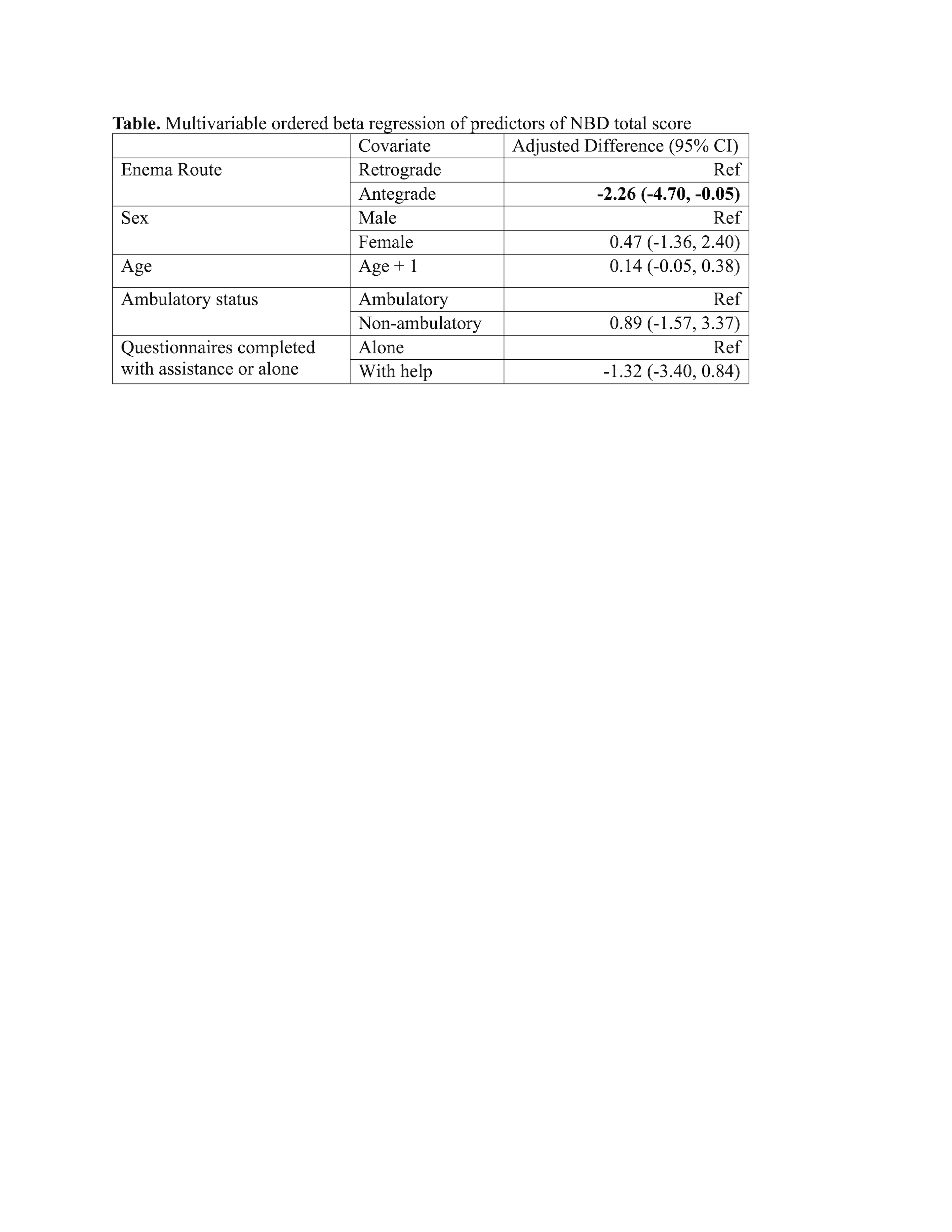
Methods: This retrospective, cross-sectional study included patients with spinal dysraphism aged ≥12 years managed with either retrograde enemas (cone, foley, or Transanal irrigation system) or antegrade enemas (Malone ACE, cecostomy button, or Chait tube). The primary outcome was bowel symptom burden measured by the Neurogenic Bowel Dysfunction (NBD) total score (lower scores indicate less dysfunction). Secondary outcomes included NBD satisfaction score (higher scores indicate greater satisfaction), PROMIS Pediatric Global Health T score (higher scores indicate better health), and stool incontinence (self-reported via questionnaire, any in the last month versus none). Multivariable ordered beta regression was used to assess associations between covariates and the primary outcome, given its bounded, skewed distribution. Secondary outcomes were analyzed using ordered beta regression (NBD satisfaction), linear regression (PROMIS global health), and logistic regression (stool incontinence).
Results: Among 113 patients on enema programs who completed all study questionnaires, 47 (42%) were managed with retrograde and 66 (58%) with antegrade enemas. Compared to the retrograde group, patients managed with antegrade enemas were older (median age 16 [IQR 13-20] vs. 13 [IQR 12-15], p=0.001) and more likely to self-administer their enema (36% vs 19% independent, p=0.001). After adjustment for age, sex, ambulatory status, and questionnaire independence, antegrade enema program was independently associated with significantly lower NBD total scores (estimated difference=-2.26, 95% CI: -4.70, -0.05; Table), reflecting less bowel symptom burden. Antegrade enema program was also associated with higher NBD satisfaction scores (estimated mean difference=1.0, 95% CI: 0.13, 1.9) and higher PROMIS global health scores (β =3.17, 95% CI: 0.12, 6.22), but was not significantly associated with odds of stool incontinence. Conclusions: After adjustment for relevant covariates, antegrade enema route was independently associated with lower bowel symptom burden, greater bowel-related satisfaction, and higher global health QOL scores compared to retrograde enemas, without a significant difference in stool incontinence rates. These findings suggest that the benefits of antegrade versus retrograde management may extend beyond continence alone to broader QOL domains and support further comparative studies.
Back to 2026 Abstracts


