Back to 2026 Abstracts
Selective Alpha-Blocker Therapy in Posterior Urethral Valves: A Within-Patient Analysis of Uroflow Parameters, Upper Tract Changes, and Curve Morphology
Mawuenyo Attawa Oyortey, MBChB, MPH, Joana Dos Santos, MD, MHSc, FRCPC, Michael Chua, MD, MASc(GH) DPBU, FPUA, FPSPU, FPhilGURS, DRCPS, Joao L.P. Salle, MD, PhD, FAAP, FRCSC, Rodrigo Romao, MD, MSc, FRCSC, Armando J. Lorenzo, MD, MSc FAAP, FACS, FRCSC, Mandy Rickard, MN NP.
Hospital for Sick Children, Toronto, ON, Canada.
BACKGROUND: Selective alpha-blockers (SAB: tamsulosin, silodosin) are often prescribed off-label in children, including those with posterior urethral valves (PUV), to facilitate bladder emptying. However, any potential benefits are theoretical and extrapolated from adults with benign prostatic hyperplasia. The effects of alpha-blocker therapy on uroflowmetry, post-void residual (PVR), upper tract dilation, and curve morphology in this population remain poorly defined.
METHODS: Retrospective analysis of a single-institution PUV registry. Longitudinal uroflowmetry data included 823 visits from 188 patients. SAB exposure was assessed at the visit level. Covariates included anticholinergic courses, intravesical and sphincteric botulinum toxin, clean intermittent catheterization (CIC), overnight catheter drainage, age, and PURK score. Outcomes were flow index (Qmax/√VV), absolute PVR, PVR as a percentage of expected bladder capacity (PVR%EBC), voided volume, voided volume as a percentage of EBC (VV%EBC), maximum anteroposterior renal pelvic diameter (APD), SFU grade, and uroflow curve shape. Within-patient comparisons were performed using Wilcoxon signed-rank tests; adjusted analyses used linear mixed-effects models with patient-level random intercepts. A floor-effect analysis used Spearman correlation between baseline PVR and treatment response.
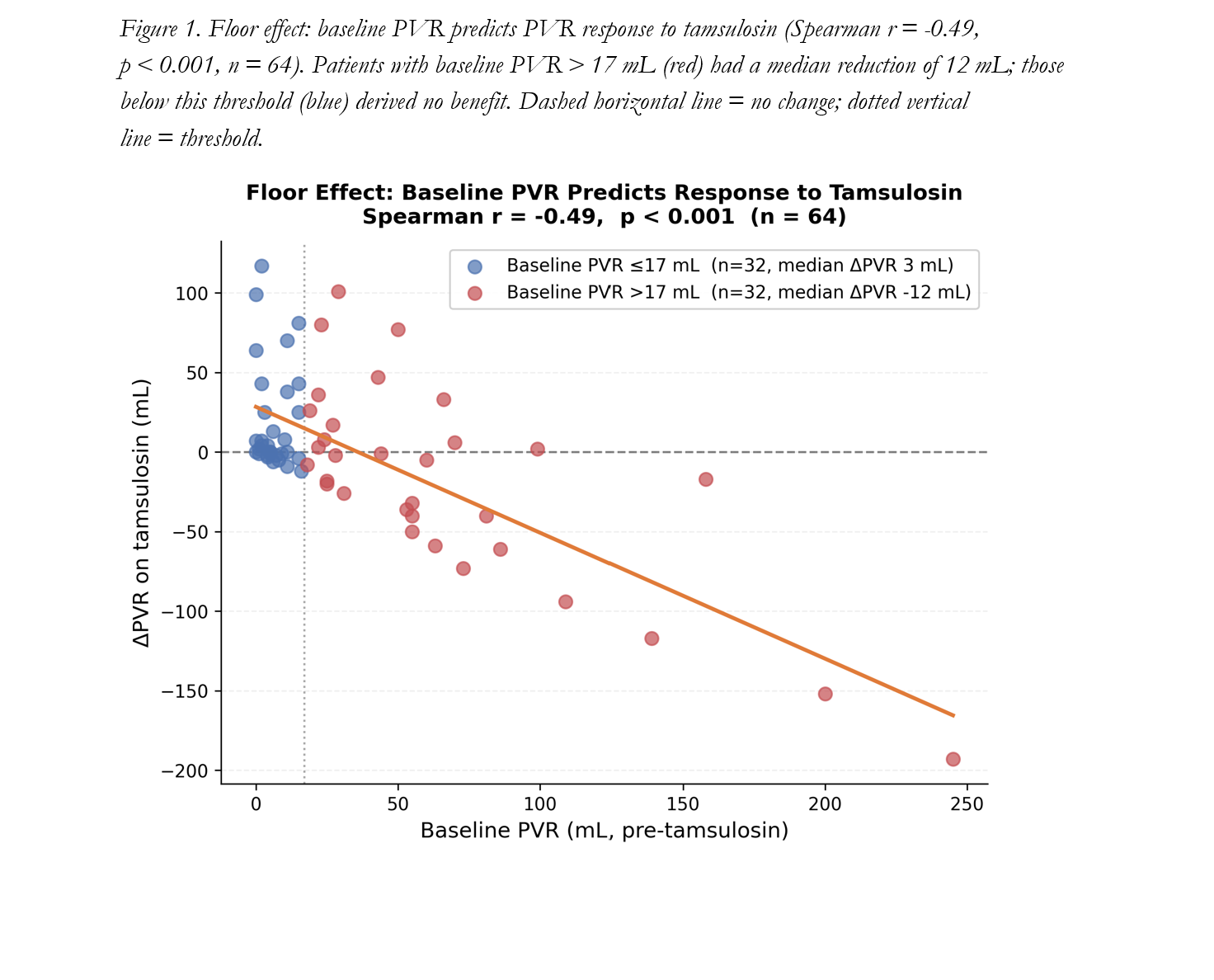
RESULTS: Of 283 patients, 159 (56%) received SAB, with a median onset of 3.7 years (IQR 1.9-9.2). Among 66 patients with paired pre- and on-treatment uroflows, no significant changes were observed in flow index (p=0.50), PVR (p=0.72), PVR%EBC (p=0.85), VV%EBC (p=0.61), APD (p=0.99), SFU grade (p=0.76), or curve shape (p=0.60). Mixed-effects models confirmed no SAB effect after covariate adjustment. However, a floor effect was present: baseline PVR strongly predicted the magnitude of PVR response (Spearman r = -0.49, p < 0.001; Figure 1). Patients with baseline PVR > 17 mL had a median PVR reduction of 12.5 mL on treatment, whereas those at or below this threshold derived no benefit (between-group p = 0.005). Overnight CIC and sphincteric botulinum toxin showed independent beneficial effects on upper tract dilation (SFU grade −1.00, p < 0.001) and flow (flow index +3.14, p < 0.001), respectively.
CONCLUSIONS: SAB do not improve uroflowmetry, bladder emptying, upper tract dilation, or curve morphology in unselected patients with PUV when the medication is trialed to limit, delay, or avoid CIC. Benefit is limited to patients with elevated baseline PVR who show a modest reduction in residual volume. Baseline PVR should be the primary selection criterion when considering alpha-blocker therapy in this population.
Table 1. Within-patient comparison of uroflow, bladder emptying, and upper tract outcomes before and during tamsulosin therapy (n = 66 paired patients with PUV). | Outcome | | Pre-tamsulosin
median (IQR) | | On tamsulosin
median (IQR) | | p value |
| Flow index (Qmax/√VV) | | 1.2 (0.9-1.6) | | 1.1 (0.8-1.5) | | 0.500 |
| PVR (mL) | | 17.0 (5.0-53.5) | | 20.5 (5.0-52.8) | | 0.718 |
| PVR (% EBC) | | 6.6 (1.8-14.6) | | 5.0 (2.2-16.4) | | 0.853 |
| VV (% EBC) | | 65.7 (40.9-98.1) | | 67.9 (43.4-106.3) | | 0.612 |
| Max APD (mm) (n=58) | | 11.5 (7.0-18.0) | | 13.5 (6.2-17.8) | | 0.991 |
| Max SFU grade (n=39) | | 3.0 (1.0-4.0) | | 2.0 (1.0-4.0) | | 0.759 |
| Curve shape (n=66) | | 2.0 (1.0-2.0) | | 2.0 (1.0-2.0) | | 0.596 |
Back to 2026 Abstracts


