Back to 2026 Abstracts
Radiomic Prediction of Chronic Kidney Disease Progression in Children with Posterior Urethral Valves
Stacy Hyojin Jeong, MD
1, Joseph Logan, MS
2, Nicholas Heller, PhD
1,
Julie Klock, MD1, Kristina Dortche, MD
1, Mandy Rickard, NP
3, Armando Lorenzo, MD
3, Greg E. Tasian, MD, MSc, MSCE
2, John K. Weaver, MD
1.
1Cleveland Clinic, Cleveland, OH, 2The Children's Hospital of Philadelphia, Philadelphia, PA, 3The Hospital for Sick Children and Department of Surgery, Toronto, ON, Canada
Background: Approximately 20% of children with posterior urethral valves (PUV) develop chronic kidney disease (CKD). However, our ability to predict which children will progress to CKD is limited. While nadir creatinine > 1 at 1 year has been validated as a risk factor, earlier identification of a high-risk cohort can help with patient counseling and encourage earlier intervention. Radiomics enables the transformation of medical images into high-dimensional, quantitative descriptors that may capture subtle tissue heterogeneity not appreciable by visual inspection alone. We developed a radiomics-based model using post-natal ultrasounds to predict CKD progression in children with PUV.
Methods: We created a retrospective cohort of children with PUV who were treated at three institutions from 1990 and 2022. CKD progression was defined as initiation of dialysis or ≥ 50% decline in estimated glomerular filtration rate (eGFR). A radiomic feature extraction was performed on the first available post-natal ultrasound. Random survival forest modeling was used to identify the eight most meaningful radiomic features (Figure 1). Patients were stratified into high- and low-risk groups based on predicted risk scores.
Results: A total of 257 patients were included. Thirty-eight patients proceeded with transplant and 18 patients experienced a decline in eGFR ≥ 50%. The radiomics model demonstrated moderate discrimination for prediction of time to CKD progression with C-index of 0.693 (95% CI 0.628-0.755). Time-dependent receiver operating characteristic (ROC) analysis showed that model performance decreased over time. The area under curve (AUC) was 0.714 at 2 years, 0.724 at 3 years, and 0.653 at 5 years (Figure 2). After risk stratification, the specificity of the model for the high-risk group (top 10%) was 94% (Table 1). Kaplan-Meier analysis of the high-risk group (top 20%) demonstrated significantly greater and earlier CKD progression compared to the low-risk group (bottom 80%) (Figure 3).
Conclusion: Our radiomics-based model derived from post-natal renal ultrasounds demonstrates moderate ability to predict CKD progression. Integrating this with clinical data may improve early risk-stratification and patient counseling.
Figures/Tables: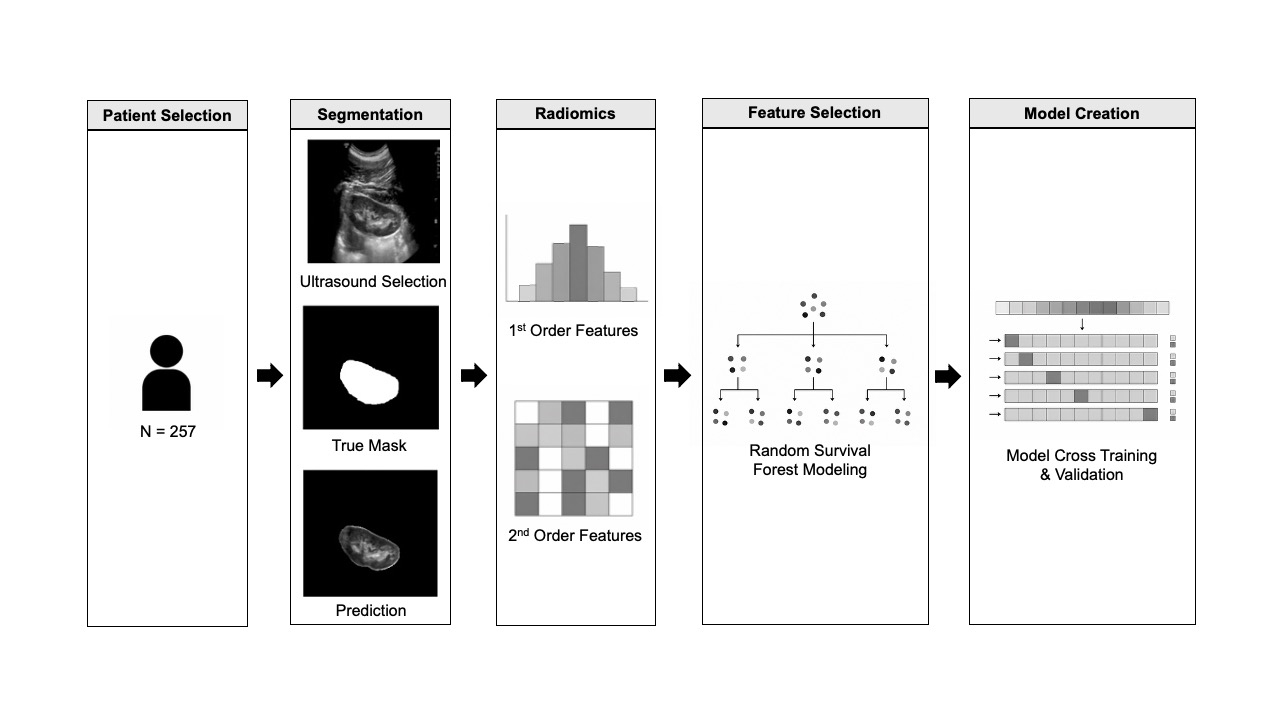 Figure 1.
 Schematic of study design
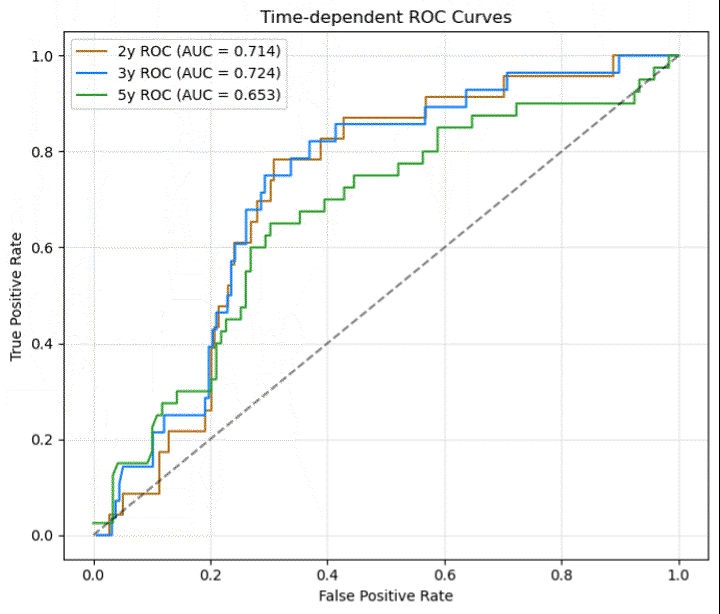 Figure 2
. Time-dependent ROC curves of the radiomic model
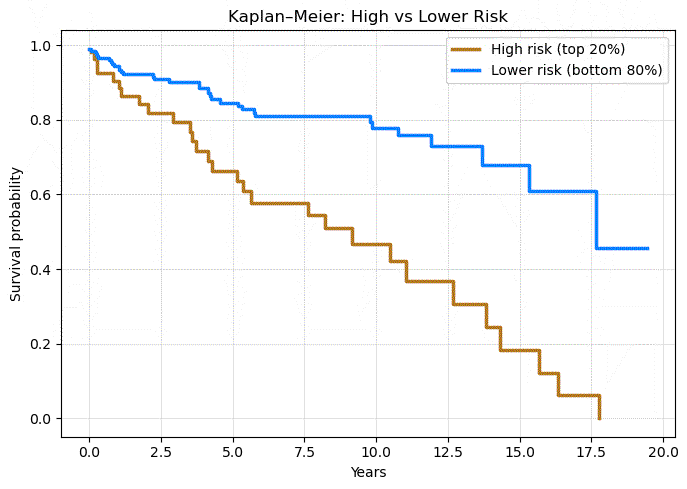 Figure 3
. Kaplan Meier analysis of low and high risk stratified
Table 1. Performative characteristics of the radiomic model| Risk Score Cutoff | Sensitivity | Specificity | Positive Predictive Value | Negative Predictive Value |
| Top 10% | 24.6% | 94.8% | 61.5% | 78.8% |
| Top 20% | 43.1% | 88.0% | 54.9% | 82.0% |
| Top 30% | 56.9% | 79.2% | 48.1% | 84.4% |
| Top 40% | 67.7% | 70.3% | 43.1% | 87.1% |
Back to 2026 Abstracts


