Back to 2026 Abstracts
Solitary Kidney in Posterior Urethral Valves: Outcomes Vary by Aetiology and Remain Worse After Adjusting for Disease Severity
Mandy Rickard, MN, NP, Joana Dos Santos, MD, Samer Maher, MSc, Adree Khondker, MD, Michael Chua, MD, Joao Pippi Salle, MD, Ashlene McKay, MD, Chia Wei Teoh, MD, Nithiakishna Selvathesan, MD, Armando J. Lorenzo, MD.
SickKids, Toronto, ON, Canada.
BACKGROUND: Prior literature has suggested no significant outcome difference between solitary and two-kidney PUV patients. However, the etiology of functional solitary kidney in PUV is heterogeneous, encompassing congenital agenesis, VURD, acquired non-function on nuclear scan, and nephrectomy. We hypothesized that outcomes differ by etiology and that solitary kidney status is independently associated with worse outcomes after controlling for disease severity.
METHODS: Single-centre retrospective cohort of 282 boys with PUV. Solitary kidney defined as functional solitary kidney at last review (n=57): agenesis (n=13), VURD (n=9), <10% function on nuclear scan (n=25), small/dysplastic (n=5), nephrectomy (n=5). Two-kidney group n=225. Primary outcomes: current eGFR (Schwartz), nadir creatinine, CKD≥3 (eGFR <60), and RRT. Secondary: CIC requirement, high-grade VUR (≥4). Disease severity adjusted using PURK score in multivariable logistic regression (binary outcomes) and linear regression (eGFR).
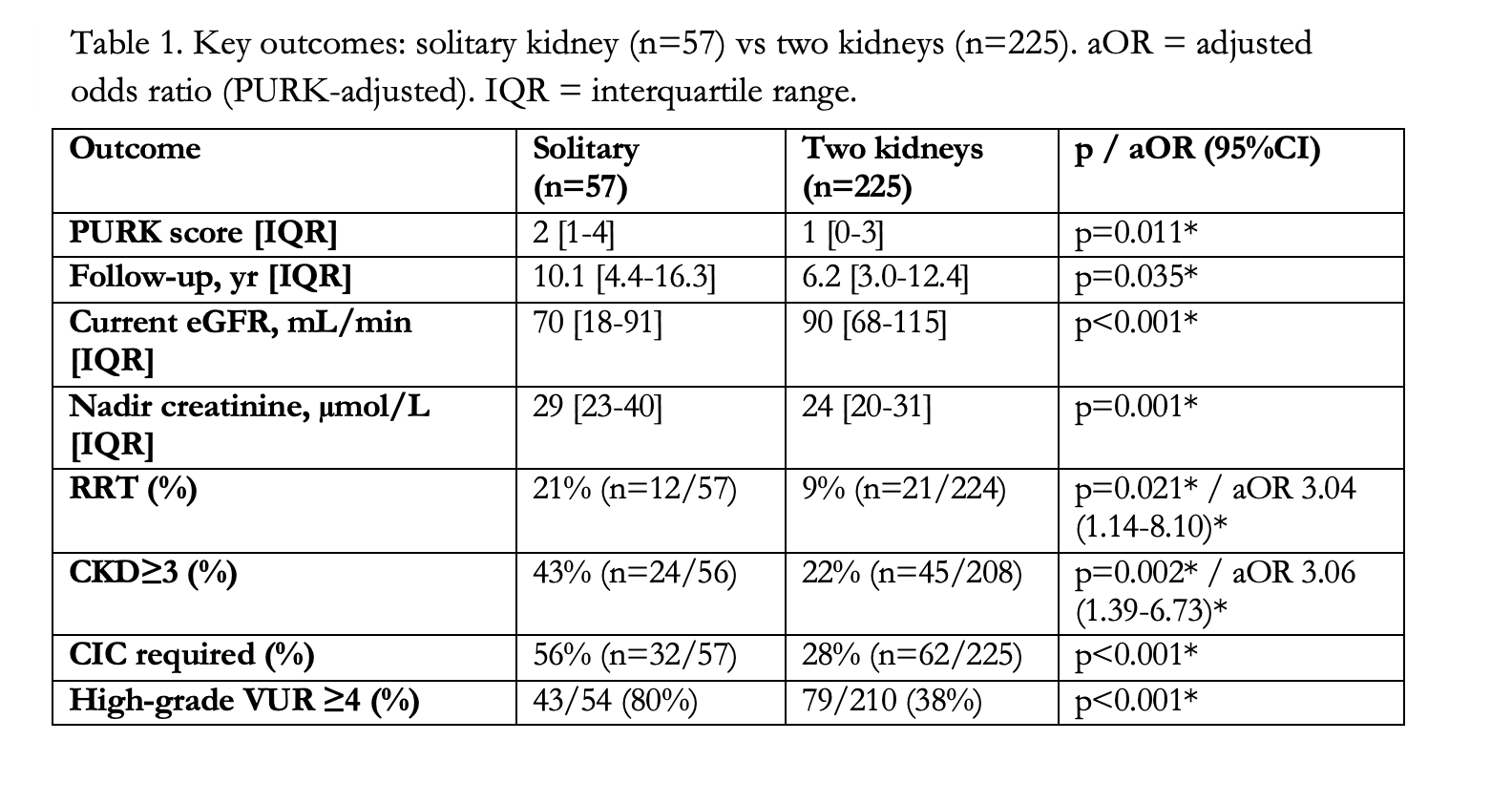
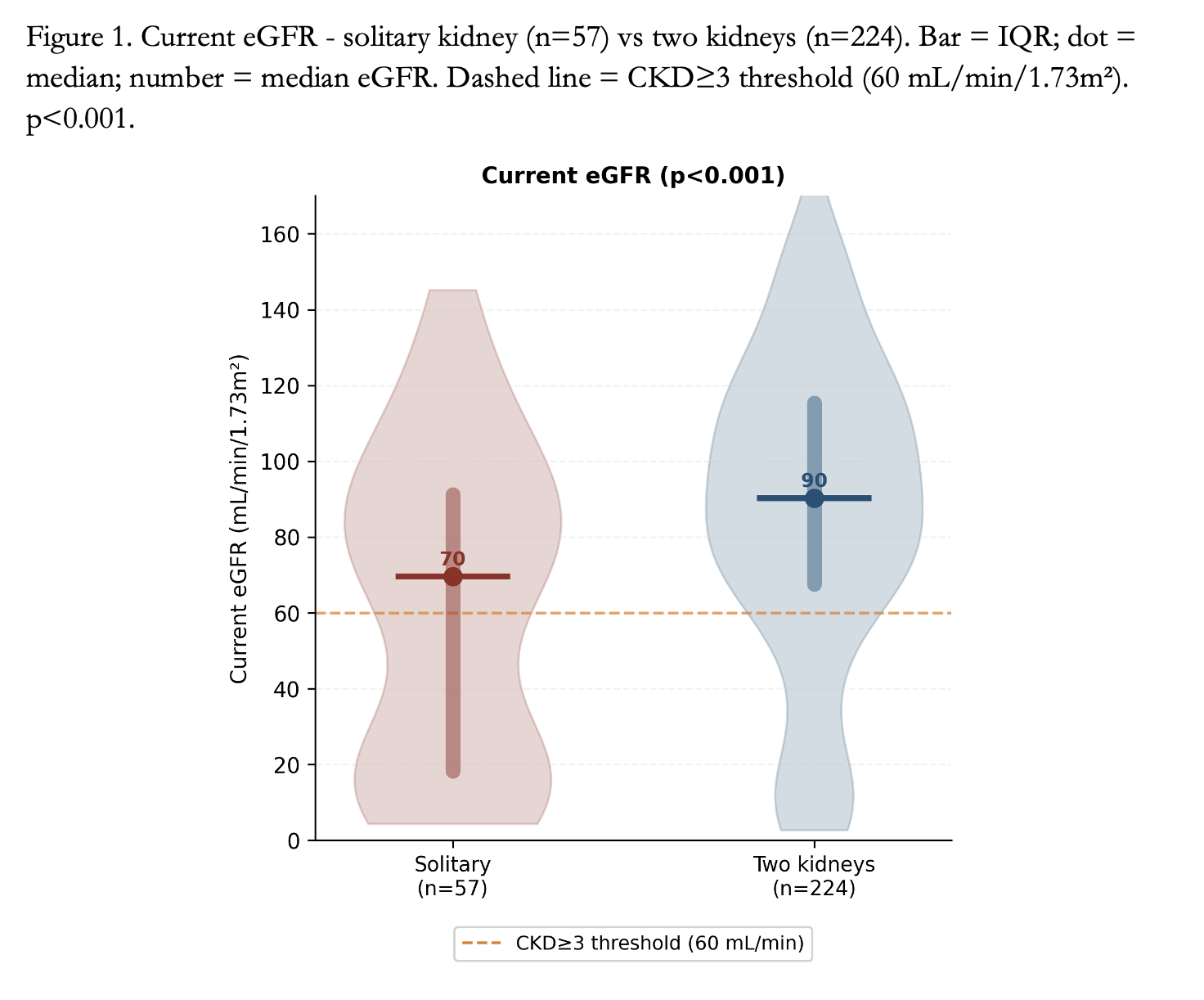
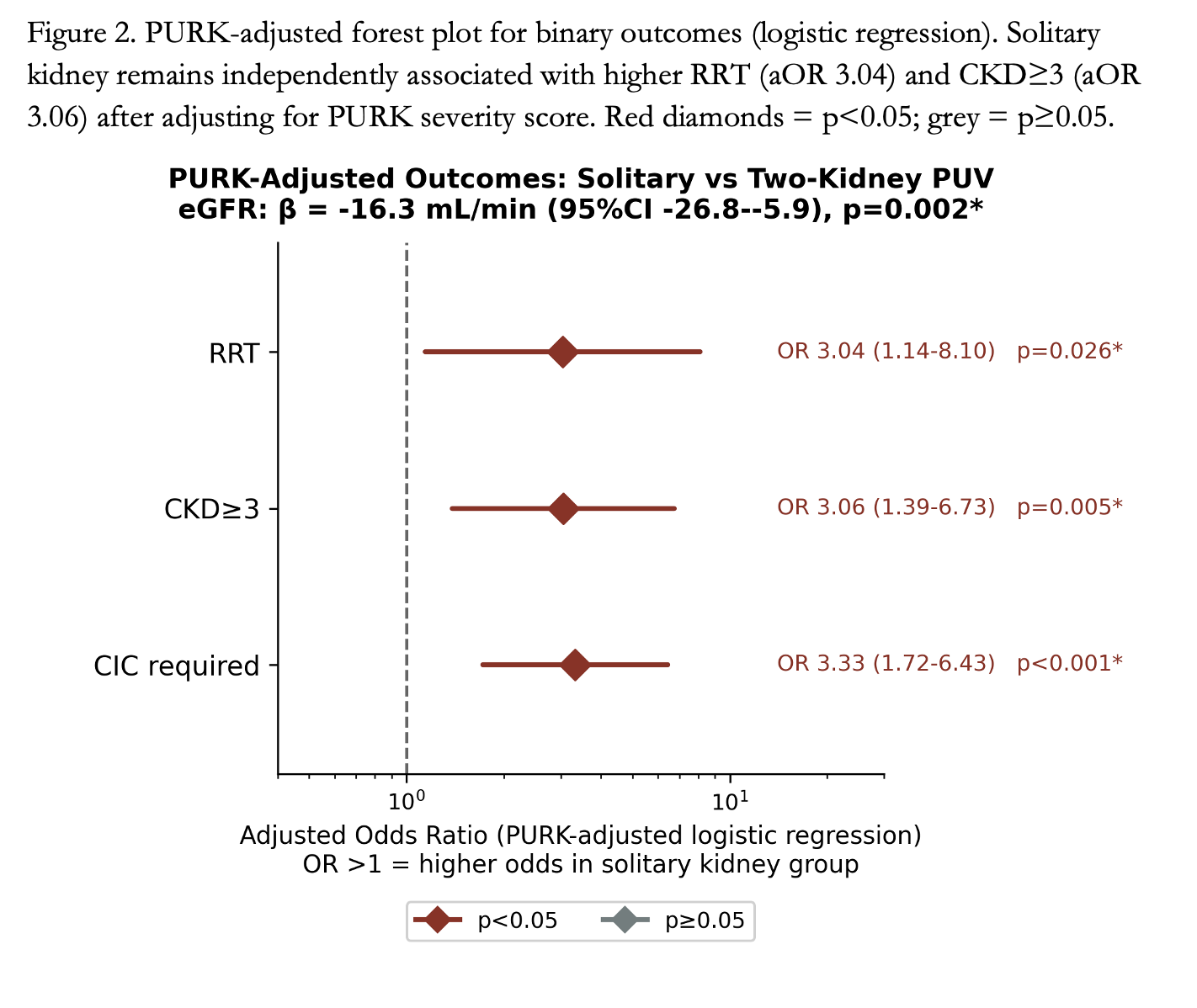
RESULTS: Solitary kidney patients had higher PURK scores at diagnosis (2 [1-4] vs 1 [0-3]; p=0.011), confirming greater baseline severity. Follow-up was longer in the solitary group (10.1 [4.4-16.3] vs 6.2 [3.0-12.4] years; p=0.035). Unadjusted outcomes were significantly worse in the solitary kidney group: current eGFR 70 [18-91] vs 90 [68-115] mL/min/1.73m² (p<0.001); nadir creatinine 29 [23-40] vs 24 [20-31] µmol/L (p=0.001); RRT 21% (n=12/57) vs 9% (n=21/225) (p=0.021); CKD≥3 43% (n=24/56) vs 22% (n=45/208) (p=0.002); CIC 56% (n=32/57) vs 28% (n=62/225) (p<0.001). High-grade VUR (≥4) was more common in solitary kidney patients (43/54, 80% vs 79/210, 38%; p<0.001). After PURK adjustment, solitary kidney remained independently associated with worse outcomes: RRT aOR 3.04 (95%CI 1.14-8.10; p=0.026), CKD≥3 aOR 3.06 (95%CI 1.39-6.73; p=0.005), and eGFR lower by 16.3 mL/min/1.73m² (95%CI -26.8--5.9; p=0.002). Outcomes differed markedly by etiology: patients with acquired non-function (<10% on nuclear scan, n=25) had the worst outcomes (RRT 40%, median eGFR 30 mL/min, CKD≥3 56%), whereas VURD (n=9) and agenesis (n=13) patients had RRT rates of 11% and 8% and median eGFR of 83 and 76 mL/min respectively - comparable to the two-kidney group (RRT 9%, eGFR 90) (Table, Figures 1-2).
CONCLUSIONS:Contrary to prior literature suggesting equivalent outcomes, solitary kidney PUV patients have significantly worse kidney function, CKD, and RRT rates that persist after adjusting for disease severity. However, the solitary kidney group is heterogeneous: VURD and agenesis patients have outcomes similar to two-kidney patients - consistent with prior series that were enriched for these phenotypes - while acquired non-function (<10% on nuclear scan) represents a high-risk subgroup with RRT rates approaching 40%. These patients warrant intensified surveillance and lower intervention thresholds. The dramatically higher rate of high-grade VUR in solitary kidney patients represents a key modifiable risk factor.
Back to 2026 Abstracts


