Back to 2026 Abstracts
Dynamic assessment of neonatal renal function to predict renal outcomes in posterior urethral valves
Carolina Martinez Fernandez, BS1, Juliana Arenas Hoyos, MD1, Craig A. Peters, MD2.
1UT Southwestern Medical Center, Dallas, TX, USA, 2UT Southwestern Medical Center / Children’s Health System Texas, Dallas, TX, USA.
BACKGROUND Multiple predictors of renal functional outcomes in the setting of posterior urethral valves (PUV) have been reported, yet they remain limited in their accuracy and clinical utility, largely due to the wide spectrum of severity in PUV. We sought to define a more robust early clinical predictor for PUV to allow more accurate and timely risk stratification, support clinical decision‑making based on likely outcomes, and enable better comparisons across risk groups.
METHODS Using an institutional billing database under IRB approval, we reviewed charts of neonates with PUV and included those with repeated early-life renal function measurements and at least 2 years of follow-up. All records were individually reviewed for accuracy. Creatinine trajectories were constructed beginning at the earlier of first decompression or day 7 of life, with censoring after dialysis or transplantation. Nadir creatinine within the first year of life was identified for comparison. Creatinine slopes were estimated using Huber robust regression, and creatinine AUC was calculated with the standard trapezoidal integration. Outcomes included estimated glomerular filtration rate (eGFR) at 2, 5, and 10 years and were estimated using the CKiD Under 25 cystatin C equation. Associations were assessed by simple linear and logistic regression models.
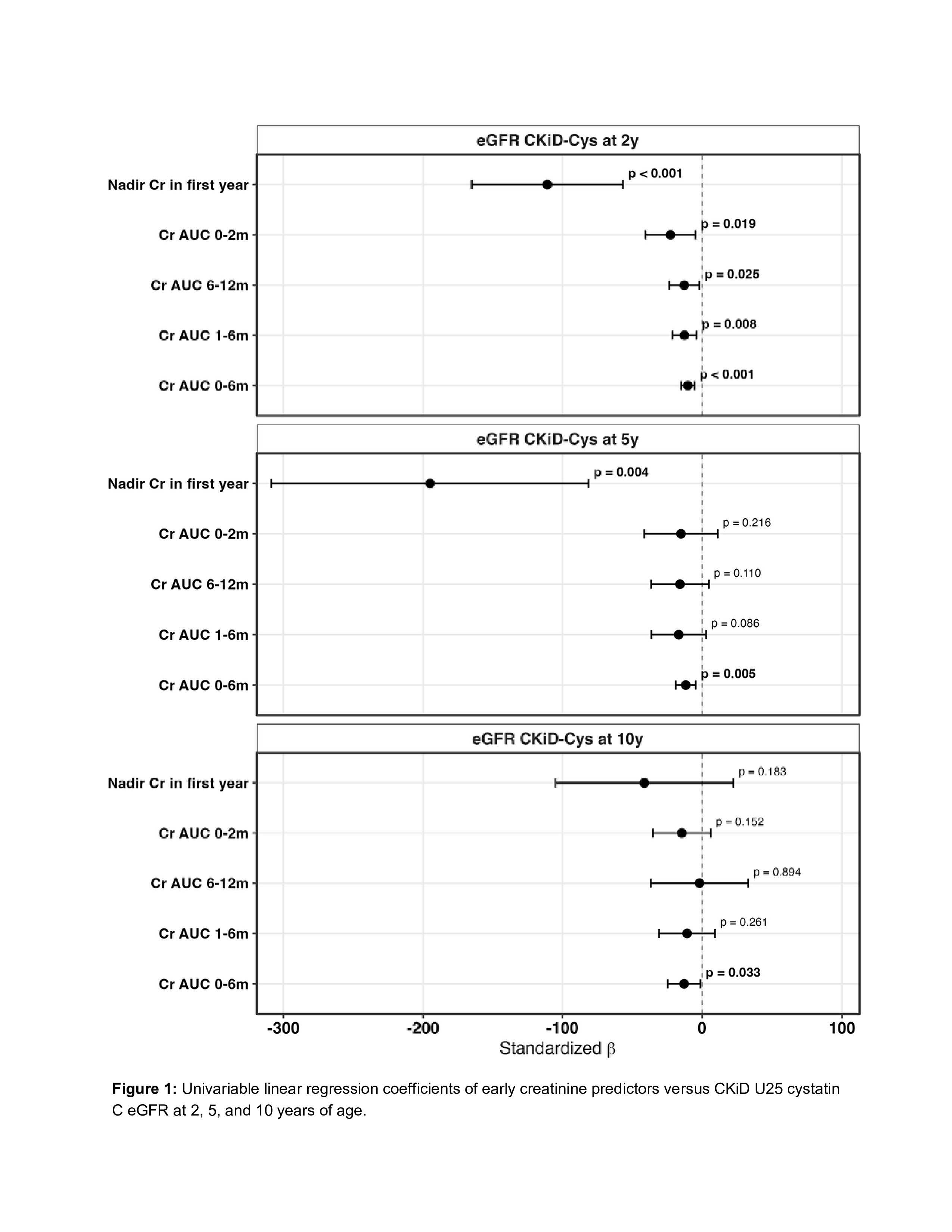
RESULTS Of 318 patients initially identified with PUV, 62 met inclusion criteria after detailed review. Median follow-up was 69.3 months (IQR 35.0-139.5) and median nadir creatinine was 0.3 mg/dL (IQR 0.2-0.4) at a median age of 3.1 months (IQR 1.4-4.3). Cumulatively, CKD stage 3 or worse (eGFR <60 mL/min/1.73 m2) was present in 6/21 patients (28.6%) by age 5 and 11/32 patients (34.4%) by age 10. We assessed the correlation between Cr slope, nadir Cr, and AUC for 0-2 and 0-6 months with eGFR and CKD stage at 2, 5 and 10 years. In linear regression, the observed 0-6 month AUC predicted lower eGFR at 2 years (n=14, β=-10.2, 95% CI: -14.9,-5.5; p<0.001), 5 years (n=11, β=-11.7, 95% CI: -18.8, -4.6; p=0.0048), and 10 years (n=14, β=-12.9, 95% CI: -24.6, -1.2; p=0.033). Logistic models for CKD stage 3 or worse by ages 5 and 10 did not identify statistically significant predictors, likely because of sparse endpoint counts, although higher early AUCs showed directionally increased odds of later CKD.
CONCLUSIONS Early dynamic measures of renal function, particularly creatinine AUC-based metrics, which reflect both initial levels and rate of change of creatinine, may improve early risk stratification in children with PUV. These may provide earlier guidance for clinical decisions than nadir creatinine in the first year. AUC-based measures were more consistently informative than early creatinine slope in univariable models, although later endpoint analyses and binary outcome models remain limited by small sample size.
Back to 2026 Abstracts


