Back to 2026 Abstracts
The Battle of the High-Risk Bladder is Lost at Night: Nocturnal Polyuria in Posterior Urethral Valves Patients and Upper Tract Recovery with Overnight Catheter Drainage
Mandy Rickard, MN, NP, Joana Dos Santos, MD, Samer Maher, MSc, Adree Khondker, MD, Michael Chua, MD, Joao Pippi Salle, MD, Ashlene McKay, MD, Chia Wei Teoh, MD, Nithiakishna Selvathesan, MD, Armando J. Lorenzo, MD.
SickKids, Toronto, ON, Canada.
BACKGROUND: Nocturnal polyuria in posterior urethral valves (PUV) is postulated to result from a tubular concentrating defect secondary to structural distal nephron damage. Chronic nighttime bladder overdistension is an underappreciated mechanism of progressive upper tract injury and a trigger of ultimate myogenic failure. We prospectively characterize nocturnal urine output in our PUV cohort and report outcomes of overnight catheter drainage.
METHODS: We reviewed our institutional PUV database and identified all patients with nighttime urine volume measurements. Nocturnal polyuria was defined per ICCS criteria as urine output exceeding 130% of expected bladder capacity (EBC; Kaefer formula). Output was quantified in cc/kg/hr and as a percentage of EBC. In patients with paired data, hydronephrosis grade (none/low/high), anteroposterior diameter (APD), and eGFR (bedside Schwartz equation) were compared before and after initiation of overnight drainage
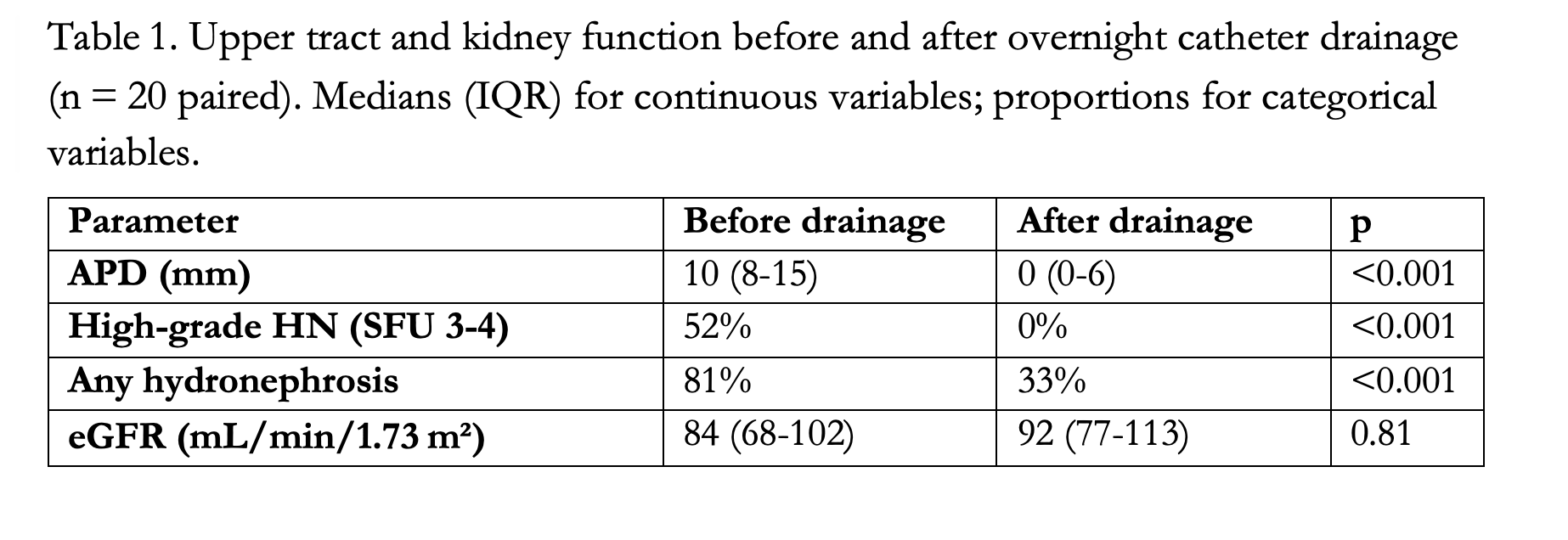
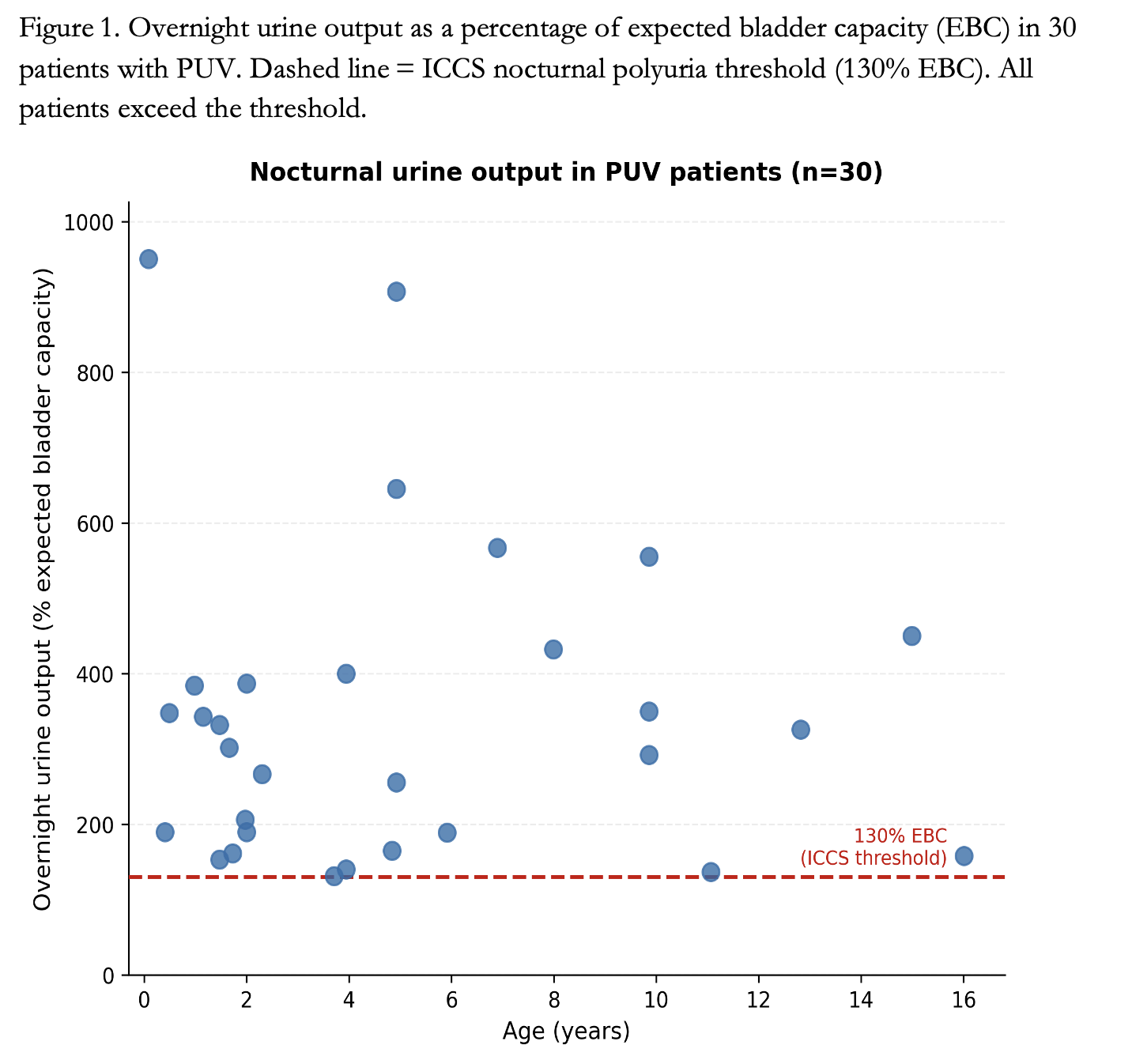
RESULTS: Thirty patients with overnight urine volume data were included (median age 3.9 years, IQR 1.7-7.7; 53% underwent primary ablation). All 30 patients (100%) met ICCS criteria for nocturnal polyuria: median overnight urine output was 2.4 cc/kg/hr (IQR 1.8-3.5), corresponding to 314% of EBC (IQR 189-397%; Figure). Among 20 patients with paired before-and-after data, overnight catheter drainage was associated with significant upper tract improvement: median APD fell from 10 (IQR 8-15) to 0 (IQR 0-6) mm (p<0.001), high-grade hydronephrosis resolved completely (52% → 0%), and any hydronephrosis fell from 81% to 33% (p<0.001; Table). Median eGFR was preserved, from 84 (IQR 68-102) to 92 (IQR 77-113) mL/min/1.73 m² (p = 0.81).
CONCLUSIONS:Nocturnal polyuria was universal in this PUV cohort: all 30 patients exceeded the ICCS threshold, with a median overnight output more than three times the expected bladder capacity, consistent with an underlying tubular concentrating defect. Overnight catheter drainage was associated with significant resolution of hydronephrosis and APD, while preserving kidney function. These findings support the systematic incorporation of overnight drainage into PUV management protocols, particularly for patients with persistent upper tract dilation.
Back to 2026 Abstracts


