Back to 2026 Abstracts
Bayesian Weibull Survival Analysis Provides Strong Evidence for Improved Long-Term Kidney Outcomes After Establishment of a Dedicated Posterior Urethral Valves Clinic
Samer Maher, MSc, Armando J. Lorenzo, MD, Michael Chua, MD, Adree Khondker, MD, Joao Pippi Salle, MD, Rodrigo Romao, MD, Chia Wei Teoh, MD, Ashlene McKay, MD, Nithiakishna Selvathesan, MD, Joana Dos Santos, MD, Mandy Rickard, MN, NP.
SickKids, Toronto, ON, Canada.
BACKGROUND: Posterior urethral valves (PUV) carry a significant risk of renal replacement therapy (RRT) and progressive chronic kidney disease (CKD). At our centre, a dedicated urology-led PUV clinic was established to standardize surveillance and optimize early interventions. Because follow-up duration differed, patients enrolled in the standardized pathway (After-clinic) had a shorter trajectory than those before implementation (Before-clinic), precluding standard comparisons. To address this, we applied a Bayesian Weibull survival analysis to quantify the probability of benefit by incorporating internal historical event rates as informative priors.
METHODS: Single-centre retrospective cohort of 224 patients with PUV: 138 Before-clinic (median follow-up 12.8 years [IQR 9.3-17.3]) and 86 After-clinic (median 2.7 years [IQR 1.1-4.5]). Outcomes: RRT, CIC, and CKD≥3 (eGFR <60 mL/min/1.73 m²; measurements ≤90 days were excluded to avoid neonatal physiology). Bayesian Weibull survival models estimated acceleration factors (AF: how much later the After group reaches each event). The posterior probability of superiority, P(After < Before), was estimated by Monte Carlo simulation (200,000 draws), using the Before-clinic group’s Kaplan-Meier rates as an informative prior.
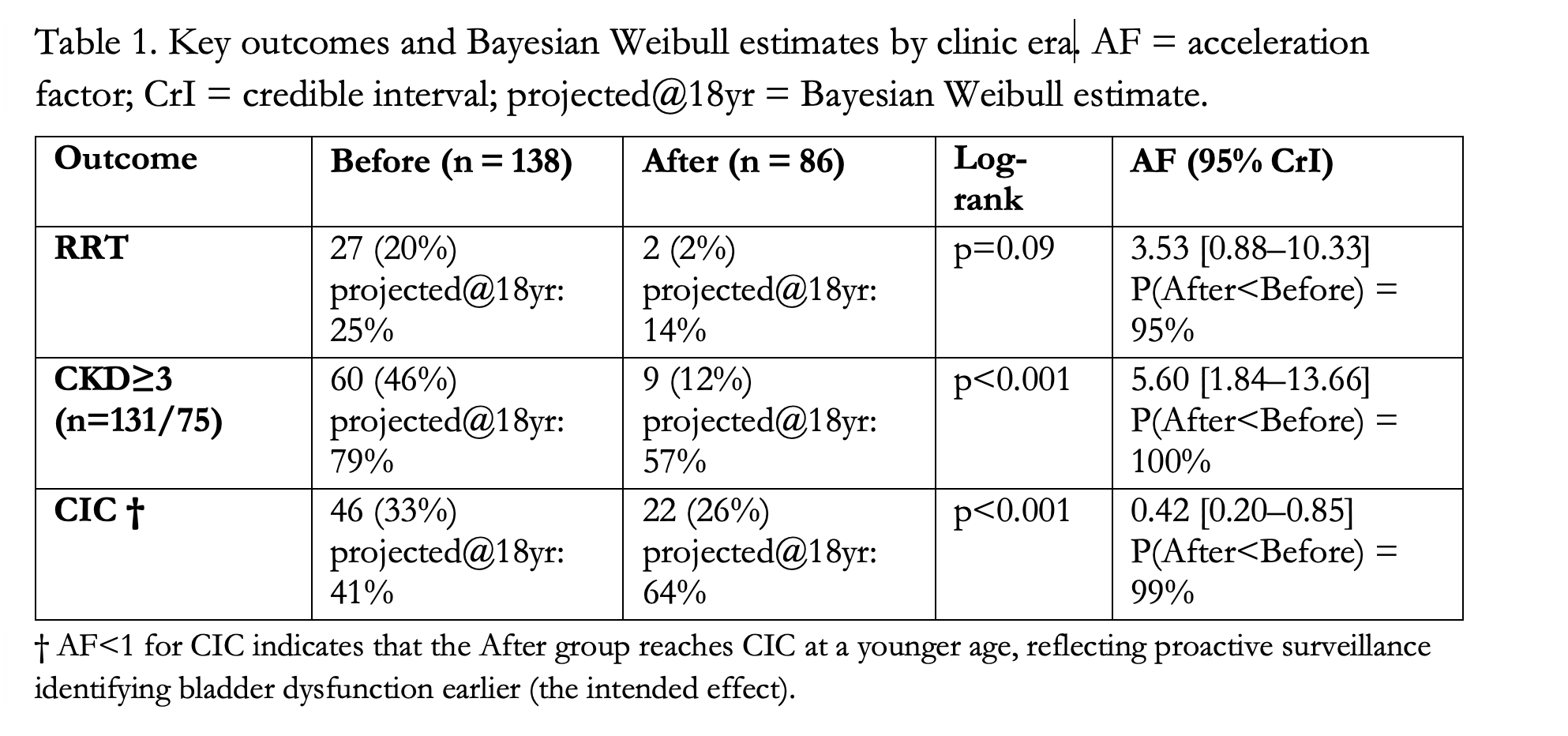
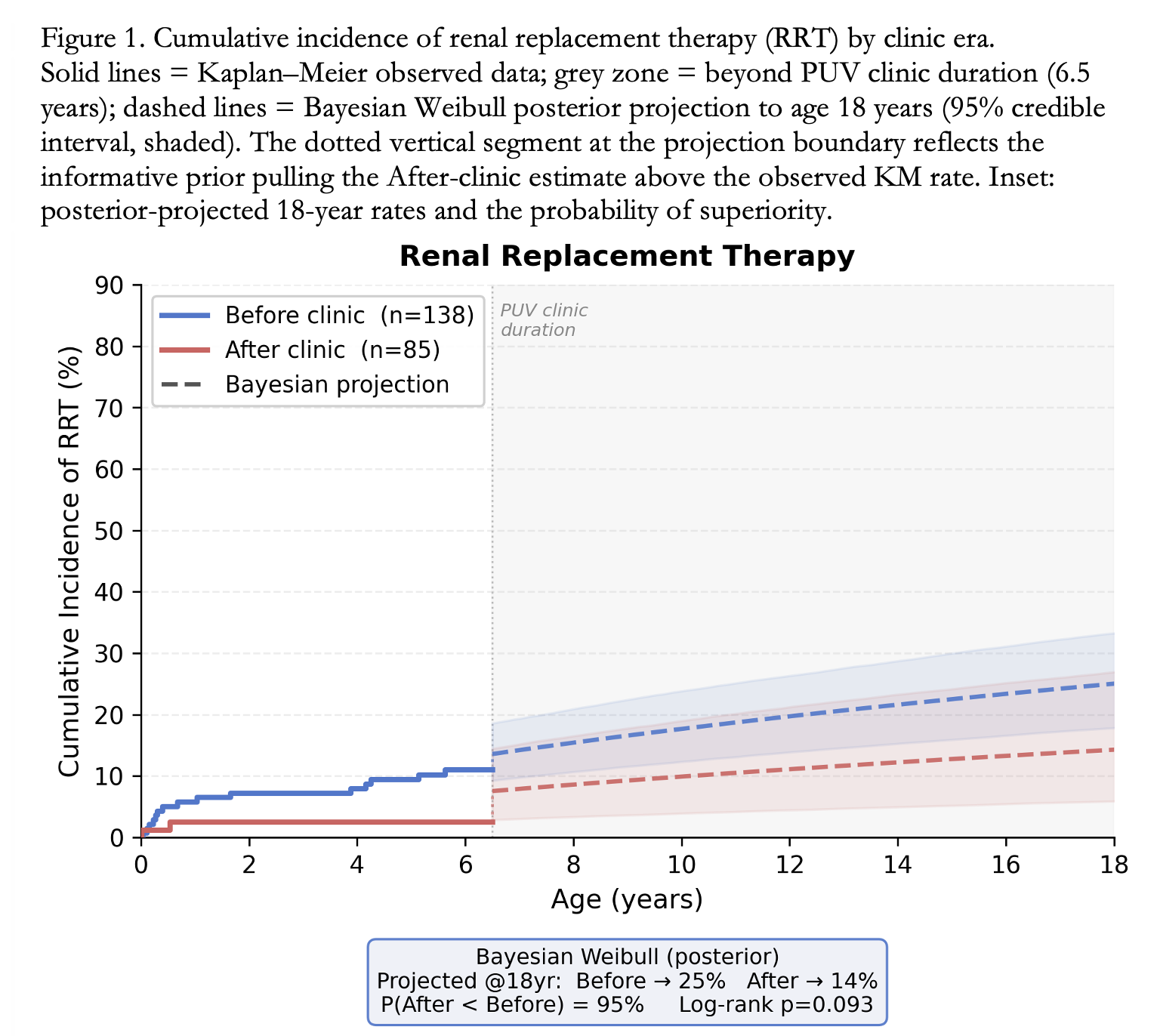
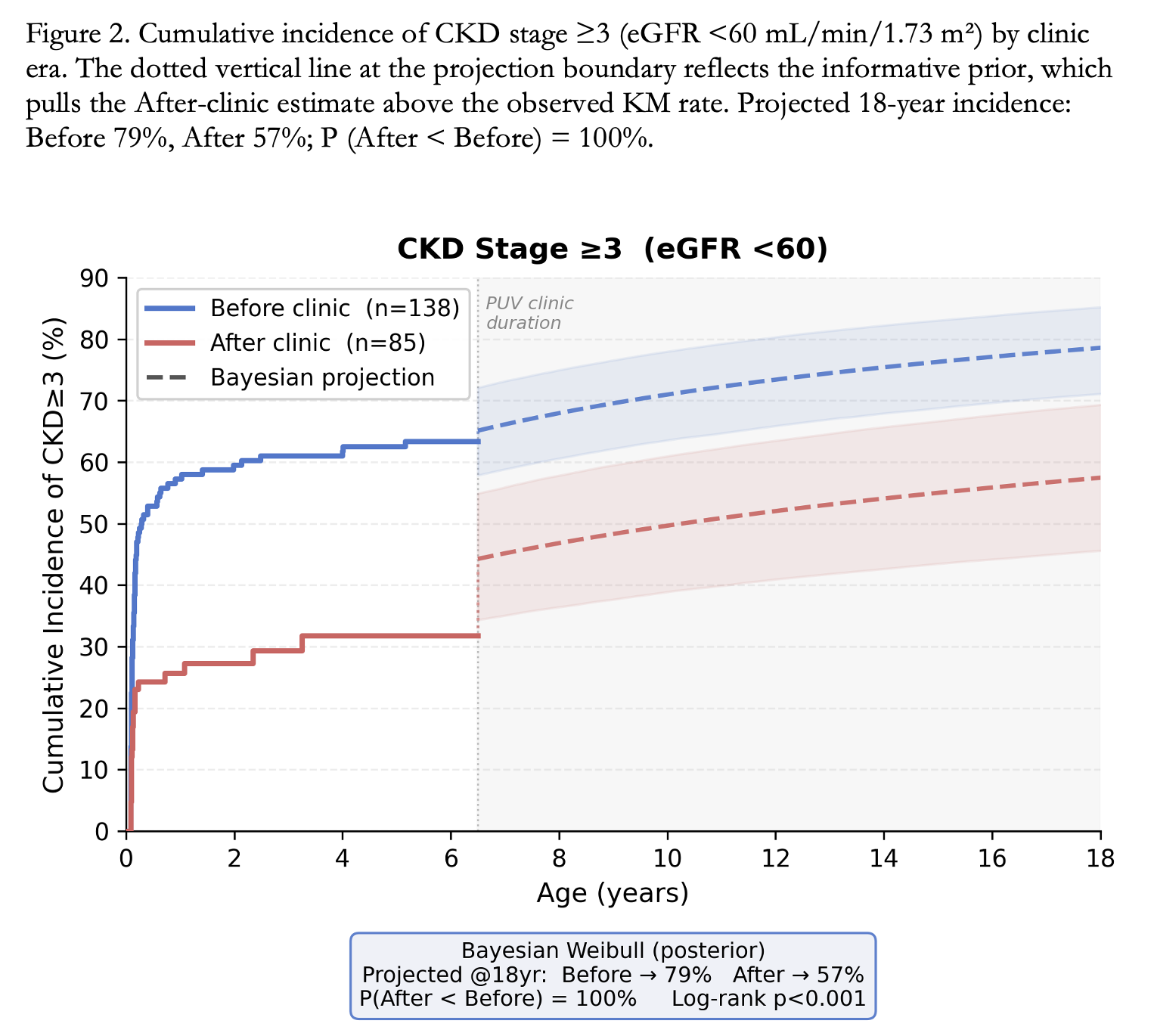
RESULTS: RRT occurred in 27/138 (20%) Before vs 2/86 (2%) After; CKD≥3 in 60/131 (46%) vs 9/75 (12%); CIC in 46/138 (33%) vs 22/86 (26%) (Table 1). Log-rank: CKD≥3 p<0.001, RRT p=0.09. Bayesian Weibull modelling estimated that the After-clinic group reached RRT 3.5× later (AF 3.53, 95% CrI 0.88-10.33). For CKD≥3, the After group progressed 5.6× later (AF 5.60, 95% CrI 1.84-13.66), with credible intervals entirely above 1. Projected 18-year rates: Before 25% vs After 14% for RRT; Before 79% vs After 57% for CKD≥3 (Figures 1-2). The After-clinic group reached CIC at a younger age, reflecting proactive bladder surveillance identifying dysfunction earlier (AF 0.42, 95% CrI 0.20-0.85; the intended clinical effect). Posterior probability of benefit: 95% for RRT, 100% for CKD≥3.
CONCLUSIONS:Bayesian analysis provides strong evidence (100% posterior probability for CKD≥3 and 95% for RRT) that patients managed in our dedicated PUV clinic have substantially better long-term kidney outcomes, despite limited follow-up after clinic visits. Time to progression to CKD≥3 is delayed by a factor of 5.6 (95% CrI 1.8-13.7). The higher early CIC rate reflects proactive bladder surveillance. These findings support the expansion and standardization of specialized PUV clinics
Back to 2026 Abstracts


