Back to 2026 Abstracts
Long-Term Uroflowmetry Provides Further Evidence Against the Bladder Defunctionalization Myth by Urinary Diversion in Posterior Urethral Valves
Mandy Rickard, MN, NP, Joana Dos Santos, MD, Michael Chua, MD, Camila Moreno Bencardino, MD, Adree Khondker, MD, Samer Maher, MD, Joao Pippi Salle, MD, Rodrigo Romao, MD, Armando J. Lorenzo, MD.
SickKids, Toronto, ON, Canada.
BACKGROUND: Ureterostomy and vesicostomy have historically raised concerns about bladder defunctionalization due to lack of cycling. Our group previously published data showing no evidence of defunctionalization in diverted PUV patients; however, uroflowmetry data were limited at that time, as many diverted patients were still too young for reliable flow studies. With a maturing cohort, we aimed to determine whether uroflow parameters differ by initial surgical management.
METHODS: Single-center retrospective cohort of 283 boys with posterior urethral valves. Management groups: ablation (n=188; primary ablation), vesicostomy (n=55; primary and secondary), and ureterostomy (n=40; any uni- or bilateral ureterostomy, primary or secondary). Parameters compared at the last available uroflow visit: void volume as a percentage of expected bladder capacity (%EBC; Kaefer formula: [age+2]×30 mL), post-void residual (PVR), maximum flow rate (Qmax), and flow curve morphology. In the subset who underwent urodynamics, VUDS bladder compliance and capacity were compared (ablation n=51, vesicostomy n=17, ureterostomy n=9).
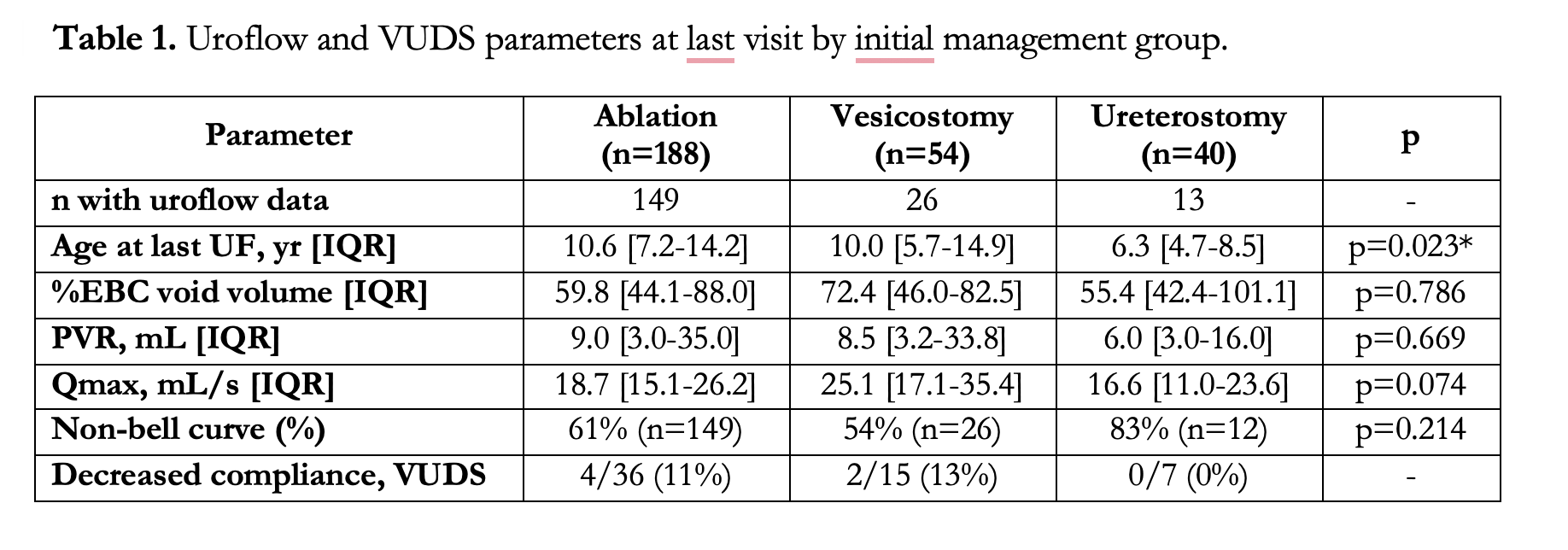
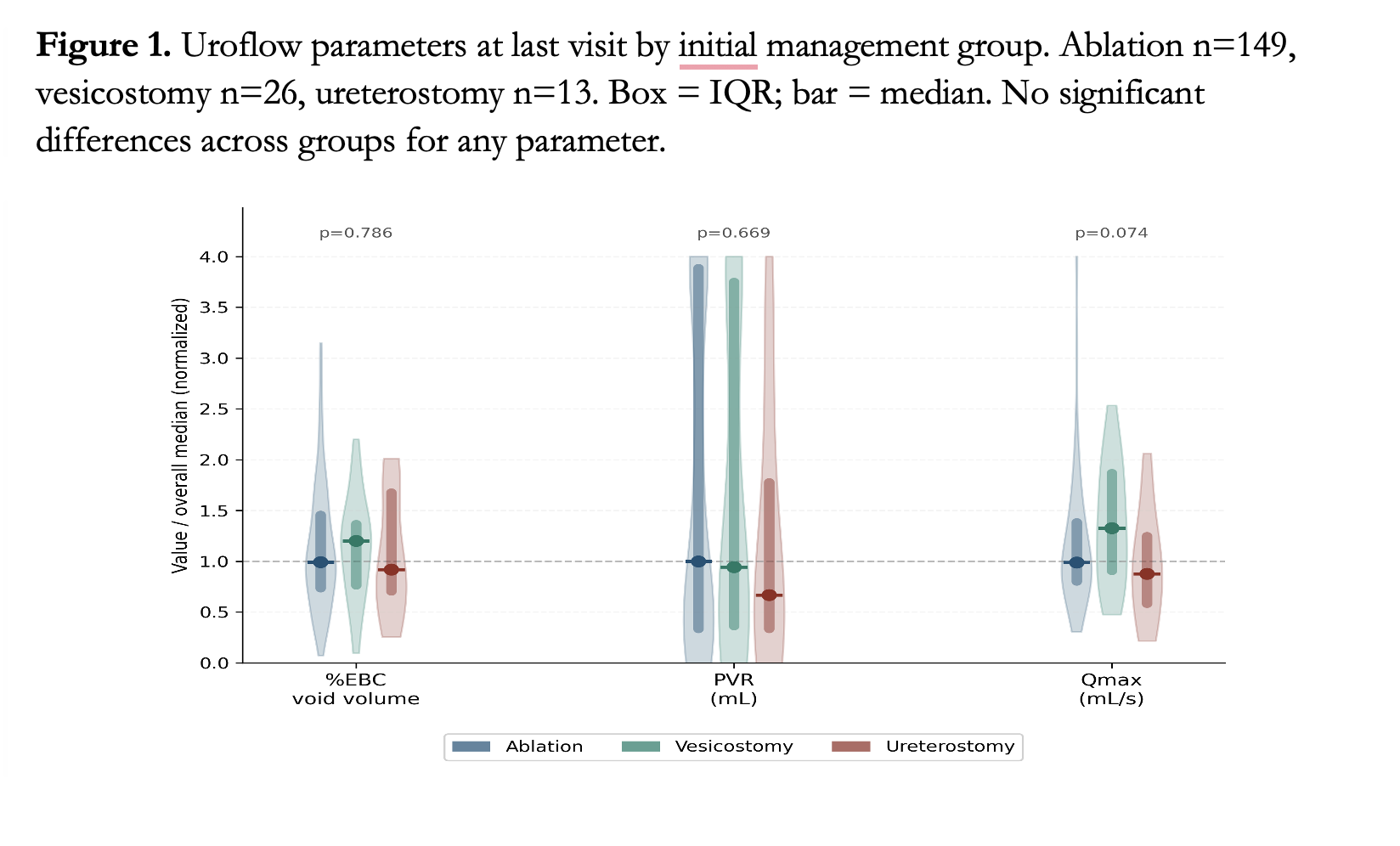
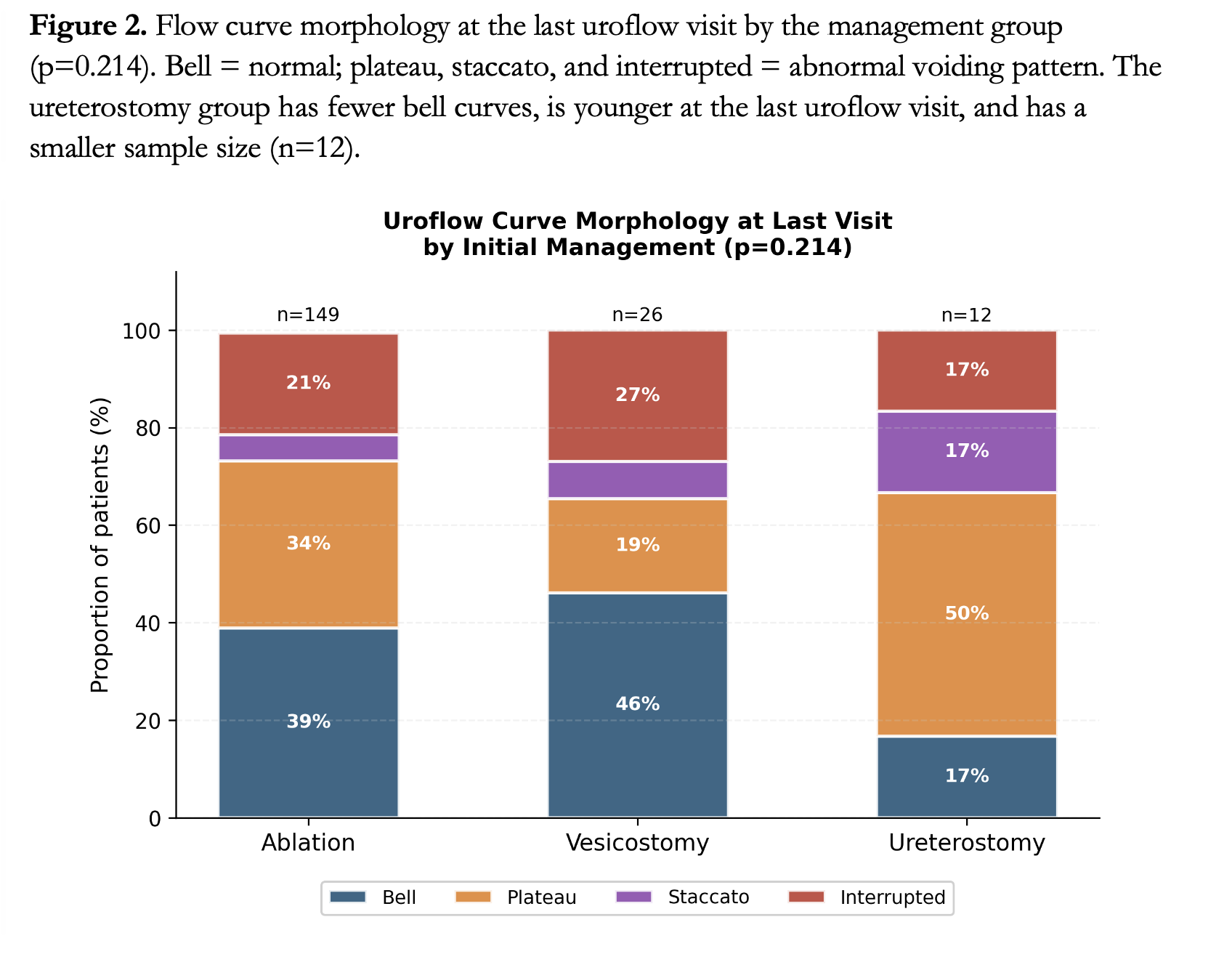
RESULTS: Median age at last uroflow: ablation 10.6 [7.2-14.2] years, vesicostomy 10.0 [5.7-14.9] years, ureterostomy 6.3 [4.7-8.5] years (p=0.023), reflecting shorter uroflow follow-up in the ureterostomy group. Despite this, there were no statistically significant differences in %EBC void volume (60% vs 72% vs 55%; p=0.786), PVR (9 vs 8 vs 6 mL; p=0.669), or Qmax (18.7 vs 25.1 vs 16.6 mL/s; p=0.074). Non-bell-shaped morphology was present in 61%, 54%, and 83%, respectively (p=0.214); the ureterostomy group had a higher proportion of plateau curves (50%). On VUDS, decreased bladder compliance was rare among those with compliance data available: ablation 4/36 (11%), vesicostomy 2/15 (13%), ureterostomy 0/7 (0%). (Table, Figures 1-2).
CONCLUSIONS:With a larger, more mature uroflowmetry dataset that includes patients who were too young for flow studies at the time of our prior publication, we find no significant differences in voided volume, PVR, or maximum flow rate across management groups. Bladder compliance is normal in the vast majority, regardless of diversion type, and no ureterostomy patient had a defunctionalized small bladder. These findings provide additional uroflowmetric evidence against the defunctionalization hypothesis and support the view that the bladder retains functional capacity after urinary diversion and subsequent closure in PUV.
Back to 2026 Abstracts


